
E-Invoicing in Antigua and Barbuda: Current Status and ABST Invoicing

Antigua and Barbuda's economy runs on tourism, imports and a steady flow of cross-border services. That makes clean sales-tax paperwork central to revenue collection. The Inland Revenue Department (IRD) administers the Antigua and Barbuda Sales Tax (ABST), a value-added style tax, and invoicing today is document-based.
Registered ABST businesses must issue ABST invoices to registered customers and sales receipts to unregistered customers and file periodic ABST returns. A government-validated e-invoicing system has been signalled in policy but has no confirmed law, date or scope. Until one is enacted, a PDF or scanned invoice is an ordinary invoice, not a structured e-invoice.
Latest news
Embeds a monitoring pages group for this blog article
{{__MONITORING_PAGES_GROUP:blog_articles_616__}}The 2026 Budget Statement, presented on 4 December 2025, says ABST compliance is being improved through digitisation. It also announces a new tax administration system at the IRD.
This is a policy announcement, not an enacted requirement. No e-invoicing law, implementation date, taxpayer phase or technical specification has been published. Businesses should treat current ABST invoicing rules as the binding ones.
Item | Current position |
|---|---|
E-invoicing mandate | Not confirmed |
ABST registration threshold | EC$300,000 annual taxable turnover (IRD FAQ) |
Return deadline | 15 calendar days after period end (Amendment Act 2024) |
Has Antigua and Barbuda adopted e-invoicing?
Antigua and Barbuda has not yet adopted e-invoicing. The Budget Statement frames digitisation as a way to strengthen ABST compliance. No model (clearance, post-audit or network) has been published.
The evolution of e-invoicing in Antigua and Barbuda
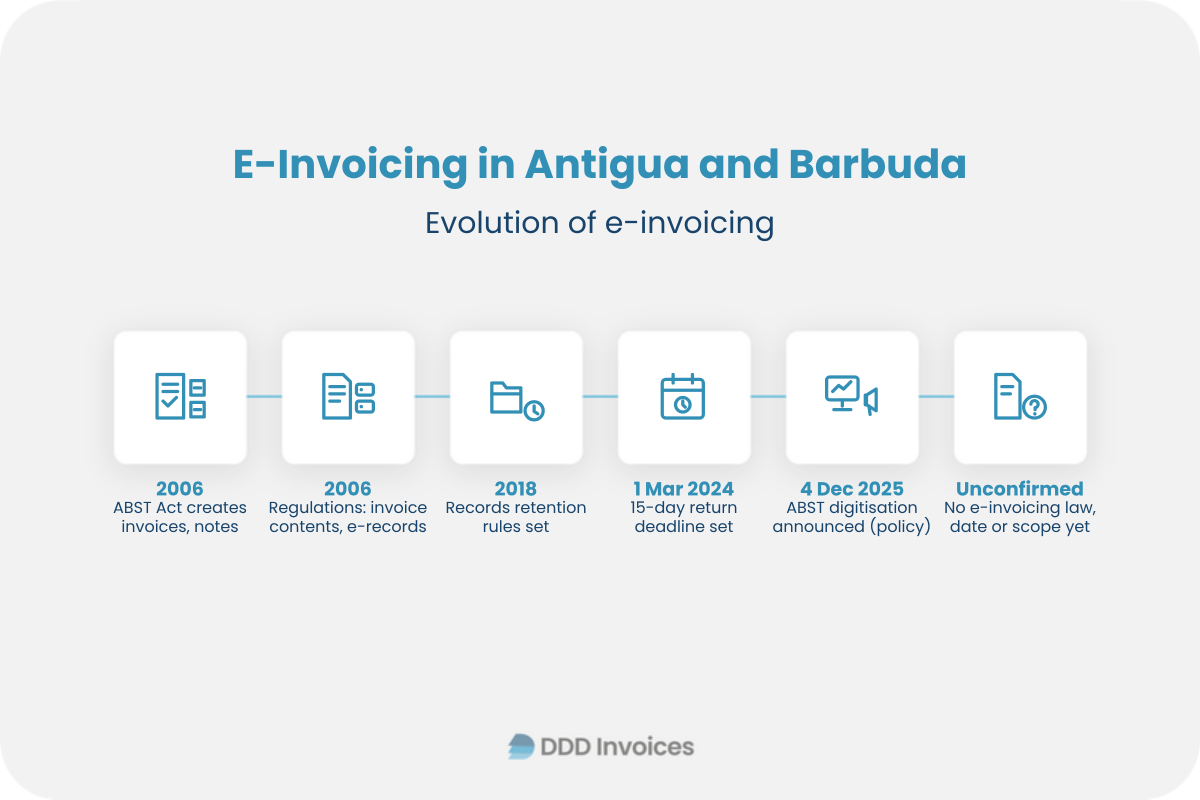
- 2006: The ABST Act No. 5 of 2006 creates ABST invoices, sales receipts, credit notes and debit notes (Part IX).
- 2006: The Sales Tax Regulations 2006 set document contents and electronic recordkeeping for compulsorily registered businesses.
- 2018: The Tax Administration and Procedure Act No. 12 of 2018 sets record retention.
- 1 March 2024: The Amendment Act No. 1 of 2024 sets the 15-day return deadline, applying from the period ending 31 March 2024.
- 4 December 2025: The Budget Statement announces ABST digitisation (policy only).
- Not yet confirmed: an e-invoicing law, date or scope.
B2G e-invoicing in Antigua and Barbuda
No separate B2G e-invoicing mandate has been published. Sales to government bodies follow the same ABST documentation rules. Where the buyer is ABST-registered, an ABST invoice applies. No official public-sector invoice portal was found.
B2B e-invoicing in Antigua and Barbuda
B2B e-invoicing is not mandatory. A registered supplier must issue an ABST invoice to another registered person. The IRD FAQ lists the contents:
- Supplier and recipient TIN, name and address.
- Serial number and issue date.
- Description of the supply, with quantity and supply date.
- Unit price, consideration and ABST charged.
Under Regulation 6, an invoice missing required information is invalid. The recipient gets no input tax credit until a correct invoice is issued. A recipient can request a valid invoice within 6 months of supply.
Credit and debit notes follow Part IX and the same regulation. Practical readiness steps:
- Register: Obtain a TIN and register for ABST if you pass the threshold.
- Template: Configure invoices, receipts and notes with the fields above.
- Reconcile: Match sales, purchases and adjustments to each return.
- Retain: Store records for the required period.
B2C e-invoicing in Antigua and Barbuda
Registered businesses issue ABST sales receipts to unregistered customers. The IRD FAQ lists the business name, address and TIN, a description of the goods or services, the price including ABST, the taxable items and the ABST charged. Prices must be ABST-inclusive.
Cross-border: Imports, exports and imported services are handled separately from domestic invoicing. TAPA section 22 requires customs documents for imports and exports. For imported services, it requires written evidence of the supplier, recipient, nature, time, place and consideration.
E-reporting and VAT compliance in Antigua and Barbuda
Antigua and Barbuda has periodic ABST returns. A registered business lodges a return for each tax period within 15 calendar days after the period ends. The return reconciles output tax on sales against input tax on purchases, plus adjustments.
Payment timing sits in section 41 of the Act, and the exact current date needs confirming. Businesses compulsorily registered after exceeding the threshold must produce and retain records electronically, through electronic tills or POS systems or computerised accounting (Regulation 8(2)).
Records must be kept for seven years from the transaction or longer until the assessment time limit expires (TAPA section 22(3)).
Penalties for non-compliance in Antigua and Barbuda
Penalties come from the IRD FAQ and the Tax Administration and Procedure Act.
Offence | Fine |
|---|---|
Late ABST filing | EC$500 or 5% of the amount owing, whichever is greater |
Late payment | 10% of the amount owing, plus 1% monthly interest (IRD FAQ) |
Failure to keep records | $10,000 or six months' imprisonment (TAPA s.22) |
Repeat-offence escalation and closures are not confirmed.
Your trusted partner for e-invoicing in Antigua and Barbuda
Antigua and Barbuda requires ABST invoices and returns today, with e-invoicing only announced. DDD Invoices offers one unified e-invoicing API to issue, receive and archive compliant invoices in over 30 countries. Antigua and Barbuda is not listed on the coverage page, so support is pending.
{{__CTA:TalkToUsCta__}}
FAQs
Is e-invoicing mandatory in Antigua and Barbuda?
No mandate has been enacted. The Budget Statement announces digitisation, but no date or scope exists.
What must an ABST invoice contain?
It needs both parties' TINs, a serial number and date, a supply description, the consideration and the ABST charged. Missing details block the recipient's input tax credit.
When are ABST returns due?
Within 15 calendar days after each tax period, under the 2024 amendment.
Who regulates ABST?
The Inland Revenue Department administers ABST; Customs handles import documents.