
E-Invoicing in Armenia: SRC Settlement Documents and 2026 Rules
Author
Bishma

Armenian tax invoices have been electronic-only since 2015, and nearly all settlement documents since 2016. E-invoicing in Armenia runs through the State Revenue Committee (SRC) and its Electronic Settlement Documents system, opened from the File Online portal.
Every organization, individual entrepreneur and notary must issue settlement documents for B2B and B2G supplies, almost all electronically in the SRC system. Since September 1, 2026, goods documents are due before the supply. Works and services are documented at completion, including contract stages, and consignment notes are issued before goods move.
Latest news
Embeds a monitoring pages group for this blog article
{{__MONITORING_PAGES_GROUP:blog_articles_644__}}Decision N1560-N of October 29, 2026 applies from January 1, 2027. A tax invoice cancelled for errors or a price change is then replaced by one citing it and keeping its supply date.
{{__CTA:IntegrationStepsCta__}}
What is e-invoicing and why has Armenia adopted it?
E-invoicing is the exchange of invoices as structured electronic data. Armenian law calls these settlement documents: tax invoices, invoice-documents, their adjusting versions, leasing hand-over acts, VAT-refund tax invoices and consignment notes. They are issued in real time in the SRC system, which holds each one from the moment it is signed. Anyone can check a document's unique series number through the SRC e-invoicing page.
The evolution of e-invoicing in Armenia
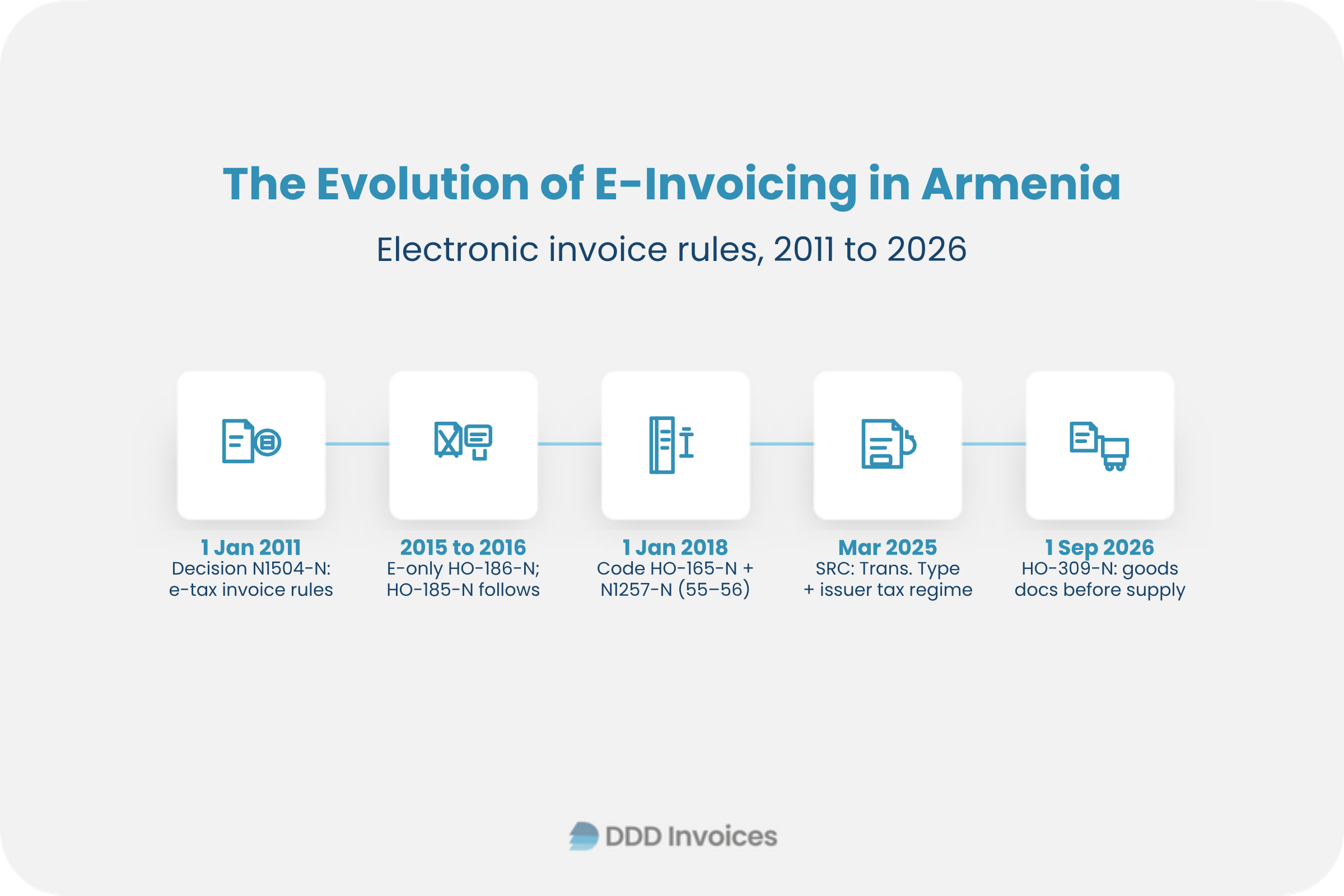
- January 1, 2011: Decision N1504-N sets the rules for issuing tax invoices electronically.
- 2015 to 2016: tax invoices turn electronic-only under Law HO-186-N, and most settlement documents follow under Law HO-185-N.
- January 1, 2018: the Tax Code HO-165-N and Decision N1257-N take effect, with Articles 55 and 56 governing settlement documents.
- March 2025: an SRC system update adds a mandatory Transaction Type field and shows each issuer's tax regime on received invoices.
- September 1, 2026: Law HO-309-N moves goods documents to before the supply.
B2G e-invoicing in Armenia
Supplies to state bodies follow the same rules, and the Tax Code sets no separate B2G channel. Suppliers issue tax invoices or invoice-documents in the SRC system, and the B2G e-invoicing guide compares other countries.
B2B e-invoicing in Armenia
Settlement documents are mandatory for every B2B supply under Tax Code Article 56. Tax invoices carry VAT, and invoice-documents cover supplies without it.
- Sign the e-filing agreement: it unlocks File Online and the right to issue documents.
- Set up e-signatures: every document needs the electronic signature of at least one authorized person.
- Connect your ERP: use the SRC's published API, XSD and XML files, including the Transaction Type field.
- Issue on time: goods before the supply; works and services at completion, including contract stages; consignment notes before transport.
When the Armenian party bears VAT on a supply by a non-resident without a permanent establishment, it issues the tax invoice itself (Article 56(7)).
B2C e-invoicing in Armenia
Retail sellers and consumer-service providers using billing systems or fiscal devices may skip the invoice unless the buyer asks for one (Article 56(2)). Receipts follow separate fiscalization rules.
E-reporting and VAT compliance in Armenia
Armenia has no periodic e-reporting, because each settlement document reaches the SRC when it is issued.
- VAT: 20% standard per the SRC tax overview and 0% for exports, with returns due by the 20th of the following month.
- Turnover tax: 10% for trade and 7% for manufacturing since January 1, 2025, for turnover up to AMD 115 million (Articles 254 and 258).
- Currency: since July 1, 2026, Law HO-234-N converts foreign-currency amounts at the previous business day's Central Bank of Armenia rate.
- Corrections: adjusting tax invoices or adjusting invoice-documents record changes, and nothing can be issued or cancelled after three tax years (Article 56).
- Records: keep tax documents for at least 5 years from the reporting period they relate to (Article 33).
Penalties for non-compliance in Armenia
Fines under Tax Code Article 410 run from 50% to 200% of the value of goods supplied or moved without a valid document.
Offence | Fine |
|---|---|
First case found during an SRC operational check | 50% of the goods' value, at least AMD 500,000 |
Second case within one year | 100% of the value, at least AMD 2,000,000 |
Third or later case within one year | 200% of the value, at least AMD 10,000,000 |
Micro-enterprises | A warning, then loss of micro-enterprise status on a second case |
If the SRC system or the connection fails, Decision N1257-N lets goods move with signed paper documents. These are issued electronically within two business days of the fix, and the Article 410 fine is waived once the failure is confirmed. The SRC reported e-invoicing outages on October 7, 2025 and July 21, 2026.
Your trusted partner for e-invoicing in Armenia
Groups that run Armenia beside other markets face mandatory settlement documents there, and since September 1, 2026 goods documents must precede the supply. DDD Invoices maintains reporting rule changes centrally in one e-invoicing API, so your ERP can issue, receive and archive invoices where supported. Armenia does not appear on the country coverage list yet, and the team can walk through your Armenian document types and fields.
{{__CTA:TalkToUsCta__}}
FAQs
How can I check that an Armenian settlement document is valid?
Enter its series number in the SRC validity checker, which confirms documents issued through the electronic system. A document signed with an electronic signature cannot be changed afterwards, only cancelled or adjusted.
What is an invoice-document in Armenia?
An invoice-document is the settlement document for supplies without VAT, such as sales by turnover-tax businesses. It carries the same data as a tax invoice except the VAT rate and amount, under Article 55.
When must a consignment note be issued in Armenia?
A consignment note must be issued before the goods are moved, under Tax Code Article 56(4.1). Like other accompanying documents, it can be issued electronically only in real time through the SRC system.
Why are some Armenian export documents issued on paper?
Decision N1257-N lists goods exports among the cases where settlement documents are issued outside the electronic system. Traceable goods and air shipments to Eurasian Economic Union states stay electronic, and exports remain zero-rated.