
E-Invoicing in Bahamas: VAT Invoice Requirements 2026
Author
Shamyudha

The Bahamas runs a customs-heavy, import-driven economy with no income tax, so VAT carries most of the domestic tax load. The Department of Inland Revenue (DIR) administers it through the online tax portal, now being folded into a single platform called One Tax Bahamas. E-invoicing in Bahamas is not a mandate yet, but the VAT rules on invoices, receipts and records are strict.
Any business with taxable turnover above BSD 100,000 in 12 months must register for VAT, issue VAT invoices to registered customers and VAT sales receipts to consumers, and file VAT returns online. Electronic invoices are permitted for all transaction types, but no structured format, clearance or real-time reporting is required as of October 2026. The next change is One Tax Bahamas, where BIN registration opened on September 1, 2026.
Latest news
Embeds a monitoring pages group for this blog article
{{__MONITORING_PAGES_GROUP:blog_articles_596__}}On September 1, 2026, the DIR opened registration for the Bahamas Identification Number (BIN) on the One Tax Bahamas platform. The BIN is a new taxpayer identifier that will be required to register, file and pay on the new portal. The One Tax Bahamas overview guide confirms a phased rollout, starting with the Domestic Minimum Top-Up Tax and extending to all taxpayers over time. It is a tax administration upgrade, not an e-invoicing mandate.
Earlier, on September 1, 2025, the VAT (Amendment) (No. 2) Act, 2025 introduced a 5% rate on selected medical supplies.
{{__CTA:IntegrationStepsCta__}}
Is e-invoicing mandatory in the Bahamas?
The Bahamas has not adopted a national e-invoicing system. The Value Added Tax Act, 2014 sets the rules for VAT invoices and VAT sales receipts, and the DIR accepts them on paper or electronically.
The model is post-audit: you issue the invoice, keep it and show it on request, with no government validation before or after issue. Digitalisation is happening on the administration side instead, through online filing and One Tax Bahamas.
The evolution of e-invoicing in the Bahamas
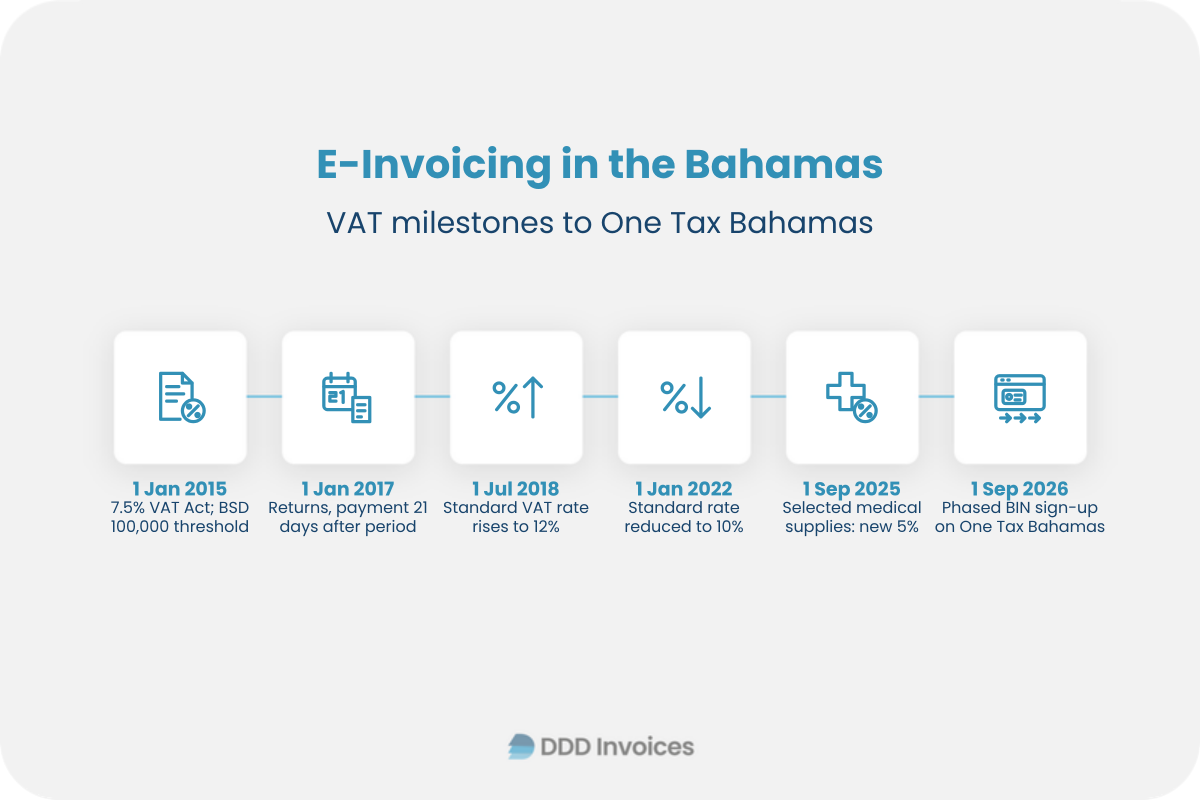
- January 1, 2015: The VAT Act, 2014 takes effect at 7.5%, with a BSD 100,000 registration threshold and section 54 rules for VAT invoices and sales receipts.
- January 1, 2017: VAT return and payment deadline moves to 21 days after the end of each tax period.
- July 1, 2018: Standard rate rises to 12%.
- January 1, 2022: Standard rate reduced to 10% under the VAT (Amendment) (No. 2) Act, 2021.
- September 1, 2025: 5% rate introduced for selected medical supplies.
- September 1, 2026: BIN registration opens on One Tax Bahamas; services migrate in phases.
B2G e-invoicing in the Bahamas
B2G e-invoicing is voluntary. There is no central platform for invoicing government bodies, and suppliers invoice ministries and agencies under the same VAT invoice rules as any registered customer. The government itself is deemed VAT-registered once an entity starts a taxable activity.
Two practical requirements apply. Suppliers to government need a Tax Compliance Certificate from the DIR, and businesses below the VAT threshold may hold a TIN-only certificate for government work. The BIN is expected to become the vendor identifier on One Tax Bahamas, but no invoice-submission step has been published.
B2B e-invoicing in the Bahamas
B2B e-invoicing is voluntary, so a PDF by email, a portal upload or a structured file are all acceptable. What is mandatory is the VAT invoice itself. Under section 54 of the VAT Act, a registrant selling to another registrant must issue an original VAT invoice within 60 days, in the form prescribed by the Comptroller.
Per the DIR VAT FAQs, a VAT invoice must show the supplier’s name, address and TIN, the customer’s name and TIN, the VAT rate and the VAT amount separately, alongside the usual invoice number, dates, descriptions and totals. It is the main evidence for the buyer’s input tax claim. Corrections run through tax credit notes and tax debit notes (section 55), never by deleting the original. Received invoices must be on file when the return is submitted, which is where an automated receiving process helps finance teams.
Onboarding steps for a new business:
- Register for VAT on vat.revenue.gov.bs within 14 days of crossing the threshold, using the VAT registration guide.
- Obtain your TIN and VAT certificate and display the certificate at each location.
- Use invoicing software or templates that capture the required particulars; keep copies of issued invoices, including spoilt or cancelled documents.
- Register for a BIN on One Tax Bahamas before your services move to the new portal.
B2C e-invoicing in the Bahamas
B2C e-invoicing in the Bahamas is voluntary, but VAT-registered businesses must generally issue VAT sales receipts to non-VAT-registered consumers. Under VAT Rule 2015-010, receipts must show “VAT Sales Receipt”, the supplier’s name, address and TIN, a serial number, date, goods or service details, applicable cash discounts, the VAT rate and amount, and the VAT-inclusive total.
Bahamas VAT reporting: returns, deadlines and reconciliation
The Bahamas compliance runs on periodic reporting through VAT returns. The standard rate is 10%, with 0% on exports and listed supplies and 5% on selected medical supplies. Returns are filed online within 21 days after each tax period: monthly above BSD 5 million turnover, otherwise quarterly.
Imported services are self-assessed by the recipient (section 45), and import VAT on goods is collected by Customs at entry. Credit and debit notes adjust output tax in the period they are issued. Records, including invoices received, must be kept for five years, in english, and available to the DIR on demand (VAT Act, sections 79 and 80). A compliant archive covers this for both paper and electronic documents.
Penalties for non-compliance in the Bahamas
Under section 16 of the VAT Act, regulations may prescribe fixed penalties of up to BSD 150,000 for a single contravention. The applicable amount depends on the prescribed offence
Offence | Fine |
|---|---|
Failure to apply for VAT registration | Up to BSD 100,000 or 12 months’ imprisonment |
Unregistered person issuing a VAT invoice or receipt | Up to BSD 250,000 or 12 months’ imprisonment |
Failure to issue a VAT invoice in time and form | Up to BSD 10,000 or 6 months’ imprisonment |
Failure to issue a VAT sales receipt | Up to BSD 10,000 or 6 months’ imprisonment |
Late VAT return or late payment | Up to BSD 10,000 or 6 months’ imprisonment |
Not showing VAT separately on invoice or receipt | Up to BSD 100,000 or 12 months’ imprisonment |
Your trusted partner for e-invoicing
E-invoicing in the Bahamas is voluntary, but every VAT invoice, receipt and credit note still has to be right and kept for five years. DDD Invoices gives software providers and businesses one API to issue, receive and archive compliant documents across markets, with rule changes tracked for you.
{{__CTA:TalkToUsCta__}}
FAQs
Is e-invoicing mandatory in the Bahamas?
No. Electronic invoices are allowed for B2B, B2C and B2G, but no structured format or clearance exists. VAT registrants must still issue VAT invoices and sales receipts with the prescribed particulars.
What is the VAT registration threshold in the Bahamas?
BSD 100,000 of taxable turnover in any 12-month period, with 14 days to apply. Voluntary registration is possible below that, as in Belize and other Caribbean markets.
How long must invoices be kept in the Bahamas?
Five years, in English, on paper or electronically, and available to the DIR on demand. This covers issued and received invoices, receipts and credit notes.
Does One Tax Bahamas mean real-time invoice reporting?
No. One Tax Bahamas is a new portal and the BIN is a new taxpayer identifier. Neither introduces invoice clearance; VAT is still reported through periodic returns.