
E-Invoicing in Bahrain: NBR Plans and VAT Invoice Rules
Author
Shamyudha

Bahrain has over 27,500 VAT registrants, yet invoices still go straight from supplier to customer. The National Bureau for Revenue (NBR) runs VAT and is preparing e-invoicing in Bahrain around a planned central platform.
Bahrain has no e-invoicing mandate, and the NBR has published no start date, format or model. VAT-registered businesses must still issue VAT invoices by the 15th day of the month after supply. Electronic invoices need no NBR approval if systems account for VAT and meet the invoice rules.
Latest news
Embeds a monitoring pages group for this blog article
{{__MONITORING_PAGES_GROUP:blog_articles_629__}}On July 29, 2026, the NBR's VAT General Guide (version 1.15) detailed how invoices must describe each supply. Descriptions must show the goods or services clearly enough to determine their VAT treatment. Invoices for constructing new buildings also need the project's building permit number.
Missing details on full or simplified invoices risk fines of up to BHD 5,000.
{{__CTA:IntegrationStepsCta__}}
What is e-invoicing and why is Bahrain preparing for it?
E-invoicing means exchanging invoices as structured data that systems read automatically. Article 55 of the GCC Unified VAT Agreement lets each state set its own electronic invoice conditions.
Saudi Arabia's FATOORAH e-invoicing has applied since December 4, 2021. Ministerial Decision No. 244 of 2025 starts e-invoicing in the UAE on January 1, 2027 for firms earning AED 50 million or more. Others follow on July 1, 2027, and government entities on October 1, 2027, all on a five-corner model using Peppol standards. Oman began its first Fawtara rollout in August 2026.
A Gulf group may run three systems before Bahrain sets a date.
The evolution of e-invoicing in Bahrain
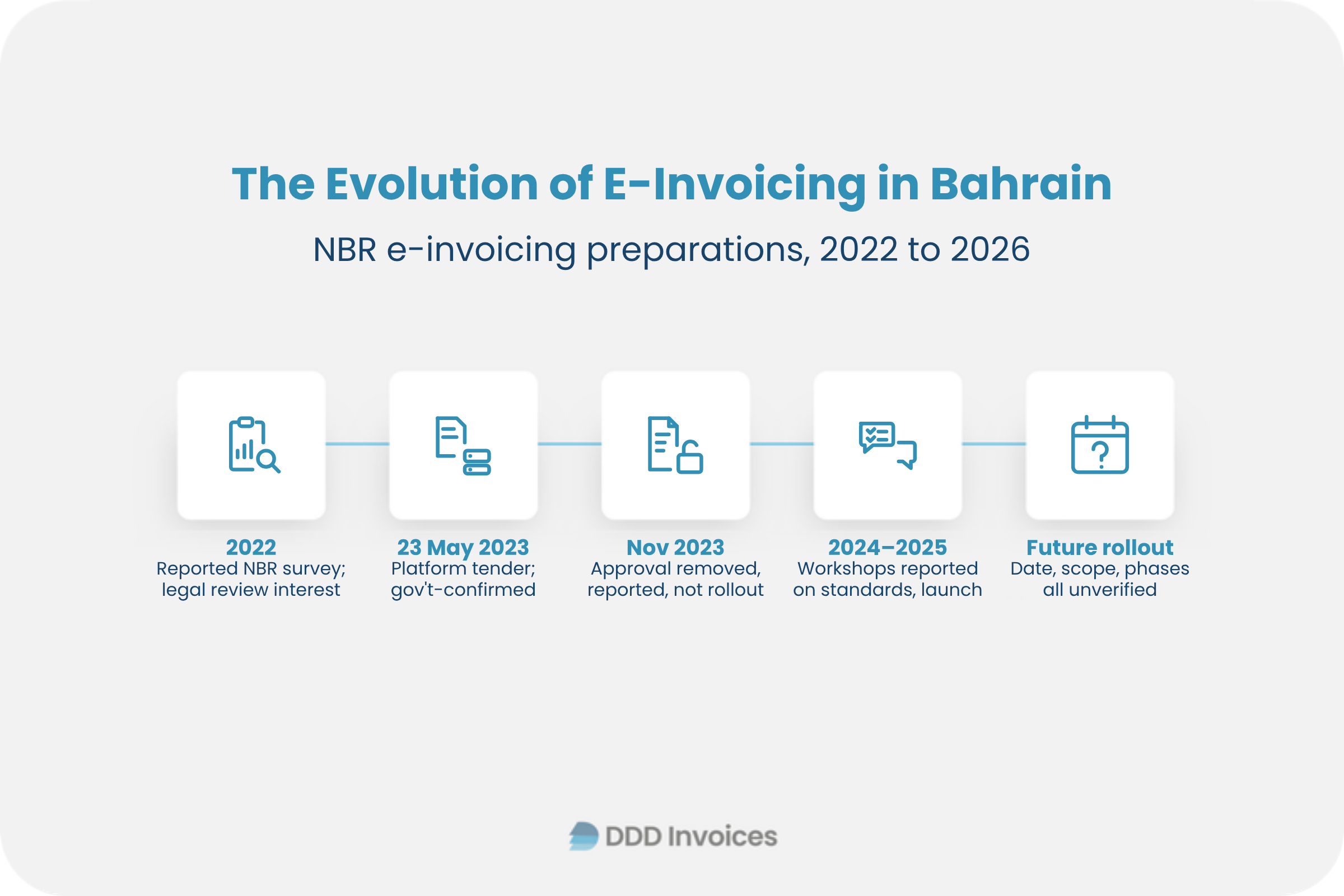
- 2022 - Preparatory work reported. Thomson Reuters/Pagero reports an NBR survey on invoice volumes and electronic invoicing, followed by interest in reviewing the legal framework for future digitalisation.
- May 23, 2023 - Central-platform tender published. The NBR issues tender 305/2023/BTB to design, implement, operate and maintain Bahrain’s central e-invoicing platform. This milestone is government-confirmed.
- November 2023 - Electronic-invoice guidance updated. VATupdate reports that the NBR removed the prior-approval requirement for issuing and retaining electronic invoices on November 16, 2023. This is secondary-source reporting, not confirmation of a mandatory e-invoicing rollout.
- 2024–2025 - Consultations reported. VATCalc describes NBR consultations and workshops with major businesses on technical standards and launch planning. The article supports the activity, but does not establish a precise 2024–2025 consultation schedule.
- Future rollout - Details remain unverified. The official central-platform tender confirms procurement preparations, but its public description does not specify a mandatory launch date, transaction scope or two-phase implementation sequence.
B2G e-invoicing in Bahrain
B2G e-invoicing is not mandatory, and no government portal or format exists. Ministries receive standard VAT invoices and can check suppliers in the NBR's VAT registrant search.
B2B e-invoicing in Bahrain
B2B e-invoicing is not mandatory. Businesses register for VAT above BHD 37,500 in annual supplies, then invoice each supply and advance payment.
Article 39 of Decree-Law No. 48 of 2018, the VAT Law, sets the deadline: the 15th day of the month after supply.
Under Article 52 of the Executive Regulations (Decision No. 12 of 2018), a full VAT invoice must be clearly titled as one. It shows both parties' names and addresses, the supplier's VAT Account Number, a sequential number and dates. It also lists the description, quantity, unit price, VAT rate and amount, and BHD totals.
Electronic invoices and credit or debit notes need no NBR approval if systems account for VAT and meet Articles 52 to 54.
- Clean master data: store buyers' VAT Account Numbers, though invoices do not require them today.
- Structure ERP output: produce invoice lines as data fields, not just PDFs.
- Plan connectivity: map an e-invoicing API integration from your ERP.
- Monitor the NBR: watch for new guidance.
B2C e-invoicing in Bahrain
B2C e-invoicing is not mandatory, and no fiscal device rule applies to POS systems. Displayed prices must include VAT.
Sellers can issue a simplified VAT invoice to buyers not registered for VAT, or for supplies of BHD 500 or less including VAT. Article 53 of the Executive Regulations requires the supplier's name, address and VAT Account Number, date, description, VAT rate and amount, and total.
E-reporting and VAT compliance in Bahrain
Bahrain requires periodic electronic VAT returns through the NBR portal. Returns are generally monthly where current or expected annual taxable supplies exceed BHD 3 million and quarterly otherwise. Eligible taxpayers with annual supplies below BHD 100,000 may apply for annual filing, subject to conditions and NBR approval. Returns are due by the last day of the month following the VAT period, according to the NBR’s filing guidance.
Bahrain’s standard VAT rate has been 10% since January 1, 2022, as confirmed by the NBR’s VAT overview. Periodic VAT-return filing should be distinguished from any separate invoice-level e-reporting requirement; the return-filing guidance does not establish such a mandate.
Penalties for non-compliance in Bahrain
Administrative fines reach BHD 10,000 under Article 60 of the VAT Law.
Offence | Fine |
|---|---|
Late VAT registration, up to 60 days (Art. 60) | Up to BHD 10,000 |
Breaching VAT invoice conditions (Art. 60) | Up to BHD 5,000 |
Late return or payment, up to 60 days (Art. 60) | 5% to 25% of the VAT due |
Not issuing VAT invoices, or using forged invoices to avoid VAT (Arts. 63 and 64) | 3 to 5 years' prison and 1 to 3 times the VAT due; doubled on repeat within 3 years |
Your trusted partner for e-invoicing in Bahrain
With no NBR format yet, Bahraini entities need clean, structured invoice data. DDD Invoices puts your ERP on one API connection to issue, receive and archive invoices across 38 covered countries, adding markets without a rebuild. Bahrain is missing from our country coverage list, and the UAE is in progress, so tell us which Gulf markets matter first.
{{__CTA:TalkToUsCta__}}
FAQs
When will e-invoicing become mandatory in Bahrain?
No date has been announced, although the NBR tendered an e-invoicing central platform in 2023. Trackers mention 2026 and 2027 starts with B2B first, but the NBR has confirmed neither.
What must a VAT invoice in Bahrain include?
Full VAT invoices show both parties' names and addresses, the supplier's VAT Account Number and sequential numbering. They also need dates, a description, quantities, BHD prices, and the VAT rate and amount.
How long must VAT records be kept in Bahrain?
VAT records and accounting books must be kept for 10 years after their VAT period ends. Records relating to real estate must be kept for 15 years under the Executive Regulations.
Why should GCC groups prepare for Bahrain e-invoicing now?
Saudi Arabia, the UAE and Oman have launched or scheduled e-invoicing, so Gulf groups face several systems. Clean invoice data can then be mapped to Bahrain's format once the NBR publishes it.