
E-Invoicing in Bolivia: SIAT Requirements, SIN Rules & 2026 Updates
Author
Shuaa

E-invoicing in Bolivia is regulated by the Servicio de Impuestos Nacionales (SIN) through its Sistema de Facturación within SIAT. IVA taxpayers must issue authorized fiscal documents using their applicable modality. Online invoicing is mandatory for taxpayers assigned an online modality, not uniformly for every business.
RND No. 102100000011, dated 11 August 2021, establishes the framework. Digital fiscal documents use prescribed XML, with digital signatures required for Electrónica en Línea. Following September’s repeal of the groups 9–12 incorporation resolutions, their previously scheduled 1 October 2026 transition deadline no longer applies.
Latest News
Embeds a monitoring pages group for this blog article
{{__MONITORING_PAGES_GROUP:blog_articles_589__}}As of October 2026, three resolutions shape implementation:
- 23 March 2026: RND No. 102600000007 extended mixed-modality issuance for groups 9–12 through 30 September, originally requiring online-only issuance from 1 October.
- 1 September 2026: RND No. 102600000034 made available a technical annex under development for Law No. 1733 adjustments. Taxpayers with proprietary or provider invoicing systems must meet its specifications for pilot testing and subsequent authorization during 1 October–16 November 2026. Existing rules remain mandatory until the implementing resolution is published and takes effect.
- 30 September 2026: RND No. 102600000038 repealed the groups 9–12 incorporation resolutions and their amendments. Their October deadline was withdrawn, not replaced with another universal date. SIN will periodically assign online modalities to IVA taxpayers that had not yet implemented one when the resolution was published.
What Is E-Invoicing and Why Is Bolivia Adopting It?
E-invoicing enables structured electronic invoice creation and processing.
Bolivia’s electronic invoicing framework supports gradual digitalization, document integrity and SIN verification. The Sistema de Facturación regulation distinguishes three online modalities with different requirements.
Modality | Main requirement |
Electrónica en Línea | SIN-authorized software and digitally signed fiscal documents, as established in Article 7. |
Computarizada en Línea | SIN-authorized software, taxpayer credentials and hash-based controls, as established in Article 8. |
Portal Web en Línea | Invoice issuance through SIN’s portal using authorized credentials, as established in Article 9. |
Traditional authorized modalities remain available where permitted under Article 10 of the regulation. A PDF representation does not replace the underlying XML fiscal record: SIN’s technical requirements distinguish the graphical representation from the XML invoice
The Evolution of E-Invoicing in Bolivia
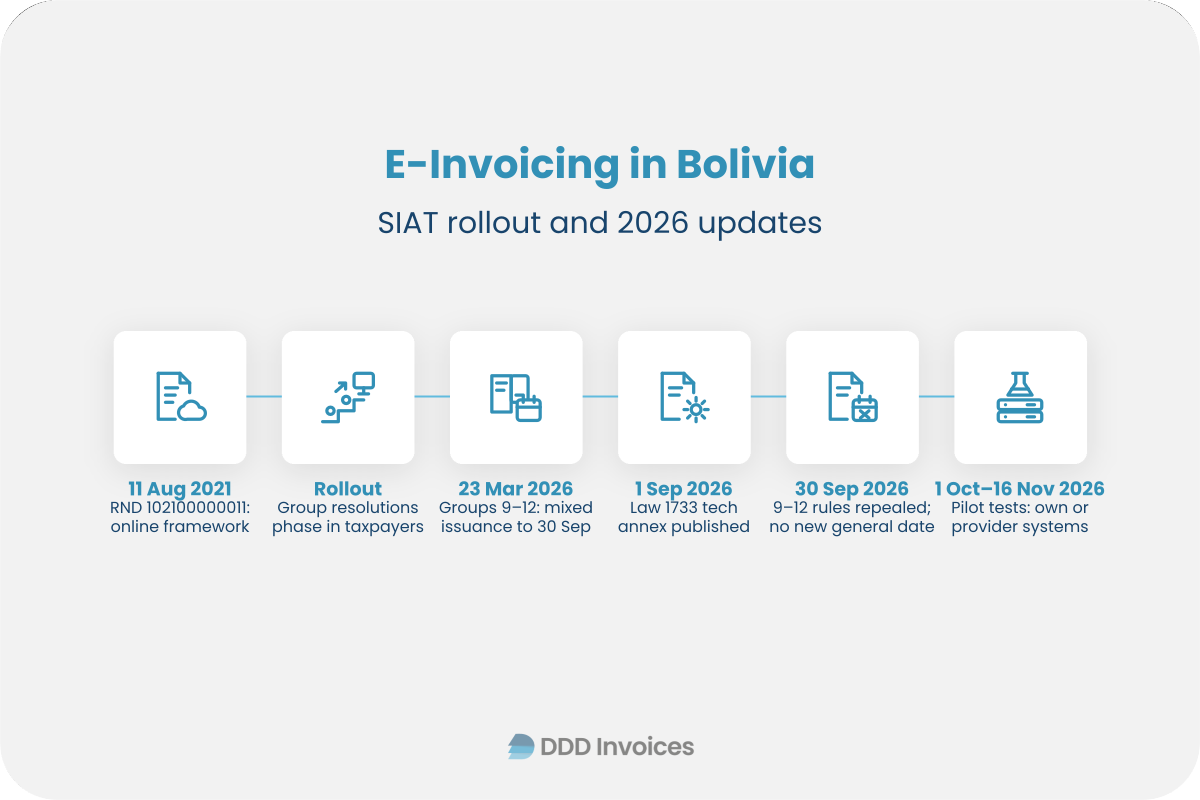
- 2021: RND No. 102100000011, dated 11 August, established the framework for online invoicing modalities and periodic taxpayer assignments.
- Subsequent rollout: Separate incorporation resolutions progressively assigned taxpayer groups to online invoicing. SIN’s September 2026 resolution identifies the earlier resolutions covering groups 9–12 and their transition arrangements.
- 2026: SIN introduced technical adaptation requirements under RND No. 102600000034 and repealed the group's 9–12 incorporation resolutions under RND No. 102600000038. Businesses must verify their current assigned modality rather than rely on superseded rollout announcements.
B2G Electronic Invoicing in Bolivia
Government suppliers issue SIN-authorized invoices under their applicable modality and sector rules. Under Article 10, SIN determines mandatory online modality assignments; supplying a government customer does not, by itself, determine the supplier’s modality.
Public-sector withholding is separate. According to SIN’s withholding guidance, it can apply when public institutions make qualifying payments to individuals who are not registered with SIN and supply occasional goods or services without issuing an invoice. These obligations should not be generalized to every government supplier invoice.
B2B Electronic Invoicing in Bolivia
B2B invoices require accurate buyer identification, including the applicable Número de Identificación Tributaria (NIT). IVA-credit eligibility also depends on substantive conditions, including the purchase’s connection with taxable activities, not simply invoice authorization.
Integrated systems must support:
- CUIS and CUFD: The system initialization code and daily invoicing code, respectively.
- CUF: A unique invoice code generated automatically by the issuer’s application.
- XML/XSD: Official sector-specific invoice structures and schemas.
- XMLDSig: Digital signatures required for Electrónica en Línea.
Systems must process SIN validation responses, not assume successful transmission means acceptance. Individual submissions return validated or observed statuses, while package submissions can also remain pending until validation completes.
Cross-border transactions require the applicable export invoice and sector-specific fiscal documents. Imports follow customs procedures, with DIM/DUI declarations recognized as equivalent fiscal documents where applicable.
B2C E-Invoicing in Bolivia
Consumer sales follow the seller’s authorized modality. Invoices must capture permitted buyer identification, subject to applicable exceptions, and prescribed verification information and QR codes. POS systems must support the relevant branch, sales-point and fiscal-document configuration.
During qualifying contingencies, offline invoice packages must generally be transmitted within 48 hours after communication and connectivity with SIN are restored. Authorized manual contingency invoices require prior printing authorization, CAFC, event registration, and XML transcription and submission within 72 hours after communication and connectivity are restored.
E-Reporting and VAT Compliance in Bolivia
Bolivia requires periodic tax reporting, including monthly IVA returns and the Registro de Compras y Ventas (RCV). Form 200 applies to general IVA obligations, while Form 210 applies to qualifying exporters. The RCV generally requires registration, confirmation and consolidation by the ninth day of the following month. If that date falls on a weekend or public holiday, the deadline moves to the next working day.
Corrections follow separate procedures:
- Annulment: Generally permitted through the ninth day of the month following issuance when the recorded transaction did not occur. RND No. 102600000025 establishes procedures for requests submitted after that deadline.
- Reversal: An erroneous annulment may be reversed once, through the ninth day of the month following the original invoice’s issuance.
- Nota de Crédito-Débito: Adjusts IVA credit or debit for qualifying returns or total or partial rescissions, as defined in Article 3(u).
For fiscal documents issued before RND No. 102600000025 took effect, its transitional annulment-request procedure remains available through 30 November 2026.
Retain accessible, integrity-protected XML, validation records and supporting documents throughout the applicable limitation period. Articles 59–62 and 70(8) of Bolivia’s Tax Code establish the general eight-year limitation period, its calculation and adjustment rules, and the obligation to preserve supporting records until prescription. Extensions, suspension or interruption can lengthen preservation requirements, so retention should not be calculated simply as eight years from invoice issuance.
What Happens If Businesses Don’t Comply?
Failure to issue required fiscal documents can result in business closure. Under Article 164 of Bolivia’s Tax Code, closure starts at six continuous days and doubles for repeat offences to 12, 24 and a maximum of 48 days. Other formal-obligation breaches attract the penalties applicable to the specific violation.
A separate immediate-control procedure under Article 170 allows a first-time closure sanction to be replaced by immediate payment of a fine equal to ten times the unbilled amount. This is not a universal alternative to every closure penalty; the applicable procedure and legal conditions must be assessed.
Your Trusted Partner for E-Invoicing in Bolivia
DDD Invoices helps businesses and software providers simplify multi-country compliance through a unified platform for issuing, receiving and archiving electronic invoices across supported markets. Its standardized API connects existing ERP, accounting and billing systems, reducing the complexity of separate country-specific integrations.
With DDD, teams can standardize invoice workflows and build a scalable foundation for expanding into additional markets. For Bolivia, discuss your requirements with DDD to confirm coverage and assess your SIN-assigned modality, XML specifications and validation needs before implementation.
Displays a content card with title, subtitle, list/body, and action button
{{__CTA:GenericCtaJson:{"type":"content","contentCta":{"layout":"cardList","title":"Talk to us!","subtitleHtml":"Still have questions?","button":{"href":"https://calendly.com/ddd-invoices/30min-intro","label":"Book a free 30min call","color":"white"},"bodyHtml":"In the <strong>30min free call</strong> we will discuss:","listHtml":"<ul><li><strong>your requirements</strong> in invoicing</li><li>how integration works</li><li><strong>demo</strong> of the product</li><li>next steps</li></ul>"}}__}}FAQs
Is e-invoicing mandatory for every business in Bolivia?
Not under one universal deadline. Online invoicing obligations depend on the taxpayer’s SIN-assigned modality and current regulations. RND No. 102600000038 confirms that SIN will periodically assign online modalities to IVA taxpayers that had not yet implemented one when the resolution was published.
Does the 1 October 2026 deadline still apply to groups 9–12?
No. On 30 September 2026, SIN repealed the incorporation resolutions for groups 9–12 and their amendments, removing their previously scheduled transition deadline. This did not repeal Bolivia’s overall invoicing framework or establish another universal implementation date.
Do all Bolivia online invoicing modalities require digital signatures?
No. SIN’s technical requirements specify XMLDSig signatures only for Electrónica en Línea. Computarizada en Línea uses prescribed hash-based controls instead, so businesses should implement the security requirements applicable to their modality.
What is the difference between CUF and CUFD in Bolivia?
CUF is the unique code identifying an individual invoice, while CUFD is the daily invoicing code used to enable fiscal-document issuance. SIN’s issuance and transmission guidance requires integrated systems to obtain CUFD daily through the corresponding web service.