
E-Invoicing in Cambodia: CamInvoice Clearance and UBL Format
Author
Shamyudha

Cambodia stores every validated e-invoice on CamDL, a national blockchain ledger built to resist tampering. The Ministry of Economy and Finance (MEF) runs e-invoicing in Cambodia through CamInvoice, operated by its General Department of Digital Economy (GDDE). Invoices are checked against General Department of Taxation (GDT) rules.
Since January 22, 2025, suppliers to listed ministries must send procurement invoices through CamInvoice. The list reached 28 ministries and institutions on June 1, 2026, and their units accept only CamInvoice e-invoices. B2B use is voluntary, and B2C is not yet covered.
Latest news
Embeds a monitoring pages group for this blog article
{{__MONITORING_PAGES_GROUP:blog_articles_622__}}On June 1, 2026, the MEF's Circular No. 007 launched Phase 1, Step 4. It adds 14 ministries and institutions, such as Foreign Affairs and Tourism, for a total of 28.
Their procurement payments now need CamInvoice e-invoices, so suppliers must register as CamInvoice members.
{{__CTA:IntegrationStepsCta__}}
What is e-invoicing and why has Cambodia adopted it?
E-invoicing swaps paper and PDF invoices for structured data that software checks automatically.
Circular No. 003 links CamInvoice to public finance reform, tax compliance and ASEAN digital integration. In this clearance model, only invoices CamInvoice identifies count as e-invoices, under Prakas No. 075.
CamInvoice checks each invoice's XML structure, UBL fields and GDT rules, plus e-KYB (electronic know-your-business) validation. It then stores valid invoices on CamDL and alerts both parties by webhook.
The evolution of e-invoicing in Cambodia
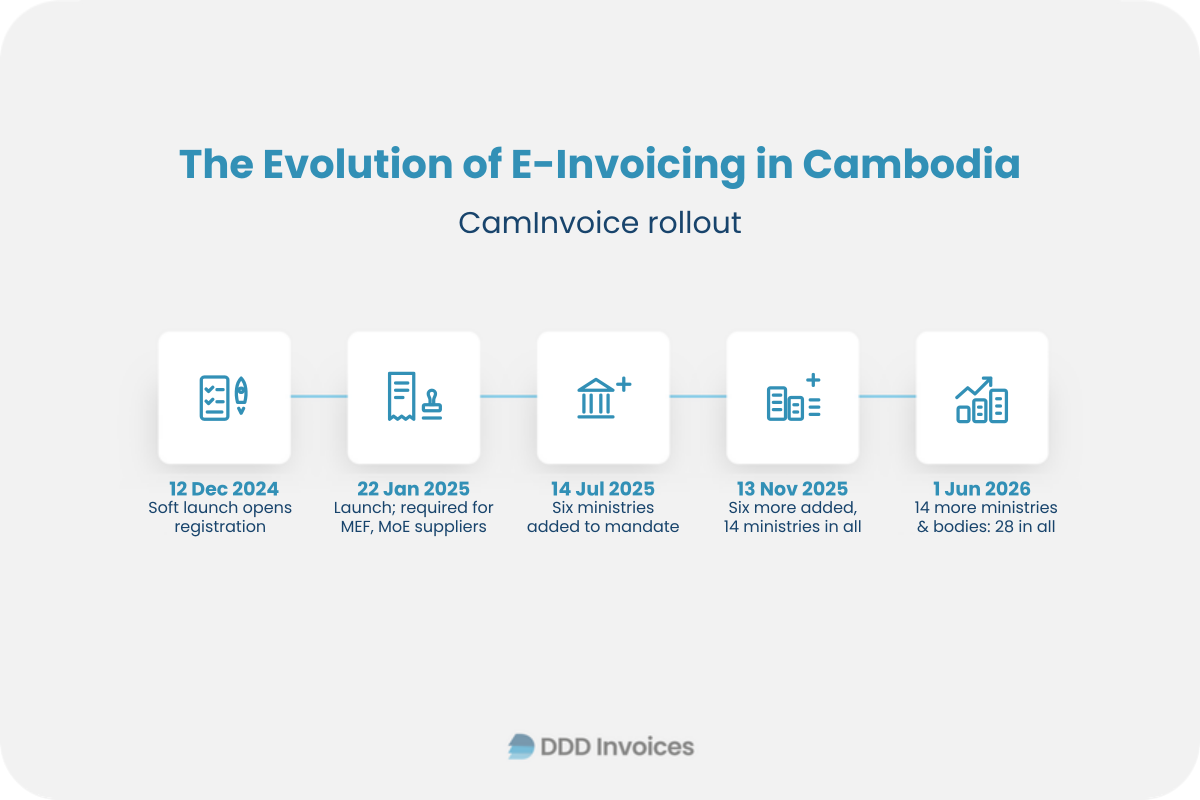
- December 12, 2024: the GDDE opens CamInvoice registration in a soft launch.
- January 22, 2025: Prakas No. 075 launches CamInvoice, and Circular No. 003 makes it mandatory for MEF and Ministry of Environment suppliers.
- July 14, 2025: Circular No. 012 adds six ministries.
- November 13, 2025: Circular No. 017 adds six more, for 14 in total.
- June 1, 2026: Circular No. 007 adds 14 ministries and institutions, for 28 in all.
B2G e-invoicing in Cambodia
B2G e-invoicing is mandatory for procurement invoices to central-level units of 28 ministries and institutions. These units join CamInvoice automatically, while suppliers register and issue through its e-Invoice Portal or an integrated IT system.
Under Circular No. 017, units attach each e-invoice to their payment request. The General Departments of Budget and National Treasury can reject any invoice CamInvoice cannot verify.
During the transition, invoices outside CamInvoice can be paid on documents the authorizing officer certifies.
B2B e-invoicing in Cambodia
B2B e-invoicing is voluntary: any registered business can use CamInvoice, but no circular names a B2B group, threshold or date.
A tax invoice to a self-assessment buyer needs both parties' details, a sequential number and date, items, prices and pre-tax totals. Under Prakas No. 723, it also shows VAT, any specific, public lighting or accommodation tax, and Khmer text above any foreign language.
- Register: once registered with the Ministry of Commerce and GDT, apply on the e-Invoice Portal with a CamDigiKey account, per the GDDE's membership rules.
- Connect: issue on the portal, or link your ERP via a service-provider member that passed integration tests.
- Map documents: send invoices, credit notes and debit notes as UBL 2.1 XML, with a tax exchange rate for non-KHR invoices.
B2C e-invoicing in Cambodia
B2C e-invoicing is not mandatory, and no start date has been announced. Consumers receive a commercial invoice with tax-inclusive prices under Prakas No. 723.
No rule requires fiscal devices or certified tills, so point-of-sale systems just issue commercial invoices.
Foreign sellers of digital goods or services register for VAT only and pay by the 20th of the next month under Sub-Decree No. 65. Business buyers reverse-charge it instead.
E-reporting and VAT compliance in Cambodia
Cambodia has periodic electronic tax filing through monthly returns. Filing deadlines are generally the 20th of the following month for manual submissions and the 25th for online submissions, subject to the GDT’s published filing calendar.
The Law on Taxation of May 16, 2023 sets VAT at 10%, or 0% for exports, in Article 65. No circular brings export or import invoices into CamInvoice. Regular gasoline has carried a temporary 4% rate since March 20, 2026.
CamInvoice records cannot be deleted; correct errors with a credit or debit note referencing the original invoice and explaining why. Under Article 201, retain records for 10 years for medium and large taxpayers, or 3 years for small taxpayers. CamInvoice also stores invoices for 10 years under Prakas No. 075, but keep your own copies.
Penalties for non-compliance in Cambodia
Invoice and filing fines run from KHR 5,000,000 to KHR 100,000,000 under the Law on Taxation, which also allows licence suspension and temporary closure.
Offence | Fine |
|---|---|
Failing to issue invoices or keep records | KHR 10,000,000 (Art. 235) |
Failing to register or file returns after more than two written warnings | KHR 5,000,000 (Art. 235) |
Repeat obstruction after a fine, or false invoices | 1 month to 1 year in prison and KHR 50,000,000 to 100,000,000 (Arts. 235 and 243) |
Your trusted partner for e-invoicing in Cambodia
For suppliers to 28 ministries and institutions, CamInvoice e-invoicing is mandatory, and an unverifiable invoice can be refused for payment.
With DDD Invoices, you test your ERP flow in a sandbox, then use one integration to issue, receive and archive invoices across 30+ countries. Our country coverage list does not include Cambodia yet, so share your CamInvoice volumes to help shape what we build next.
{{__CTA:TalkToUsCta__}}
FAQs
How do suppliers register for CamInvoice?
Suppliers need a CamDigiKey account and Ministry of Commerce and GDT registration to apply on the e-Invoice Portal. Software vendors join as service-provider members, signing an NDA and passing integration tests before signing an MOU.
What is CamInvoice in Cambodia?
CamInvoice is the MEF's central e-invoicing platform, run by the GDDE, which validates and records every e-invoice. Invoices arrive as UBL 2.1 XML from its portal or integrated systems and are stored on CamDL.
When will B2B e-invoicing be mandatory in Cambodia?
No date has been set, because no MEF circular has yet extended CamInvoice beyond government buyers. Businesses can already exchange B2B e-invoices voluntarily, which also prepares their systems for any later phase.
Why can a ministry reject a supplier's invoice?
Listed ministries must accept only CamInvoice e-invoices when paying for goods and services bought through public procurement. Under Circular No. 012, budget and treasury officials can reject attached invoices CamInvoice cannot verify.