
E-Invoicing in Canada: GST/HST Invoice Rules and Québec Mandatory Billing
Author
Ameera

Canada has moved GST/HST returns, customs accounting and Québec restaurant billing online, yet it has never built a national invoice platform. The Canada Revenue Agency (CRA) administers the GST/HST under the Excise Tax Act; Revenu Québec runs separate sector billing. E-invoicing in Canada means documentary rules, not clearance.
No Canadian business must issue structured e-invoices; the CRA is only evaluating B2B e-invoicing. What applies: GST/HST disclosure and input tax credit documentation under the Excise Tax Act, electronic GST/HST returns for reporting periods beginning on or after January 1, 2024, and Québec mandatory billing (certified SRSs with the WEB-SRM for restaurants from June 1, 2025, and second-generation SRSs for taxi operators from January 1, 2026).
Latest news
Embeds a monitoring pages group for this blog article
{{__MONITORING_PAGES_GROUP:blog_articles_615__}}In September 2026 the CRA replaced the 2005 versions of GST/HST Memorandum 15-1 and GST/HST Memorandum 15-2 to reflect Excise Tax Act amendments on electronic records and inspection. Every registrant keeping books electronically is affected; the retention period stays six years after the year-end under subsection 286(3).
The CRA's 2025-26 Departmental Plan lists evaluating B2B e-invoicing as a future initiative: no date, no obligation. The only thresholds in force are the CAD 30,000 small-supplier limit for GST/HST registration and the CAD 100 / CAD 500 input tax credit documentation bands, both explained below.
What is e-invoicing and has Canada adopted it?
E-invoicing is the exchange of invoices as structured, machine-readable data. Canada has adopted no model: no clearance, no national schema, and no mandatory network. The CRA is still evaluating B2B e-invoicing for GST/HST compliance, so any format is a private choice, often set by an ERP integration.
The evolution of e-invoicing in Canada
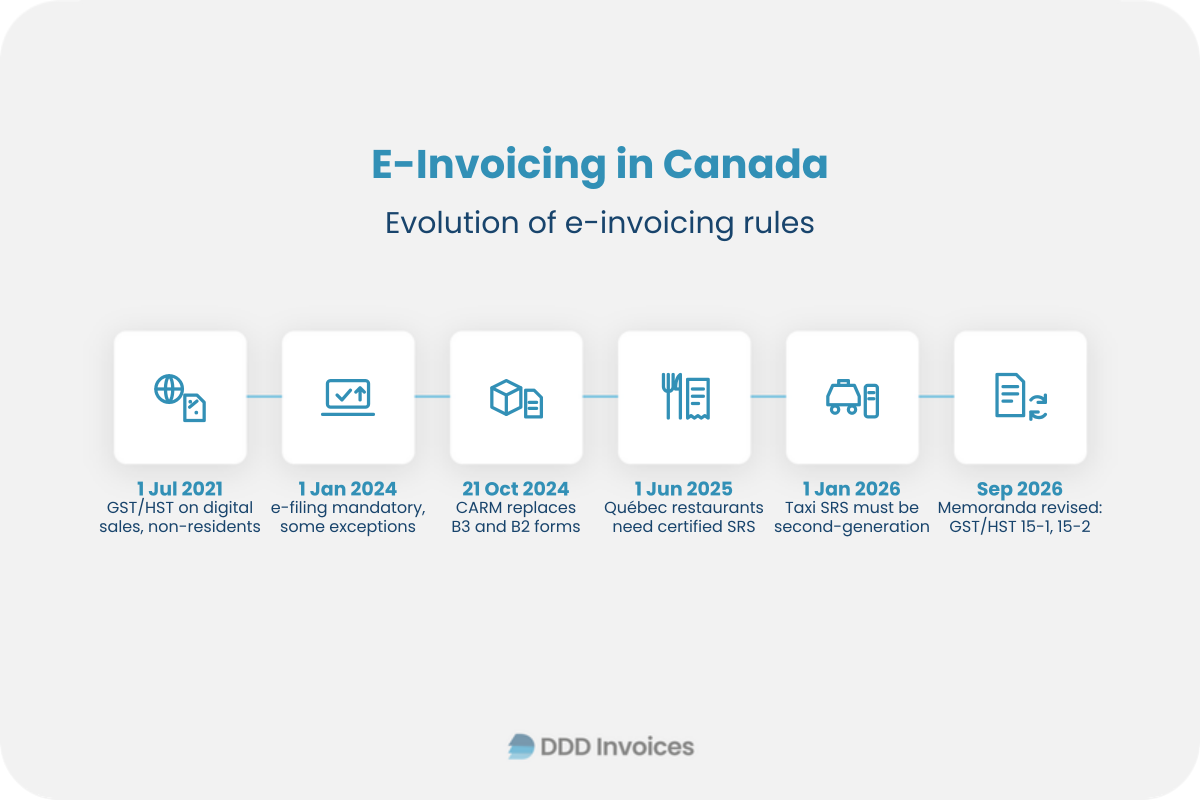
- July 1, 2021: Excise Tax Act digital-economy GST/HST provisions apply to non-resident vendors and platform operators.
- January 1, 2024: mandatory electronic filing under subsection 278.1(2.1) for reporting periods beginning on or after this date, except charities and selected listed financial institutions.
- October 21, 2024: CARM becomes the Canada Border Services Agency system of record; the Commercial Accounting Declaration replaces B3 and B2 forms.
- June 1, 2025: Québec restaurants must use a certified SRS with the WEB-SRM; the 2025-26 Departmental Plan (June 17, 2025) adds B2B e-invoicing evaluation.
- January 1, 2026: covered taxi operators need a second-generation certified SRS.
- September 2026: GST/HST Memoranda 15-1 and 15-2 revised.
B2G e-invoicing in Canada
B2G e-invoicing is voluntary: no federal law prescribes a format, portal or network; each buyer and contract sets the route. Shared Services Canada's invoicing instructions are typical: type of service, contract or purchase order number and other contract-required details, by email or mail, paid within 30 days of receipt and acceptance.
B2B e-invoicing in Canada
B2B e-invoicing is voluntary for every business, new registrants included. The CRA small-supplier rule of CAD 30,000 in a single calendar quarter or over four consecutive quarters decides GST/HST registration only; public service bodies and non-residents have their own tests.
Invoice content follows section 3 of the Input Tax Credit Information Regulations (SOR/91-45): supplier name, date and total under CAD 100; plus supplier GST/HST number and tax amount or tax-included statement from CAD 100 to 499.99; plus recipient name, payment terms and a sufficient supply description from CAD 500. Paper, PDF, EDI or XML all qualify.
Onboarding when a partner wants structured invoices:
- Register for GST/HST above the threshold.
- Agree the format (Peppol BIS, UBL, EDI or PDF) by contract.
- Map the data to the ITC band fields; the DDDI invoice object carries supplier, recipient, tax and payment-term fields in one structure.
- Test, then archive both issued and received documents for the full retention period.
B2C e-invoicing in Canada
Consumer sales carry no federal e-invoicing or fiscal-device duty. Subsection 223(1) of the Excise Tax Act requires disclosing GST/HST on invoices, receipts or agreements, or by a visible notice at the place of supply under the Disclosure of Tax (GST/HST) Regulations, as Memorandum 15-1 explains.
Québec differs. Restaurants, bars and caterers under mandatory billing must give every customer a bill from a certified sales recording system (SRS) that sends transaction data to the WEB-SRM, Revenu Québec's cloud environment that receives, validates and stores it. Covered taxis use second-generation SRSs; limited exemptions apply.
Fiscalization exists only in Québec; DDD covers it through its fiscalization layer and POS integrations.
E-reporting and VAT compliance in Canada
Canada has periodic reporting, and the CRA sets different schedules by taxpayer type
GST is 5%; HST is 13% in Ontario, 14% in Nova Scotia since April 1, 2025, and 15% in New Brunswick, Newfoundland and Labrador and Prince Edward Island, per the CRA rate table; Québec adds 9.975% QST.
Returns are monthly, quarterly or annual by taxable supplies; most registrants file electronically. Filing reconciles invoices to ledgers to the return; it is not clearance. Adjustments use credit or debit notes under section 232 of the Excise Tax Act, with the information prescribed by the Credit Note and Debit Note Information (GST/HST) Regulations (SOR/91-44); there is no central approval or correction deadline.
Records stay readable for six years after the year-end under subsection 286(3), longer for objections, appeals or a CRA demand, and in Canada unless the CRA authorises storage elsewhere. Compliant archiving has to cover all of this.
Penalties for non-compliance in Canada
Federal penalties follow the CRA penalties page under the Excise Tax Act; Québec fines follow the restaurant-sector sanctions under the Tax Administration Act.
Offence | Fine |
|---|---|
Late return with tax owing | 1% of tax owing plus 25% of that per complete month, up to 12 months |
Return not filed electronically | CAD 100 first time, CAD 250 thereafter |
Ignoring a demand to file | CAD 250 |
Québec: no bill or missing data | CAD 100 penalty plus CAD 300 to 5,000 fine; CAD 1,000 to 10,000 for a second offence; CAD 5,000 to 50,000 for further offences within five years |
Québec: no certified SRS | CAD 2,000 to 100,000 fine, up to six months in prison, registration suspension possible |
Your trusted partner for e-invoicing in Canada
Canada asks for correct invoice data, electronic returns and six-year archives rather than structured e-invoices, outside Québec's covered sectors.
DDD Invoices gives you one API to issue, receive and archive compliant invoices, PDF included, from the same integration your ERP already uses for other markets. Canada is supported today and sits among the countries we cover, and when the CRA or Revenu Québec changes a rule, we update the compliance layer so your integration stays untouched. Check every market we support on the country coverage list before you expand.
{{__CTA:TalkToUsCta__}}
FAQs
Is e-invoicing mandatory in Canada?
No, there is no federal B2B, B2G or B2C e-invoicing mandate anywhere in Canada today. The CRA is only evaluating B2B e-invoicing, while Québec requires certified billing systems in restaurants and taxis.
What is the WEB-SRM in Québec?
The WEB-SRM is Revenu Québec's cloud environment that receives, validates and stores restaurant and taxi transaction data. Certified SRSs feed it, mandatory for restaurants from June 1, 2025, and taxis from January 1, 2026.
When does a Canadian business have to register for GST/HST?
Registration is required once taxable supplies exceed CAD 30,000 in one quarter or four consecutive quarters. Public service bodies and non-residents follow separate tests, and registration never obliges anyone to issue e-invoices.
Why must invoices be kept for six years in Canada?
Subsection 286(3) of the Excise Tax Act sets six years after the year-end as the retention period. Records must stay electronically readable, remain in Canada unless authorised elsewhere, and last longer during objections or appeals.