
E-Invoicing in Chile: SII Requirements & DTE Rules
Author
Ameera
E-invoicing in Chile is mandatory. VAT taxpayers must issue invoices, credit and debit notes, dispatch guides and consumer receipts (boletas) as Documentos Tributarios Electrónicos (DTE): signed XML files sent to the Servicio de Impuestos Internos (SII). Paper is allowed only with an SII exception for areas without data coverage or electricity, or declared catastrophe zones.
Each document needs a folio (document number) authorised by the SII and an electronic tax stamp. Phased invoice mandates ran through 2018, and electronic boletas became mandatory from 2021. Legal exceptions apply.
Latest News
Embeds a monitoring pages group for this blog article
{{__MONITORING_PAGES_GROUP:blog_articles_593__}}SII Exempt Resolution No. 2, dated 7 January 2026, sets up a centralised SII digital signature for boletas issued through the SII's free system.
However, the most recent DTE-specific change is SII Res. 121 of 4 September 2026, published in the extract in the Diario Oficial. No later DTE rule had been issued as of yet.
What does e-invoicing mean in Chile?
In Chile, e-invoicing means issuing tax documents as Documentos Tributarios Electrónicos (DTE): XML files built to the SII's published schema, signed electronically by the issuer and sent to the SII, which validates them on receipt. The XML file is the DTE. A PDF or printed copy is only a representación impresa or virtual of it.
Main DTE types and SII codes
The Servicio de Impuestos Internos (SII), under the Ministry of Finance, sets formats and procedures through exempt resolutions published in extracts in the Diario Oficial. Taxpayers can issue through the free SII system or through market or own software, which must pass SII certification.
Code | Document | Typical use |
|---|---|---|
33 | Factura electrónica | Taxable sale to another business (B2B, B2G) |
34 | Factura no afecta o exenta electrónica | Exempt or non-taxable sale to a business |
39 | Boleta electrónica | Taxable sale to a final consumer |
41 | Boleta no afecta o exenta electrónica | Exempt sale to a final consumer |
43 | Liquidación factura electrónica | Sales made on behalf of a principal |
46 | Factura de compra electrónica | Issued by the buyer when the seller cannot invoice |
52 | Guía de despacho electrónica | Movement of goods without an immediate invoice |
56 / 61 | Nota de débito / crédito electrónica | Increase, reduce or annul a domestic DTE |
110 / 111 / 112 | Factura, nota de débito and nota de crédito de exportación electrónica | Export sales and their adjustments |
E-invoicing timeline
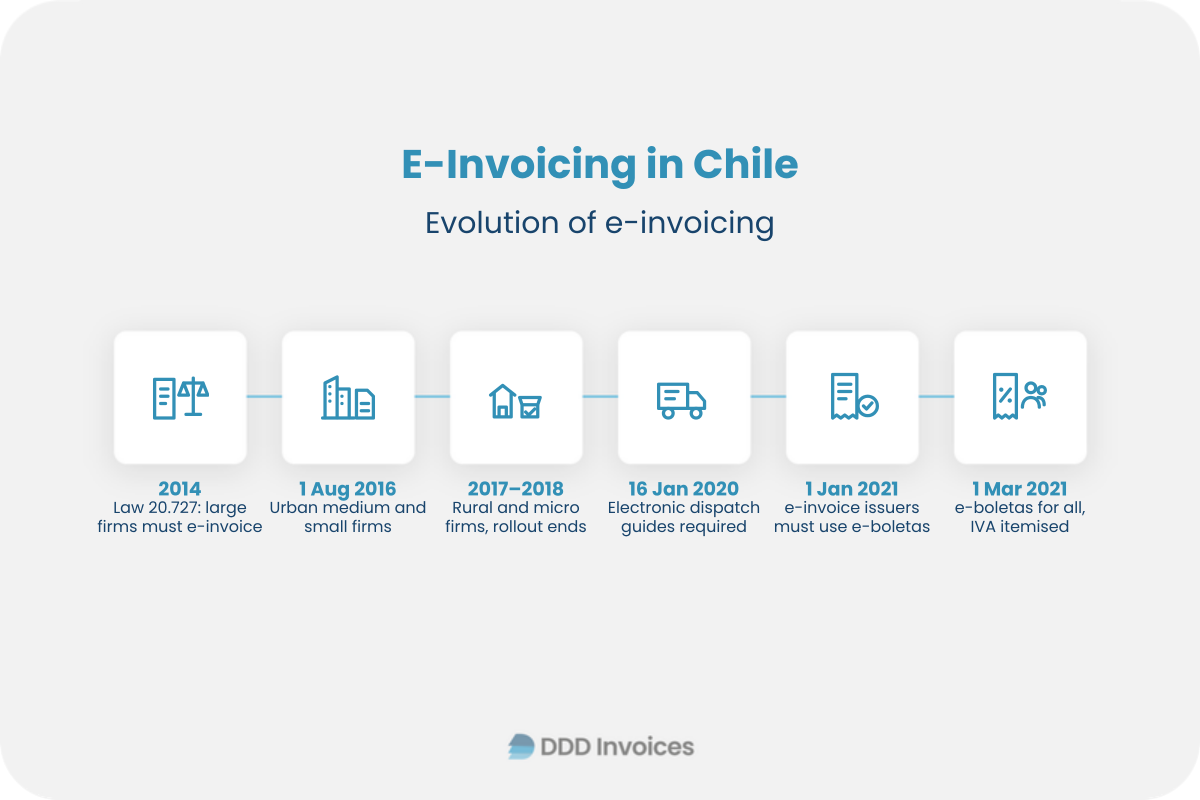
- 2014 (Law 20.727): makes electronic invoices mandatory, along with electronic debit and credit notes, purchase invoices and settlement invoices. Deadlines depend on annual sales and on whether the business is urban or rural.
- 1 Nov 2014 (Stage 1): Large companies must comply.
- 1 Aug 2016 (Stage 2): Urban medium and small companies must comply.
- 1 Feb 2017 - 2018 (Stages 2 and 3): Rural medium and small companies and urban micro-enterprises must comply. Rural micro-enterprises join, completing the rollout.
- 16 Jan 2020: Electronic dispatch guides (guías de despacho) become mandatory.
- 1 Jan 2021: Electronic boletas become mandatory for taxpayers who already issue electronic invoices.
- 1 Mar 2021: Electronic boletas become mandatory for everyone else. The IVA amount must also be itemised on the boleta from this date.
B2G regulations in Chile
There is no separate B2G e-invoicing format or national B2G platform in Chile. A supplier invoicing a ministry, hospital or municipality issues the same DTE it would issue to a company, typically a factura electrónica (33) or factura exenta (34), sent to the SII and then to the public body.
B2B regulations in Chile
Every sale between VAT taxpayers must be documented with an electronic invoice that identifies the buyer by RUT and shows IVA at 19% separately, or with an exempt invoice where no IVA applies. Paper is allowed only under a granted exception.
Chile e-invoicing deadlines by taxpayer size
Taxpayer | Location | Mandatory from |
|---|---|---|
Large: over 100,000 UF | Urban or rural | Nov 2014 |
Medium and small: over 2,400 to 100,000 UF | Urban | Aug 2015 |
Medium and small | Rural | Feb 2016 |
Micro: up to 2,400 UF | Urban | Feb 2016 |
Micro | Rural | Feb 2017 |
New businesses today | Any | From start of activities |
B2C regulations in Chile
Every sale to a final consumer must be documented with a boleta electrónica (39) or, for exempt sales, a boleta no afecta o exenta electrónica (41). Both are DTEs: signed XML with folios and TED, and each boleta must be sent to the SII. Registering for boletas covers both types.
Chile VAT & e-reporting: RCV and Form 29
Chile has no separate e-reporting obligation. The DTE itself is the report: every invoice, note and boleta reaches the SII when it is issued. The SII uses those files to build each taxpayer's purchase and sales register (RCV) and to propose the monthly VAT return (Form 29). Your monthly job is to check that data, complete it and file.
Step | Rule | Deadline or trigger |
|---|---|---|
DTEs reach the SII | Sales and purchase DTEs feed the Registro de Compras y Ventas (RCV) automatically | On transmission |
Complete the RCV | The taxpayer adds non-electronic documents and confirms it | Before filing Form 29 (Res. 61 and 68/2017) |
F29 proposal | SII proposes Form 29 from the RCV and XML data | Monthly |
File and pay Form 29 | Monthly VAT return with simultaneous payment | 12th of the following month; 20th for electronic invoicers filing online |
VAT Law art. 58 requires invoice duplicates and boleta originals to be kept for six years; credit notes, debit notes and dispatch guides follow the same rule.
Penalties for Non-Compliance in Chile
Most DTE failures are punished under article 97 No. 10 of the Tax Code (failure to issue or deliver tax documents): a fine based on the operation amount plus closure of the premises. Other breaches of SII resolutions fall under the general penalty of article 109.
Severity | Fine | Closure | Repeat offences |
|---|---|---|---|
Serious | 300% of the operation (min. 2 UTM, max. 120 UTM; where 50% of the operation exceeds 120 UTM, that 50% applies up to the legal cap of 40 UTA) | 6 days | Rate and cap rise 50% each time; closure +2 days, up to 20 days |
Less serious | 150% (min. 2 UTM, max. 12 UTM; same 50% / 40 UTA rule above 12 UTM) | 4 days | Rate and cap rise 50%; closure +2 days, up to 20 days |
Minor | 50% (min. 2 UTM, max. 40 UTA) | 2 days | Closure +1 day, up to 20 days |
Under the same policy, the SII can waive up to two-thirds of a first-offence fine and part of the closure if conditions are met.
Which rules trigger which penalty?
Breach | Penalty basis |
|---|---|
Not issuing a required DTE or issuing paper without an exception | Art. 97 No. 10 (art. 54 VAT Law; Res. 72/2014) |
Not delivering the printed or virtual boleta or voucher | Art. 97 No. 10; other breaches of Res. 12/2025 under art. 109 |
No buyer identification on boletas over 135 UF | Art. 97 No. 10 (Res. 44/2025) |
DTEs failing the Res. 121/2026 obligations | Art. 97 No. 10 or art. 109; criminal penalties under art. 97 No. 4 if DTEs are used for tax fraud |
Misuse of the free SII boleta system | Exclusion from the system plus art. 97 No. 6, No. 10 or art. 109 (Res. 2/2026) |
Transport documents under Res. 144/2026 | From 1 Nov 2026: art. 97 No. 10 (not issuing or not sending), No. 17 (moving goods without a guía or invoice), No. 4 (false guías); other breaches of art. 109 |
Your trusted partner for e-invoicing in Chile
Chile's requirements are technical and constantly refined: SII XML schemas, CAF folio management, digital certificates, TED stampsz, a six-year XML archive and a new validation layer in 2026. DDD Invoices is built to absorb that kind of country logic behind one API running across 30+ countries.
Chile support is confirmed per use case (B2B, B2C, B2G, issuing, receiving). Check DDD Invoices country coverage for the current status, and review the API documentation to see how one integration extends to new markets.
{{__CTA:TalkToUsCta__}}
FAQs
Who must issue electronic invoices in Chile?
Every VAT taxpayer, whatever its size. The phases of Law 20.727 ended for the last group, rural micro companies, on 1 February 2017. Paper is allowed only with an SII exception for no data coverage, no electricity or a catastrophe zone.
Do I need certified software to issue DTEs?
Not if you use the free SII invoicing or boleta system. Market or own software must pass SII certification before it can issue DTEs in production. The SII lists the requirements in its market invoicing system guidance.
How do I correct or cancel an electronic invoice in Chile?
Issue an electronic credit note referencing the invoice. To annul your own error, mark the credit note as an annulment, reference one invoice only and issue it in the same or the next tax period. For returns, issue it within 6 months to reduce your VAT debit.
How long must DTEs be kept?
Six years under article 58 of the VAT Law, in the SII-authorised XML format, retrievable on demand. A PDF copy alone does not meet the obligation for an electronic issuer or receiver.