
E-Invoicing in China: E-Fapiao Rollout and Rules
Author
Shamyudha

Every e-fapiao in mainland China carries a 20-digit number from one national scheme. The State Taxation Administration (STA) runs e-invoicing in China on its Electronic Invoice Service Platform, which issues the e-fapiao a fully digitalized electronic invoice.
Every VAT taxpayer in mainland China must issue an invoice for each taxable transaction. Since December 1, 2024, general and small-scale taxpayers can issue e-fapiao nationwide, but paper invoices keep the same legal effect. Refined oil retail stations must issue an e-fapiao at each sale by November 1, 2026.
Latest news
Embeds a monitoring pages group for this blog article
{{__MONITORING_PAGES_GROUP:blog_articles_606__}}On June 8, 2026, the STA issued Announcement No. 11 of 2026. Refined oil retail stations must issue an e-fapiao at each sale by November 1, 2026.
Invoices flow from transaction data through Leqi, the STA's direct-connection platform, and late stations face correction orders and penalties.
{{__CTA:IntegrationStepsCta__}}
What is an e-fapiao?
An e-fapiao is an official electronic tax invoice. Here, the term refers to China’s fully digitalized invoices issued through the STA’s Electronic Invoice Service Platform.
The platform automatically assigns each invoice a unique number, without requiring dedicated tax-control devices. The STA’s official interpretation confirms support for XML, PDF and OFD formats, allowing businesses to issue, deliver, verify and archive invoices digitally.
China e-invoicing timeline
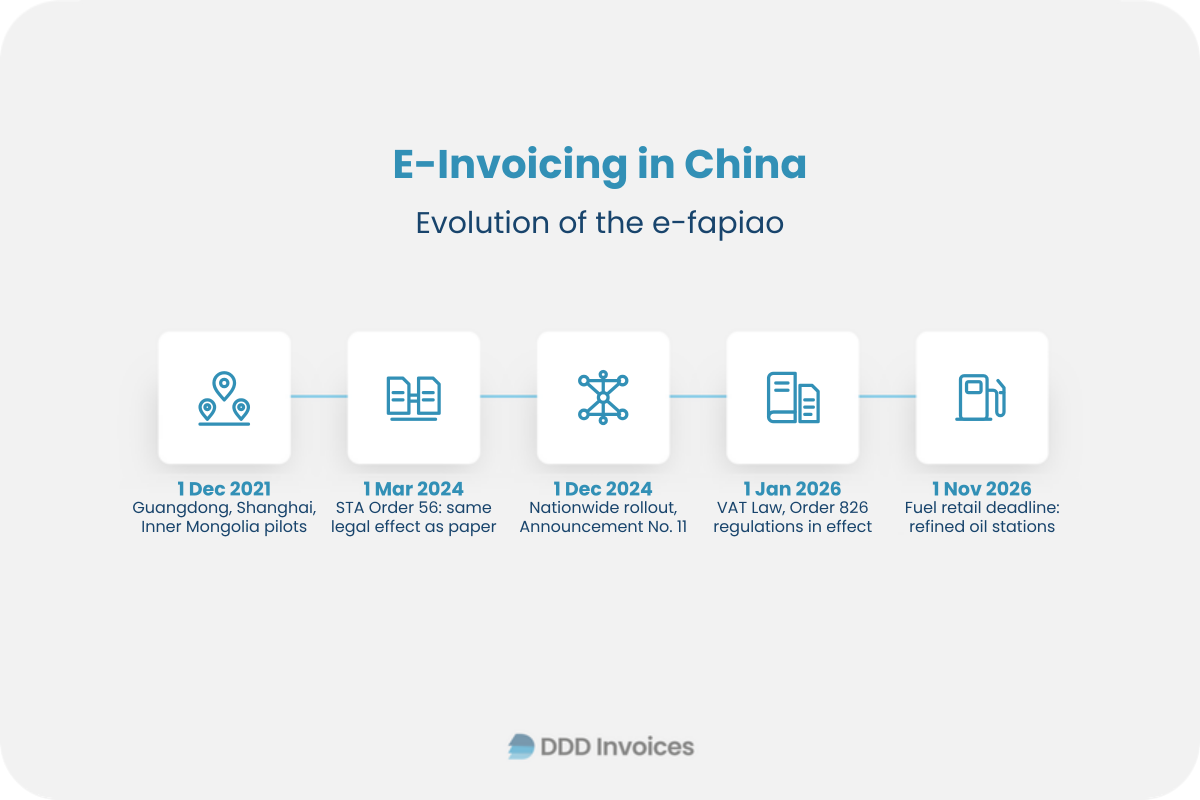
- December 1, 2021: pilots start in Guangdong, Shanghai and Inner Mongolia (STA rollout announcement).
- March 1, 2024: STA Order No. 56 gives e-invoices the same legal effect as paper.
- December 1, 2024: nationwide rollout under Announcement No. 11 of 2024.
- January 1, 2026: the VAT Law and its Implementing Regulations (Order No. 826) take effect.
- November 1, 2026: the fuel retail announcement deadline for refined oil stations.
B2G e-invoicing in China
There is no separate B2G mandate or deadline. Government buyers receive the same e-fapiao as any buyer and can verify them on the National VAT Invoice Verification Platform.
B2B e-invoicing in China
E-fapiao are open to all VAT taxpayers, with no electronic-only rule for B2B. Of six categories, the VAT special invoice shows VAT separately and is an input VAT deduction voucher. It cannot be issued to natural persons or for VAT-exempt sales (Order No. 826, Articles 11 and 37). Others cover the ordinary invoice, air and rail e-tickets, and vehicle sales.
Each e-fapiao is XML data with PDF and OFD versions, digitally signed when downloaded from the tax digital account (each taxpayer's invoice account) (STA interpretation). Fields cover number, date, parties, items, rate, tax and total. ERP-generated PDFs and scans are not e-fapiao.
- Register: for VAT and e-tax bureau access.
- Verify identity: pass real-person authentication (Announcement No. 11 of 2024).
- Check your quota: a monthly cap on invoiced amounts excluding VAT.
- Choose a channel: the platform, or Leqi with testing.
- Issue and deliver: each 20-digit e-fapiao goes out via the platform, email, QR code or download.
- Confirm purchases: buyers confirm purpose in the tax digital account before deducting input VAT.
B2C e-invoicing in China
B2C e-invoicing is not mandatory. Consumers receive an ordinary e-fapiao, viewable in the Individual Income Tax app.
In fuel retail, a third-party payment triggers an ordinary invoice automatically (Leqi interpretation). Stations must upgrade their point-of-sale systems or join a shared Leqi platform by November 1, 2026. No offline issuance mode appears in either announcement.
E-reporting and VAT compliance
China has no periodic e-reporting: invoice data reaches the STA at issuance and is checked against each VAT return.
Under the VAT Law, rates are 13%, 9%, 6% and 0% for exports. Small-scale taxpayers (sales up to RMB 5 million a year) use a statutory 3% levy rate. Returns are due within 15 days after each month or quarter, and Announcement No. 6 of 2026 revised return columns from February 1, 2026.
- Exports: zero-rated, with refund or exemption claims.
- Imported goods: customs collects VAT; its import VAT special payment letter is the deduction voucher.
- Imported services: the buyer withholds VAT, deducting it with the tax payment certificate.
Corrections and cancellations use a red-letter invoice. Once the original is confirmed, the counterparty confirms within 72 hours and the buyer reverses deducted input VAT.
Keep invoice stubs for 5 years (Invoice Measures, Article 28) and accounting archives 10 or 30 years (Order No. 79), as original electronic files.
E-fapiao penalties in China
Invoice fines reach RMB 500,000 under the Invoice Measures; filing and evasion fines follow the Tax Collection and Administration Law (TCAL).
Offence | Fine |
|---|---|
Not issuing, misissuing or not keeping invoices | Up to RMB 10,000 (Art. 33) |
False invoicing | Up to RMB 50,000 for amounts up to RMB 10,000, otherwise RMB 50,000 to 500,000 (Art. 35) |
Repeat or serious invoice violations | Public announcement (Art. 38) |
Late VAT return | Up to RMB 2,000, or RMB 2,000 to 10,000 if serious (TCAL Art. 62) |
Tax evasion | 50% to 5 times the unpaid tax (TCAL Art. 63) |
How DDD Invoices maps to China's requirements
With e-fapiao mandatory at each sale for fuel retailers by November 1, 2026, your billing needs a reliable link to the STA platform.
DDD Invoices gives you one API to issue, receive and archive compliant invoices across every country we support, so your ERP or billing software connects once and we keep each country's format, validation and deadline rules up to date. China is on our country coverage list as collecting interest, and talking to us is the fastest way to move it up the roadmap.
{{__CTA:TalkToUsCta__}}
FAQs
What is an e-fapiao in China?
An e-fapiao is a fully digitalized electronic invoice issued and numbered through the STA's Electronic Invoice Service Platform. It carries a 20-digit number and is issued as XML, with PDF and OFD versions also supported.
When is e-invoicing mandatory in China?
E-fapiao have been available nationwide since December 1, 2024, but paper invoices keep the same legal effect. Fuel retail is stricter, as stations must issue an e-fapiao at each sale by November 1, 2026.
How long must e-fapiao records be kept in China?
Invoice stubs must be kept for 5 years under Article 28 of the Invoice Measures. Accounting archives, which include invoices used as vouchers, are generally kept for 10 or 30 years.
Why are e-fapiao corrected with red-letter invoices?
An issued e-fapiao cannot be deleted, so returns, errors and discounts are reversed with a red-letter invoice. If the buyer already confirmed it, the other party has 72 hours to confirm the request.