
Cuba E-Invoicing: Digital Invoice Rules and Tax Reform Plans
Author
Bishma

Cuba has no confirmed mandatory e-invoicing regime, but the government has announced an (factura electrónica fiscal) electronic tax invoice as part of a wider tax reform. Businesses can already issue a digital invoice under Resolution 55/2021 of the Ministry of Finance and Prices.
No start date, scope or technical standard for the new electronic tax invoice has been published. Businesses should watch for ONAT announcements and keep structured, compliant invoice data.
Latest News
Embeds a monitoring pages group for this blog article
{{__MONITORING_PAGES_GROUP:blog_articles_600__}}On 13 October 2026, the tax authority ONAT explained measures 104 to 116, which aim to modernise and simplify the tax system. Its official communication says an electronic tax invoice has been established, with incentives for adopting it. It also says sales and services tax rebates will reflect the level of banked (electronic payment) operations.
President Miguel Díaz-Canel said Cuba will move toward a creditable VAT supported progressively by electronic invoicing, to avoid cascading taxation. These announcements set policy direction.
Is E-Invoicing Mandatory in Cuba?
Cuba has digital invoices, but no government-connected e-invoicing system yet. Resolution 55/2021 sets the issuing, distribution and data rules for the digital invoice. Entities with IT-based accounting systems can issue it digitally if it includes the mandatory data.
The tax reform aims to change this. Cuba’s sales and services taxes apply at every stage, with no credit between companies. A creditable VAT needs reliable invoice data, so the reform ties VAT to an electronic tax invoice.
No clearance, real-time reporting or central validation has been confirmed, and the new invoice’s model hasn’t been published. Wait for ONAT’s rules before assuming any model.
E‑Invoicing Timeline
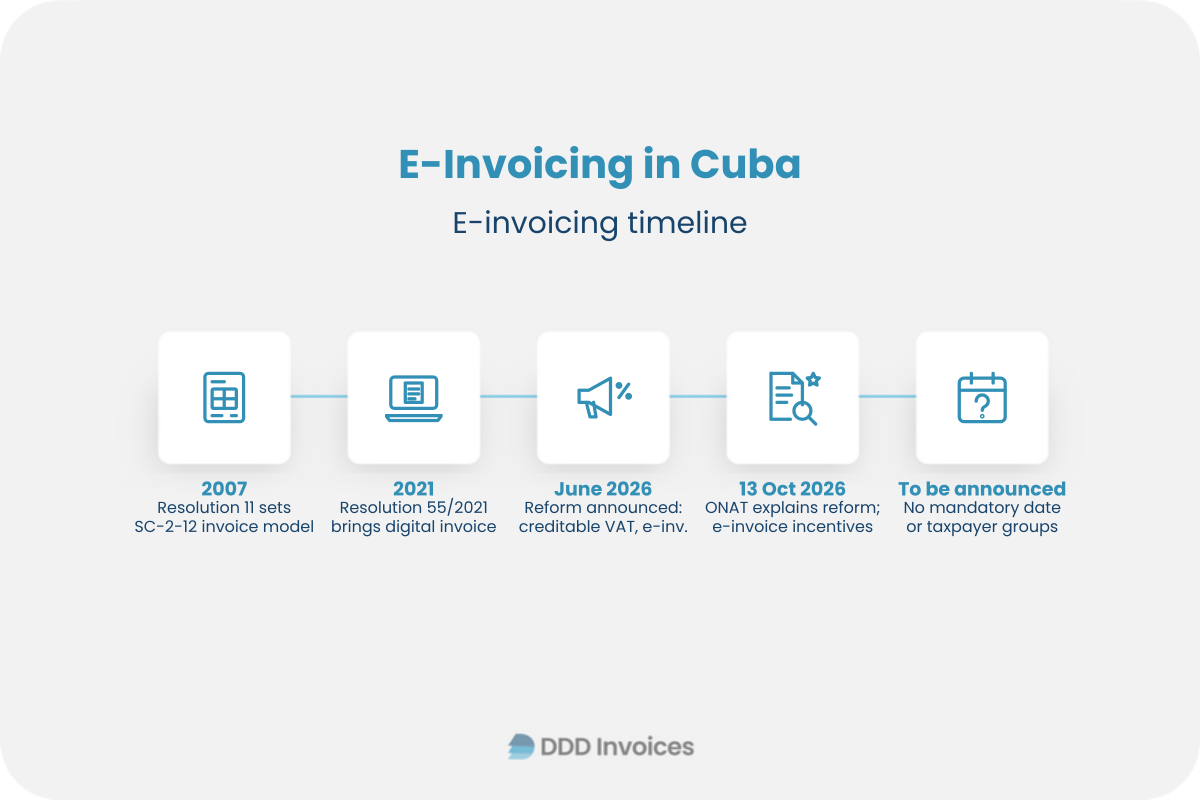
- 2007: Resolution 11 established the SC‑2‑12 invoice model.
- 2021: Resolution 55/2021 introduced the digital invoice.
- June 2026: The government announced its tax reform with a creditable VAT and the electronic tax invoice.
- 13 October 2026: ONAT explained the reform measures, including the electronic tax invoice and its incentives.
- To be announced: No mandatory start date or taxpayer groups have been published.
Who Is in Scope?
No taxpayer group is formally required to issue a government-connected e-invoice yet. Entities that use IT-based accounting systems may issue digital invoices. The reform’s incentives are aimed at encouraging adoption among taxpayers.
When the electronic tax invoice is regulated, expect scope to follow the VAT rollout, which starts with certain production and consumption chains. That is an inference, not an announcement. Businesses in those chains should prepare first.
B2G E‑Invoicing in Cuba
No B2G e-invoicing mandate has been identified in Cuba. Suppliers to state entities can issue the digital invoice under Resolution 55/2021 if they use IT-based accounting systems, and the invoice must include the mandatory data. The announced electronic tax invoice has no published scope or date, so keep your invoice data structured and watch ONAT announcements.
B2B E‑Invoicing in Cuba
No B2B e-invoicing mandate has been identified. Businesses can choose to issue the digital invoice under the SC‑2‑12 model, as long as they include the mandatory data and distribute it digitally. The reform’s creditable VAT will depend on reliable invoice data, so B2B invoicing is likely to be among the first areas affected. The government hasn’t confirmed when or how.
B2C E‑Invoicing in Cuba
No B2C e-invoicing obligation has been described. The reform includes a bonus on the sales and services tax based on banked sales levels. ONAT presented it on 13 October 2026 among measures 104 to 116. It is an incentive for electronic payments, not an invoicing rule. Retailers should keep issuing compliant receipts and wait for ONAT’s rules.
E‑Reporting and Tax Compliance in Cuba
Cuba has e-reporting in the form of periodic electronic tax filing. ONAT runs a Tax Portal where registered taxpayers file declarations and use online services. Legal entities must file the annual profits tax return digitally with an electronic signature, as required by Resolution 8/2024. It is due by 31 March, together with digital financial statements. Individuals with a digital signature can also file through the portal.
Penalties for Non‑Compliance
No e-invoicing penalty regime exists because no mandate has been confirmed. General tax obligations still apply, and ONAT administers them. Check the penalty provisions that accompany the electronic tax invoice rules once they are published.
Your E‑Invoicing Partner
Cuba’s electronic tax invoice is still taking shape, so preparation means clean, structured invoice data and flexible integrations. DDD Invoices helps businesses standardise invoicing workflows through one API connected to ERP, billing, accounting and POS systems.
It can retain transaction records and archive invoices. That helps teams keep audit-ready records now and prepare for future requirements.
{{__CTA:TalkToUsCta__}}
FAQs
Is e-invoicing mandatory in Cuba?
No mandate has been confirmed. The government has announced an electronic tax invoice with adoption incentives, but no date or scope has been published.
What is the electronic tax invoice?
It’s the factura electrónica fiscal announced in the 2026 tax reform. Its technical format and rules have not been published.
Can businesses issue digital invoices today?
Yes. Resolution 55/2021 sets the rules for digital invoices under the SC‑2‑12 model.
Does Cuba have VAT
VAT is being introduced gradually. It starts with certain production and consumption chains.
Who is the tax authority?
ONAT administers taxes, and the Ministry of Finance and Prices issues the rules.