
E-Invoicing in Dominica: Current Status and VAT Rules
Author
Ameera
Dominica is a small Caribbean island economy that trades in goods, tourism services and imports. Its Value Added Tax (VAT) runs through the Inland Revenue Division (IRD), under the Comptroller of Inland Revenue. The IRD also runs an online Tax eFiling System for returns.
Dominica has no nationwide structured e-invoicing mandate for B2B, B2C or B2G transactions. VAT-registered businesses must issue conventional tax invoices to registered customers and receipts to unregistered consumers. They must also file a VAT return for every tax period, with payment due on the 20th of the following month.
Latest news
Embeds a monitoring pages group for this blog article
{{__MONITORING_PAGES_GROUP:blog_articles_617__}}No e-invoicing mandate has been officially identified for Dominica. The IRD's VAT page lists the Value Added Tax Act 2005 (Act 7 of 2005) and its amendments as the governing rules. The latest listed amendment regulation is SRO 49 of 2016.
The IRD's online tax filing service only submits returns. It is not an invoice-clearance or e-invoicing platform. Treat any future change as "not yet confirmed" until the IRD publishes it.
What does e-invoicing in Dominica mean?
E-invoicing is the exchange of invoices as structured digital data, not paper or plain PDF files.
Dominica's VAT system relies on paper-style tax invoices, sales receipts and monthly returns. The VAT Act defines an "invoice" simply as a document notifying an obligation to pay (Act 7 of 2005, section 2). No clearance or post-audit e-invoicing model has been confirmed.
e-invoicing timeline
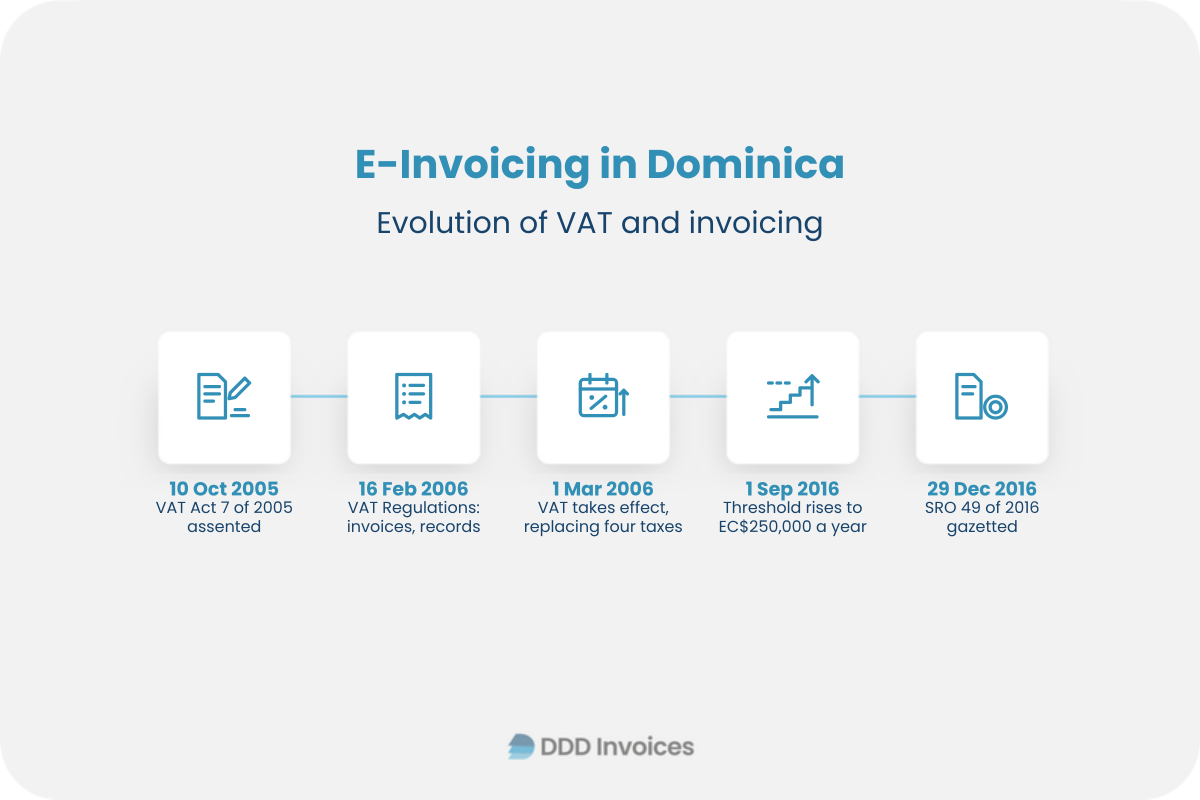
- October 10, 2005: The President assented to the Value Added Tax Act, Act 7 of 2005. It was gazetted on October 20, 2005.
- February 16, 2006: The Value Added Tax Regulations 2006 (SRO 9 of 2006) were gazetted. They include rules on tax invoices, credit notes and records.
- March 1, 2006: VAT came into effect. It replaced the Consumption Tax, Sales Tax, Hotel Occupancy Tax and Entertainment Tax.
- September 1, 2016: The VAT registration threshold rose to EC$250,000 a year for all business categories. SRO 49 of 2016 was gazetted on December 29, 2016.
B2G e-invoicing in Dominica
No separate B2G e-invoicing mandate has been identified. The State, agencies and local authorities are covered by the same VAT Act. They must register when they carry out a taxable activity such as auctions, equipment hire, space rental or drug sales (sections 6 and 11).
A supplier to a public body issues the same tax invoice or receipt as for any other customer.
B2B e-invoicing in Dominica
B2B e-invoicing is not mandatory. A registered supplier making a taxable supply to a registered recipient must give an original tax invoice, in the form set by regulations (section 29, Act 7 of 2005).
- The supplier issues only one tax invoice per taxable supply.
- If the recipient asks in writing within 60 calendar days, the supplier has 14 calendar days to comply.
- A lost original can be replaced by a copy clearly marked "copy" (Act 4 of 2006).
Regulation 14 of SRO 9 of 2006 covers tax invoices and sales receipts. A compliant tax invoice should show:
- supplier name and VAT taxpayer account number;
- customer identification, where applicable;
- invoice number and date;
- description of the supply;
- taxable value, VAT rate and VAT amount;
- total consideration.
Credit and debit notes: Tax credit and debit notes follow section 30 of the Act and regulation 15. Post-sale adjustments and bad debts follow section 27.
Registration: VAT registration is required above EC$250,000 of annual taxable supplies. Both taxable and zero-rated supplies count towards that figure. Exempt supplies do not.
Imports and exports: Import VAT is paid by the importer. For imported services, the recipient pays the VAT. Qualifying exports may be zero-rated when the documentation rules in regulations 101 and 102 are met.
Numbered onboarding steps for a business starting out:
- Check the threshold: Compare your taxable turnover with EC$250,000.
- Register: Submit the VAT registration form to the IRD.
- Configure invoices: Set up numbering, VAT rates and the required particulars.
- Test and file: Check a sample month of sales and purchases against your return.
B2C e-invoicing in Dominica
B2C e-invoicing is not mandatory. A registered supplier selling to an unregistered customer must provide a sales receipt for the taxable supply (section 29(7), Act 7 of 2005).
E-reporting, VAT compliance and archiving
Dominica has periodic reporting. Filings are made to the Inland Revenue Division (IRD), and Social Security schedules go to the Social Security Board.
- Monthly VAT: Returns and payment are due by the 20th of the following month.
- Monthly payroll: Employers file PAYE returns and Social Security schedules. Social Security is due by the 15th of the following month.
- Self-employed: Quarterly PAYE advance instalments.
- Corporate income tax: Three instalments of 25%, 35% and 40%, by the end of Q1, Q2 and Q3/year-end.
- Annual returns: The T.D.5 payroll return and the corporate tax return are due by March 31.
The VAT Act sets the period at seven years after the end of the tax period the records relate to. This covers tax invoices, credit and debit notes, customs documents and accounting records. They must be kept in Dominica, and the Comptroller can approve earlier disposal in writing.
Penalties for non-compliance in VAT
Late filing and payment penalties are on the IRD VAT page, and the Act's civil penalties are in Part XIV.
Offence | Fine |
|---|---|
Return not filed by the 20th | $100 for each month or part of a month until filed |
VAT not paid by the 20th | 10% late payment penalty |
Unpaid tax | 1% interest per month or part of a month |
Promoter of public entertainment without Comptroller approval | $10,000, or two years in prison, or both, plus 15% of printed ticket value |
Invoice and record failures (sections 83, 86) | Amounts not yet confirmed |
Temporary closure of premises (section 91) | Available under the Act; conditions not yet confirmed |
Your trusted partner for e-invoicing
Dominica requires conventional VAT invoices, receipts and monthly returns, with no e-invoicing mandate. DDD Invoices offers a unified e-invoicing API for software providers and businesses across more than 30 countries. It can issue, receive and archive compliant invoices.
Dominica is not currently listed on the coverage page, so support is pending. We will update this page if the IRD announces a mandate.
{{__CTA:TalkToUsCta__}}
FAQs
Is e-invoicing mandatory in Dominica?
No nationwide structured e-invoicing mandate has been officially identified. VAT-registered businesses issue tax invoices and receipts under the VAT Act.
When are VAT returns due in Dominica?
Registered persons file a return for each tax period, even when no tax is payable. Payment is due by the 20th of the following month.
Who must register for VAT in Dominica?
Businesses with annual taxable supplies above EC$250,000 must register with the IRD. Taxable and zero-rated supplies count towards that figure.
Why is online tax filing not e-invoicing?
Online filing submits the VAT return. E-invoicing exchanges structured invoice data. Dominica's IRD forms cover returns, not invoice transmission.

E‑invoicing in Malta is primarily encouraged in the public sector, where public entities must be able to receive electronic invoices.

E‑invoicing is the process of sending and receiving structured e‑invoices. See how it works and how it improves tax control and automation.
Discover what is electronic tax reporting and how it benefits your business. Learn to comply with digital mandates and improve revenue.