
E-Invoicing in the Dominican Republic: e-CF & DGII Rules 2026
Author
Shamyudha

The Dominican Republic ran a voluntary electronic invoicing scheme from 2019 before making it law in 2023. The Dirección General de Impuestos Internos (DGII) runs the system, and e-invoicing in Dominican Republic means issuing a digitally signed XML, the comprobante fiscal electrónico (e-CF), which DGII validates before it has tax effect.
E-invoicing in Dominican Republic is mandatory for every taxpayer registered in the RNC. Large national taxpayers had to comply by May 15, 2024, large local and medium taxpayers by November 15, 2025, and small, micro and unclassified taxpayers by November 15, 2026. Every invoice must be a signed XML e-CF validated by DGII, and from November 1, 2026 large local and medium taxpayers may issue nothing else.
Latest news
Embeds a monitoring pages group for this blog article
{{__MONITORING_PAGES_GROUP:blog_articles_597__}}On August 26, 2026 DGII published Aviso 14-26 on exclusive e-CF issuance: large local and medium taxpayers issue only type E documents from November 1, 2026. Their type B sequences are valid through October 31, 2026 (Article 55 of the regulation), afterwards only in a declared contingency.
On May 6, 2026, Aviso 06-26 gave small, micro and unclassified taxpayers an automatic six-month extension, from May 15 to November 15, 2026, after which Law 32-23 sanctions apply.
{{__CTA:IntegrationStepsCta__}}
Why has the Dominican Republic adopted e-invoicing?
The Dominican Republic adopted e-invoicing to strengthen tax transparency, improve compliance and reduce businesses’ paperwork and operating costs. Under Law 32-23, DGII validates digitally signed XML documents called comprobantes fiscales electrónicos (e-CF). The system also supports automated invoice processing and reduces document loss and storage costs.
The evolution of e-invoicing in Dominican Republic
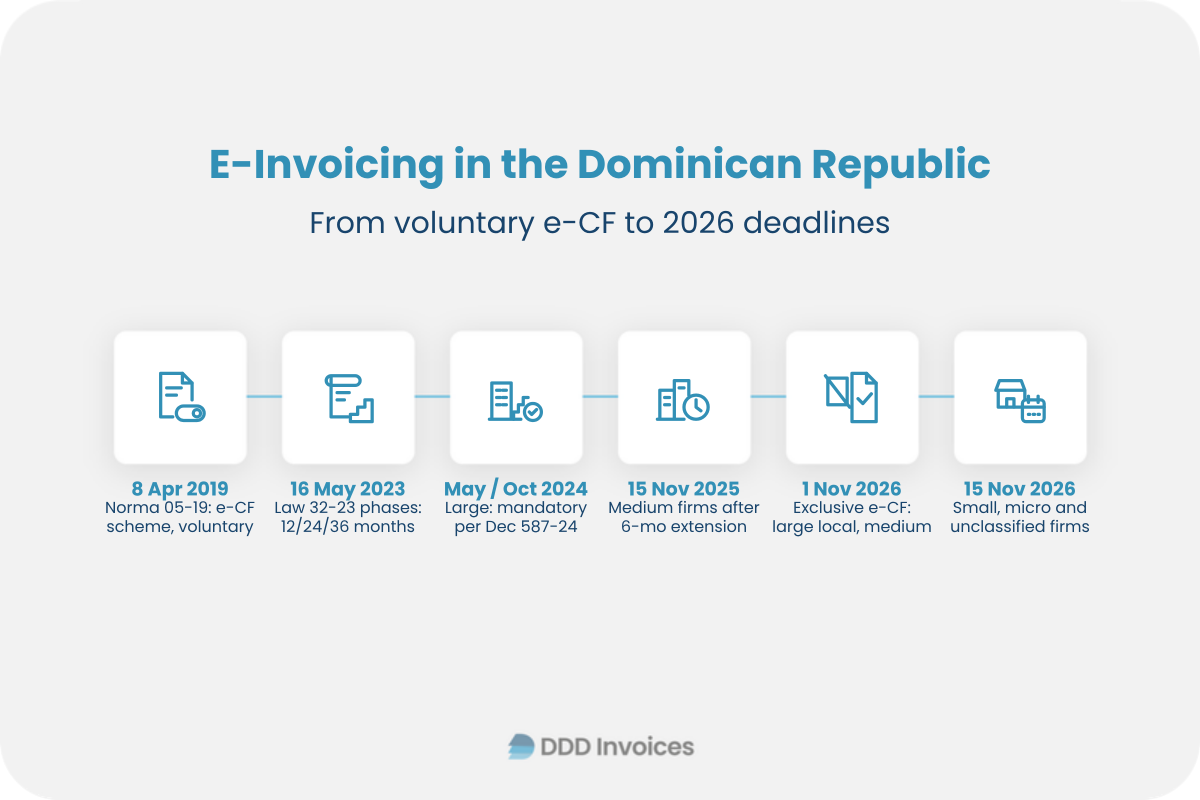
- April 8, 2019: Norma General 05-19 creates the e-CF; issuance is voluntary.
- May 16, 2023: Law 32-23 sets a 12, 24 and 36-month calendar by taxpayer class.
- May 15, 2024: Large national taxpayers become mandatory, phased in three groups under Aviso 08-23.
- October 2024: Decree 587-24 issues the implementing regulation.
- November 15, 2025: Large local and medium taxpayers, after a six-month extension under Aviso 12-25.
- November 1, 2026: Exclusive e-CF issuance for large local and medium taxpayers under Aviso 14-26.
- November 15, 2026: Small, micro and unclassified taxpayers under Aviso 06-26.
B2G e-invoicing in Dominican Republic
Invoices to public bodies are mandatory e-CF of type E45 Comprobante Electrónico Gubernamental, sent to DGII like any other document. State institutions themselves went electronic on May 15, 2024 (large national) and May 15, 2026 (the rest), under Aviso 16-23. The institution verifies the e-NCF via the DGII status query and sends its commercial approval; no supplier is exempt.
B2B e-invoicing in Dominican Republic
B2B invoices are mandatory e-CF for every class from its deadline; new RNC registrations get 120 days. The core document is the factura de crédito fiscal, adjusted with debit and credit notes. Self-issued types cover purchases from unregistered sellers, minor expenses and special regimes; exports use, qualifying payments abroad. Imports rest on DGA customs documentation, not e-CF.
Issuing means sending the signed XML to DGII, then delivering it to electronic receivers or a printed representation to others. The receiver acknowledges automatically, then sends commercial approval or rejection to DGII and the issuer (Article 20 of Law 32-23), so DGII acceptance and buyer approval are separate events for issued e-invoices and received e-invoices alike. Unused e-NCF ranges are cancelled through a web service; issued documents are corrected with notes, never cancelled.
The DGII guide to becoming an electronic issuer sets the steps:
- Certificate: obtain a digital certificate from an INDOTEL-authorised entity.
- Application: submit form FI-GDF-016 in the Oficina Virtual.
- Software: in-house development, a DGII-certified provider or the Facturador Gratuito
- Testing: pass the data, simulation and communication test sets and file the sworn statement.
- Certification: receive issuer status and request e-NCF sequences.
B2C e-invoicing in Dominican Republic
B2C e-invoicing is mandatory, with the final implementation deadline on November 15, 2026.Every consumer sale, in store or online, needs an E32 factura de consumo. Invoices of DOP 250,000 or more go to DGII in full with the buyer's identification. Below that, the seller sends a Resumen de Factura de Consumo Electrónica (RFCE), and DGII is explicit that each summary covers exactly one invoice, never a daily total. The seller keeps the XML and gives the consumer a printed representation with a QR code and código de seguridad.
POS systems that lose connectivity may issue e-CF offline and transmit within 72 hours. The e-CF itself is the fiscalization layer for the till; there is no fiscal-device regime. If e-CF cannot be issued at all, the contingency procedure allows type B paper for up to 15 calendar days, declared in the Oficina Virtual, with replacement e-CF sent to DGII within 30 calendar days of exit. If DGII is down, issuers store and resend later.
E-reporting and VAT compliance
The Dominican Republic has periodic reporting and no SAF-T. VAT is the ITBIS, 18% with a 16% reduced rate, declared monthly on form IT-1 and paid by the 20th of the following month. E-CF never replace this return.
Formats 606 (purchases) and 609 (payments abroad) remain due; issuers invoicing 100% electronically need not file 607 and 608, a position DGII calls provisional. Issued and received XML stay archived for 10 years under Article 50(h) of the Tax Code, accessible for DGII audits through a compliant archiving service.
Penalties for non-compliance
Article 26 of Law 32-23 lists 16 infractions, sanctioned under Article 257 of the Tax Code with 5 to 30 minimum salaries.
Offence | Sanction |
|---|---|
Not issuing e-CF, invalid format, late submission | 5 to 30 minimum salaries, provisional closure, NCF inactivation |
Late ITBIS payment (from July 2026) | 3% surcharge plus 1.10% monthly interest |
Tax evasion | Up to 2x the tax omitted, closure where applicable |
Fraudulent invoices (Art. 30) | 1 to 5 years prison, 2x to 4x invoice value, definitive closure |
Your trusted partner for e-invoicing
Every Dominican business must issue DGII-validated e-CF. DDD Invoices gives software providers and businesses one API to issue, receive and archive compliant e-invoices across markets, rule changes included. Dominican Republic support is pending; ERP integrators can register interest now.
{{__CTA:TalkToUsCta__}}
FAQs
What is an e-CF in the Dominican Republic?
An e-CF is a digitally signed fiscal document in DGII’s XML format, identified by an authorised e-NCF and verifiable through its printed representation.
Why is the Dominican Republic making e-invoicing mandatory?
The mandate strengthens tax transparency and compliance while helping businesses automate invoice processing, reduce printing and storage costs, and prevent document loss.
When must businesses implement e-invoicing in the Dominican Republic?
Large local and medium taxpayers issue only e-CF from November 1, except during authorised contingencies. Other groups must comply by November 15, 2026.
What tax reporting remains compulsory after adopting e-CF?
Monthly IT-1 filing and ITBIS payment remain due by the following month’s 20th. Formats 606/609 apply where required; qualifying electronic issuers receive 607/608 relief.