
E-Invoicing in Honduras: Current SAR and CAI Requirements
Author
Shamyudha

E-invoicing in Honduras is legally ready but not yet switched on. Acuerdo 481-2017 already defines electronic invoices, and the Servicio de Administración de Rentas (SAR) can require them from any taxpayer by direct notice.
E-invoicing in Honduras is not mandatory nationwide yet. Every business and public institution that sells goods or services must issue SAR-authorised fiscal documents under the Régimen de Facturación (Acuerdo 481-2017, in force since October 2017). Each invoice needs a CAI, a valid number range and an issue deadline. It can come from a certified printer or from the company’s own system, which includes an optional electronic mode.
Latest news
Embeds a monitoring pages group for this blog article
{{__MONITORING_PAGES_GROUP:blog_articles_583__}}No official source confirms a nationwide e-invoicing rollout date. In July 2026, SAR updated its Régimen de Facturación guides covering registration in the regime, print authorizations for printers and self-printers, and notification of unused fiscal documents. Returns, including the ISV return (Code 201), are filed through SAR's Oficina Virtual with the taxpayer's RTN and password.
What is e-Invoicing and why is Honduras adopting It?
In Honduras, the core control is the CAI (Clave de Autorización de Impresión). SAR assigns a CAI for each emission point and document type, together with an authorised number range and a deadline of up to one year. Buyers must check that the documents supporting their ISV credit are valid (Article 39).
Acuerdo 481-2017 already defines e-invoicing. In this mode, the taxpayer’s system connects to SAR and each document gets a CAEE code (Articles 4 and 54). Under Article 57, SAR can notify taxpayers that they must switch to it. For now, Honduras is closer to a fiscalization model than full e-invoicing.
The evolution of e-Invoicing in Honduras
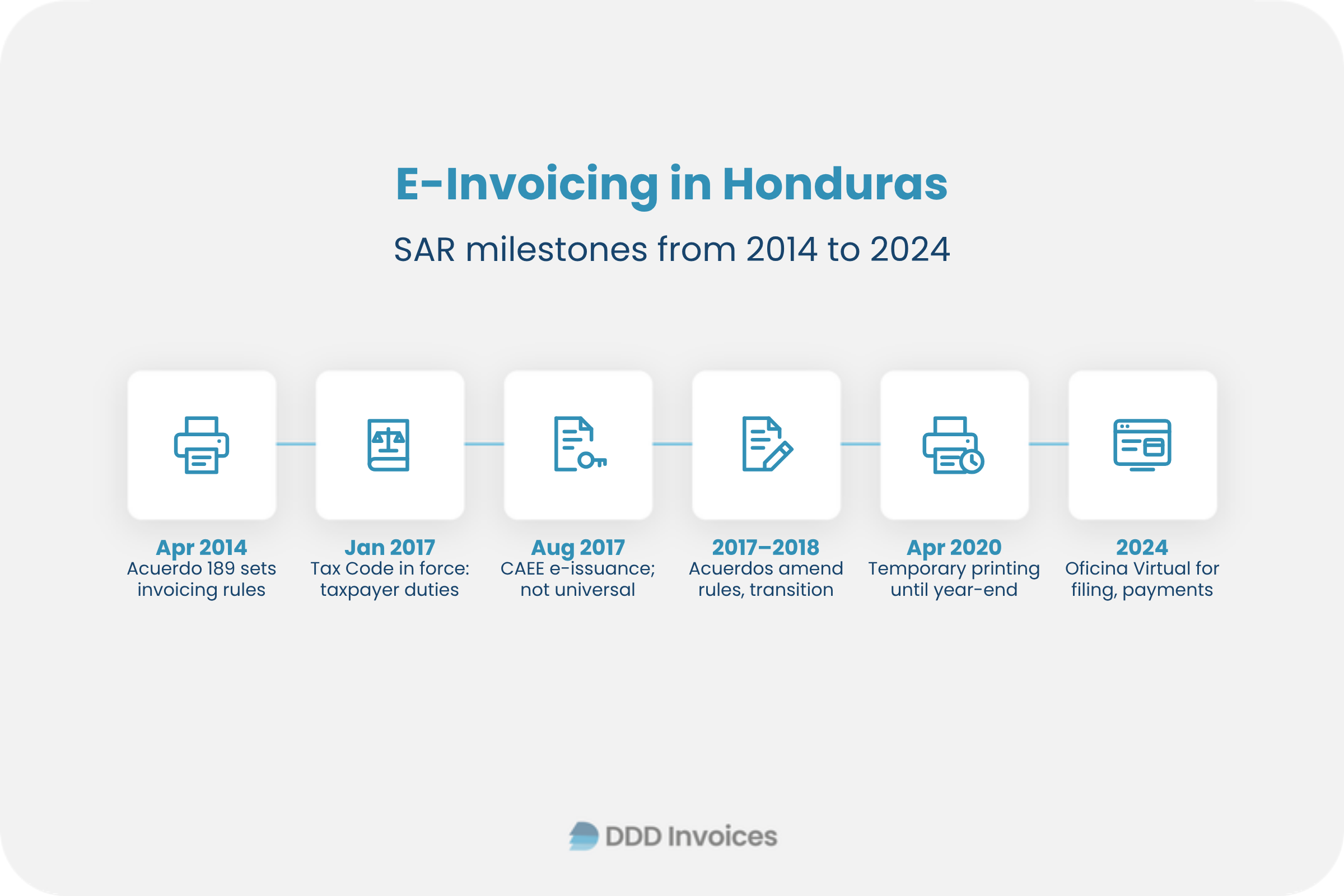
- April 2014: Acuerdo 189-2014 establishes the invoicing framework, covering invoices, fiscal documents and registered printers.
- January 2017: Código Tributario (Decreto 170-2016) takes effect, setting taxpayer obligations and tax administration rules.
- August 2017: Acuerdo 481-2017 replaces the 2014 rules and provides for electronic issuance using CAEE authorisation codes, not a universal e-invoicing mandate.
- 2017–2018: Acuerdos 609-2017, 725-2018 and 817-2018 amend invoicing rules and transition arrangements.
- April 2020: Acuerdo 231-2020 temporarily authorises fiscal-document printing for affected taxpayers through year-end.
- 2024: SAR introduces its new Oficina Virtual for online tax filing, payments and other taxpayer services.
B2G electronic Invoicing in Honduras
Public institutions follow the same Régimen de Facturación as companies, unless a special law says otherwise (Article 3). Suppliers issue a standard CAI invoice with the institution’s RTN. There is no government invoicing platform and no mandatory XML format.
For exempt purchases, the invoice shows the Orden de Compra Exenta number or the exoneration registry number. Public bodies that withhold ISV file the public sector ISV withholding return (Code 116). The supplier then receives a comprobante de retención.
B2B electronic Invoicing in Honduras
A B2B invoice supports the buyer’s ISV credit. It must therefore include:
- the buyer’s name and RTN
- exempt, exonerated and zero-rated amounts
- ISV by rate (15% or 18%)
Invoices in another currency must show the exchange rate on the issue date. The original goes to the customer and the copy stays with the issuer. Each document carries a 16-digit number (NNN-NNN-NN-NNNNNNNN) that identifies the establishment, emission point, document type and sequence.
- Documents: facturas, credit and debit notes, guías de remisión and comprobantes de retención. Recibos por honorarios, boletas de compra and donation certificates each have their own rules.
- Corrections: documents with errors are marked “ANULADA” and kept. Credit notes cancel sales, accept returns or grant later discounts. Debit notes record adjustments. Both reference the original CAI and number, like a storno invoice.
- Unused documents: report them to SAR within 10 business days of expiry or a system failure.
- Contingency: self-printers may keep pre-printed backup documents from a certified printer.
- Withholding: large taxpayers withhold ISV on freight, cleaning, printing, security and rental services.
- Cross-border: exports are invoiced at a zero rate. Import documents count as “other vouchers” that can support ISV credit.
B2C e-Invoicing in Honduras
Every sale needs a fiscal document, even if it is exempt or free. Consumer invoices show the buyer’s name and ID or the legend “CONSUMIDOR FINAL”. Above L10,000, the buyer must be identified; SAR can change this threshold. Sales of up to L50 can be grouped into one end-of-day document, except on cash registers and computerised systems.
Retailers can also issue:
- Tickets, only from SAR-registered cash registers with fiscal memory and an audit tape. Any correction needs the original ticket.
- Facturas prevaloradas, pre-printed fixed-price invoices for mass-consumption sales such as events.
E-reporting and VAT compliance
Honduras uses periodic reporting. Taxpayers report through returns filed online in SAR's Oficina Virtual with their RTN and password.
- ISV return (Form 201): filed and paid within the first 10 calendar days of the following month (SAR guide).
- DMC (Form 527): a monthly list of purchase documents, filed only by taxpayers who are obliged to (SAR guide).
- Withholding returns (DMR): filed only by withholding agents, within the first 10 calendar days of the following month.
Fiscal documents, including voided ones, must be kept in order for the prescription period set in the Código Tributario.
What happens if businesses don't comply?
Invalid invoices lose their tax value, and SAR can restrict authorisations and apply Código Tributario sanctions.
- Invoices without a valid CAI do not support ISV credit or income tax deductions.
- SAR can limit or cancel authorisations because of poor compliance or altered documents.
- The Código Tributario sanctions selling without documents during a system failure, failing to report unused documents, and late DMC filings (Article 160).
Your trusted partner for e-Invoicing
Honduras requires CAI-authorised fiscal documents for every sale. E-invoicing with a CAEE is already in the law but still optional, and SAR can make it mandatory by direct notice.
DDD Invoices gives software providers and businesses one e-invoicing API for compliant invoicing and secure archiving across the countries we cover. We track regulatory changes for you, so your integration stays ready when the rules change.
Displays a content card with title, subtitle, list/body, and action button
{{__CTA:GenericCtaJson:{"type":"content","contentCta":{"layout":"cardList","title":"Talk to us!","subtitleHtml":"Still have questions?","button":{"href":"https://calendly.com/ddd-invoices/30min-intro","label":"Book a free 30min call","color":"white"},"bodyHtml":"In the <strong>30min free call</strong> we will discuss:","listHtml":"<ul><li><strong>your requirements</strong> in invoicing</li><li>how integration works</li><li><strong>demo</strong> of the product</li><li>next steps</li></ul>"}}__}}FAQs
Is e-invoicing mandatory in Honduras?
No. SAR has not set a nationwide mandate. All businesses must issue CAI-authorised fiscal documents. Electronic emission with a CAEE is optional unless SAR notifies a taxpayer that it must switch.
What is a CAI in Honduras?
A code SAR generates to authorise a numbered range of fiscal documents for one emission point and document type.
How long is a CAI valid?
A CAI is valid for the period set in the authorization, up to one year. Once it expires, unused documents lose their validity and must be reported to SAR.
How do I correct an invoice in Honduras?
Mark the wrong document “ANULADA” and keep both copies, or issue a credit or debit note linked to the original CAI and number.