
E-Invoicing in Guyana: Current GRA and VAT Invoice Requirements
Author
Bishma

Guyana has no announced national e-invoicing mandate, and no format or clearance model has been published. Invoice duties sit in the VAT Act, No. 10 of 2005, Chapter 81:05. These rules set the wording and fields of a tax invoice, not a government e-invoice format or clearance platform.
The GRA does offer digital taxpayer services. They cover registration, return filing, account views and payments, but none of them is presented as invoice clearance or mandatory electronic invoicing.
Latest News
Embeds a monitoring pages group for this blog article
{{__MONITORING_PAGES_GROUP:blog_articles_598__}}The most recent GRA invoice guidance in the sources is a "Taxation Simplified" explainer updated on 2 February 2026. It restates the tax invoice and sales invoice rules.
{{__CTA:IntegrationStepsCta__}}
What Is E-Invoicing in Guyana?
Guyana has not published an e-invoicing system. Businesses follow the standard VAT invoice rules set out by the Guyana Revenue Authority (GRA).
Every VAT-registered business must issue a tax invoice for taxable supplies at 14% or 0%. The invoice must show the words “Tax Invoice”, the seller’s name, address and VAT number, a description of the goods or services, the quantity, the tax charged and total, and a unique serial number and date. For cash sales of G$10,000 or less, a simpler sales invoice may be used instead.
The GRA’s online portal, Optimal eServices, is for taxpayer administration. Users create an account to file returns and view their tax account statements. The GRA’s invoice guidance does not describe invoices being sent to the GRA for validation.
E-Invoicing Timeline
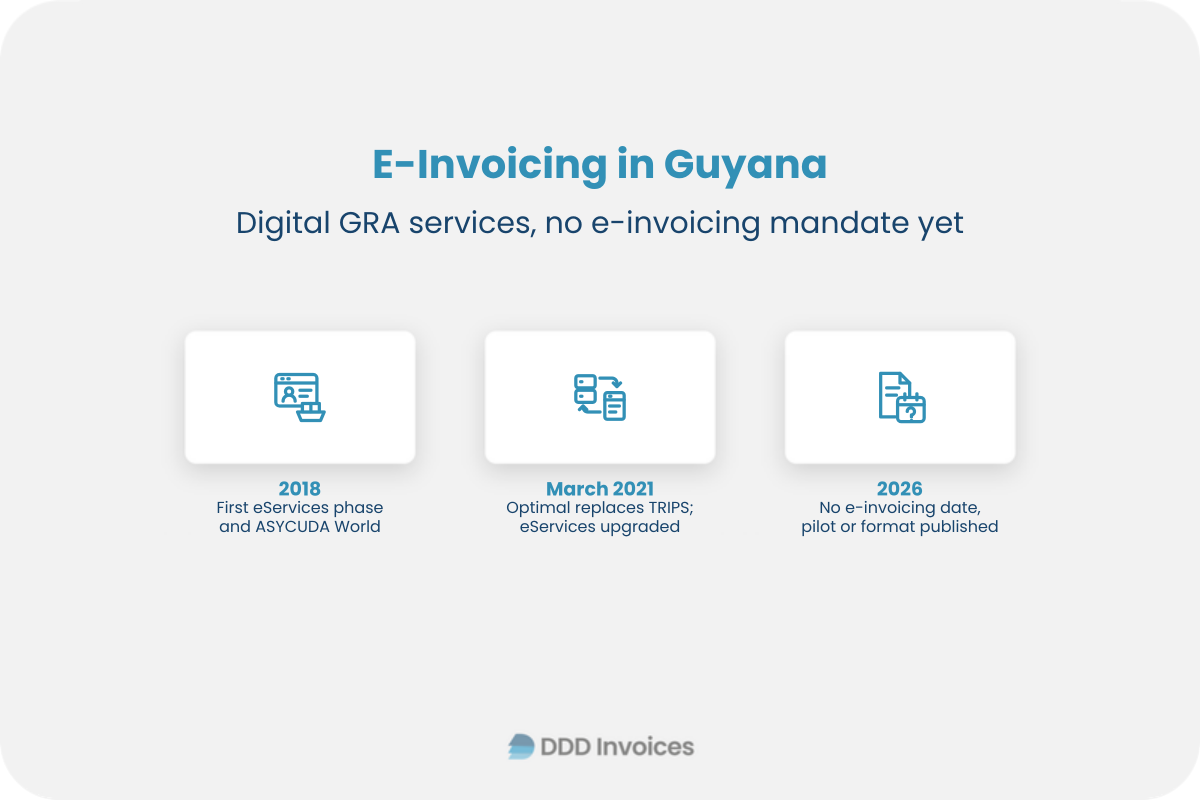
- 2018: The GRA launched the first phase of eServices and ASYCUDA World for online tax and customs transactions.
- March 2021: The GRA replaced TRIPS with the Optimal Revenue Management System and upgraded eServices.
- 2026: No e-invoicing implementation date, pilot or format has been published.
B2G E-Invoicing in Guyana
B2G e-invoicing does not exist in Guyana. Suppliers to government bodies issue standard VAT tax invoices, and the contract or tender sets the invoicing, purchase-order, delivery and payment terms.
A VAT-registered supplier must show the words “Tax Invoice”, its own name, address and VAT number, a description, the quantity, the tax and total, and a unique serial number and date. The government body is the buyer, so its name and address should appear as the recipient.
B2B E-Invoicing in Guyana
B2B e-invoicing is not mandatory. Businesses may send invoices by email or accounting software by agreement, which is a voluntary commercial practice. The compliance point is a correct tax invoice, including the buyer's VAT details where the buyer is registered.
B2C E-Invoicing in Guyana
B2C e-invoicing does not exist in Guyana. Retailers and other consumer-facing businesses don’t have to use fiscal devices, issue e-receipts or report sales to the Guyana Revenue Authority(GRA) in real time.
VAT-registered businesses must still issue a tax invoice for taxable sales to consumers. For cash sales of G$10,000 or less, a simpler sales invoice may be used instead. Businesses must also keep their VAT records in Guyana for seven years after the end of the relevant tax period.
E-Reporting and Tax Compliance
Guyana has e-reporting. VAT-registered businesses file a VAT return for each tax period, which is one calendar month. The return is due by the 21st of the following month, or the next business day if the 21st is a holiday. Taxpayers file through GRA eServices, the Guyana Revenue Authority’s online portal.
Penalties for Non-Compliance
Guyana has no e-invoicing penalty, but VAT invoice, record-keeping and filing failures carry fines. All amounts are in Guyana dollars (G$).
- Failing to provide a tax invoice: A registered person who knowingly or recklessly fails to provide a required tax invoice faces a fine of up to G$15,000 and up to six months’ imprisonment.
- Failing to keep records: Knowingly or recklessly failing to keep proper records carries a fine of up to G$200,000 or 5% of the tax assessed, whichever is greater. A separate civil penalty of G$100 per day applies while the failure continues, unless the person has been convicted for the same act.
- Late VAT return: GRA says the greater of G$1,000 or 10% of tax payable, assessed per month or part of a month
Your E-Invoicing Partner
Guyanese businesses need accurate tax invoices, consistent numbering and a secure archive, even without an e-invoicing mandate. VAT records must be kept in Guyana for seven years after the tax period ends.
DDD Invoices is an API-first platform that lets business software issue, receive, archive and manage locally compliant invoices through one integration. DDD invoices can help centralise billing data, manage corrections and credit notes, and retain audit-ready records. Any local setup should be checked against current GRA guidance.
{{__CTA:TalkToUsCta__}}
FAQs
Who must issue e-invoices in Guyana?
No one. No national e-invoicing mandate has been announced.
What is the GRA eServices portal?
It is a tax filing portal run by the Guyana Revenue Authority (GRA). It is not an invoice platform, so Guyana has no e-invoicing portal.
Which format is required, such as Peppol or XML?
None. No e-invoicing format has been published.
What must a Guyanese tax invoice contain?
The words "Tax Invoice", the seller's details and VAT number, a description, the quantity, the tax and total amounts, a unique serial number and the date.