
E-Invoicing in Haiti: Invoice Rules and DGI Requirements
Author
Bishma

Haiti has no mandatory e-invoicing system as of 27 December 2026. Businesses charging the turnover tax (TCA) must issue invoices with the mandatory particulars set by the new Fiscal Code, which took effect on 1 October 2026.
There is no DGI platform, no XML format and no clearance. Invoices are not validated electronically by the tax authority. Treat the rules below as ordinary invoicing duties, and check the official Code for article-level detail.
Latest News
Embeds a monitoring pages group for this blog article
{{__MONITORING_PAGES_GROUP:blog_articles_601__}}The Code has two parts, the General Tax Code and the Book of Fiscal Procedures, and entered into force on 1 October 2026. The DGI had announced that the Code’s implementation was planned for that date.
What Is E-Invoicing in Haiti?
Haiti has no e-invoicing regime as of 27 October 2026. Invoices follow the standard TCA rules. Haiti's tax administration is digitising in other ways. For example, the MEF, DGI and customs launched the DSI Connect platform on 1 July 2025 to centralise fiscal data. It is a data platform, not an invoicing system.
Timeline
- 19 December 2022: The previous Fiscal Code decree is adopted.
- 1 July 2025: DSI Connect goes live.
- 30 September 2026: The new Fiscal Code decree is published.
- 1 October 2026: The Code enters into force.
Who Is in Scope?
E-invoicing in Haiti has no scope to define yet, because no e-invoicing regime exists. Businesses issue invoices under the general tax rules set out in the Fiscal Code, and the DGI is the authority that administers them.
B2G in Haiti
As of 27th December 2026, there is no B2G e-invoicing rule. Suppliers to public bodies follow the same TCA invoice rules as other businesses. Each contract or tender may add its own requirements, such as submission format or supporting documents. DSI Connect links tax and customs data, but it is not an invoicing channel for suppliers.
B2B in Haiti
B2B sales follow the standard invoice requirements for TCA taxpayers, and no e-invoicing is mandated.
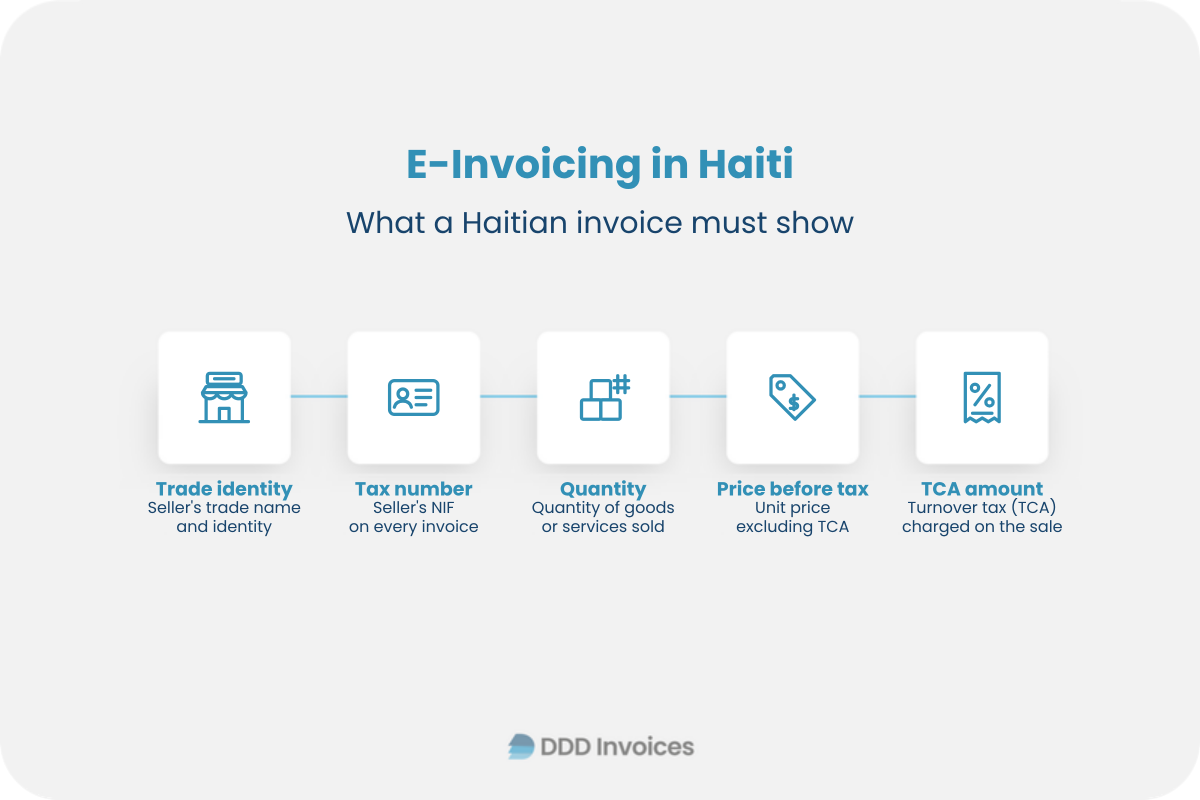
An invoice shows:
- the seller’s trade identity
- its tax number (NIF)
- the quantity sold
- the price before tax
- the TCA amount
B2C in Haiti
Haiti has no mandatory e-invoicing system for B2C retail. TCA-registered retailers follow the standard invoice rules.
E-Reporting and Tax Compliance
E-reporting means sending transaction or invoice data to the tax authority electronically on a periodic or real-time basis, and Haiti has no such requirement. Businesses do not transmit invoice data to the DGI.
Penalties for Non-Compliance
Haiti has no e-invoicing regime, so it has no e-invoicing-specific penalties. Mistakes on invoices and late or missing returns are handled under the general sanctions in the Fiscal Code.
Your E-Invoicing Partner
Haiti is modernising its tax administration. DDD Invoices tracks DGI and MEF announcements, so your business is ready when a format and a date are set.
Today, invoices follow the standard TCA rules, and there is no platform or mandate to connect to. When Haiti announces an e-invoicing framework, DDD Invoices will help you:
- Map your invoice data to the official format.
- Connect your systems to the required platform.
- Meet the deadlines and compliance rules.
Until then, we recommend keeping your invoice data accurate, your numbering consistent and your records organised. That groundwork makes any future switch faster and cheaper.
{{__CTA:TalkToUsCta__}}
FAQs
Who must issue e-invoices in Haiti?
No one. E-invoicing is not mandatory in Haiti.
Who still has to issue invoices?
TCA taxpayers must still issue invoices that include the mandatory particulars under the new Fiscal Code.
What do those particulars include?
Reports on the Code list the seller’s trade identity, its tax number (NIF), the quantity sold, the price before tax and the TCA amount. Confirm this against the official Code text.
When did the new Fiscal Code start?
It entered into force on 1 October 2026. The DGI’s July 2026 news item said implementation was planned for that date.[gouv]
Where can I read the Code?
The Code is published on the MEF and DGI sites.