
E-Invoicing in Maldives: MIRA's Upcoming System and GST Invoice Rules
Author
Bishma

E-invoicing in Maldives is still at the planning stage. In June 2026, the Maldives Inland Revenue Authority (MIRA) began an e-invoicing mission funded by the Asian Development Bank (ADB). Meanwhile, MIRA administers Goods and Services Tax (GST) under the GST Act, Law No. 10/2011, including a separate tourism GST (TGST).
E-invoicing is not mandatory in the Maldives, and MIRA has published no go-live date, format or model. GST-registered businesses must issue a tax invoice or receipt within 3 days of each supply. From January 1, 2027, all registered businesses must file GST returns through MIRAconnect.
Latest news
Embeds a monitoring pages group for this blog article
{{__MONITORING_PAGES_GROUP:blog_articles_627__}}A government bill submitted on October 18, 2026 would end this charge and refund tax collected. It is at committee stage on MIRA's tax bills page, so current rules still apply.
{{__CTA:IntegrationStepsCta__}}
What is e-invoicing and why is the Maldives planning it?
E-invoicing means exchanging invoice data in a structured format that systems read automatically. MIRA's project sits in its digital transformation roadmap, aimed at automating tax compliance and curbing evasion. MIRA has said the system will let it monitor transactions and documents directly, linking taxpayer platforms to its systems using international models. Preliminary work began in mid-2025, targeting completion in 2026, but no dates are confirmed.
The evolution of e-invoicing in the Maldives
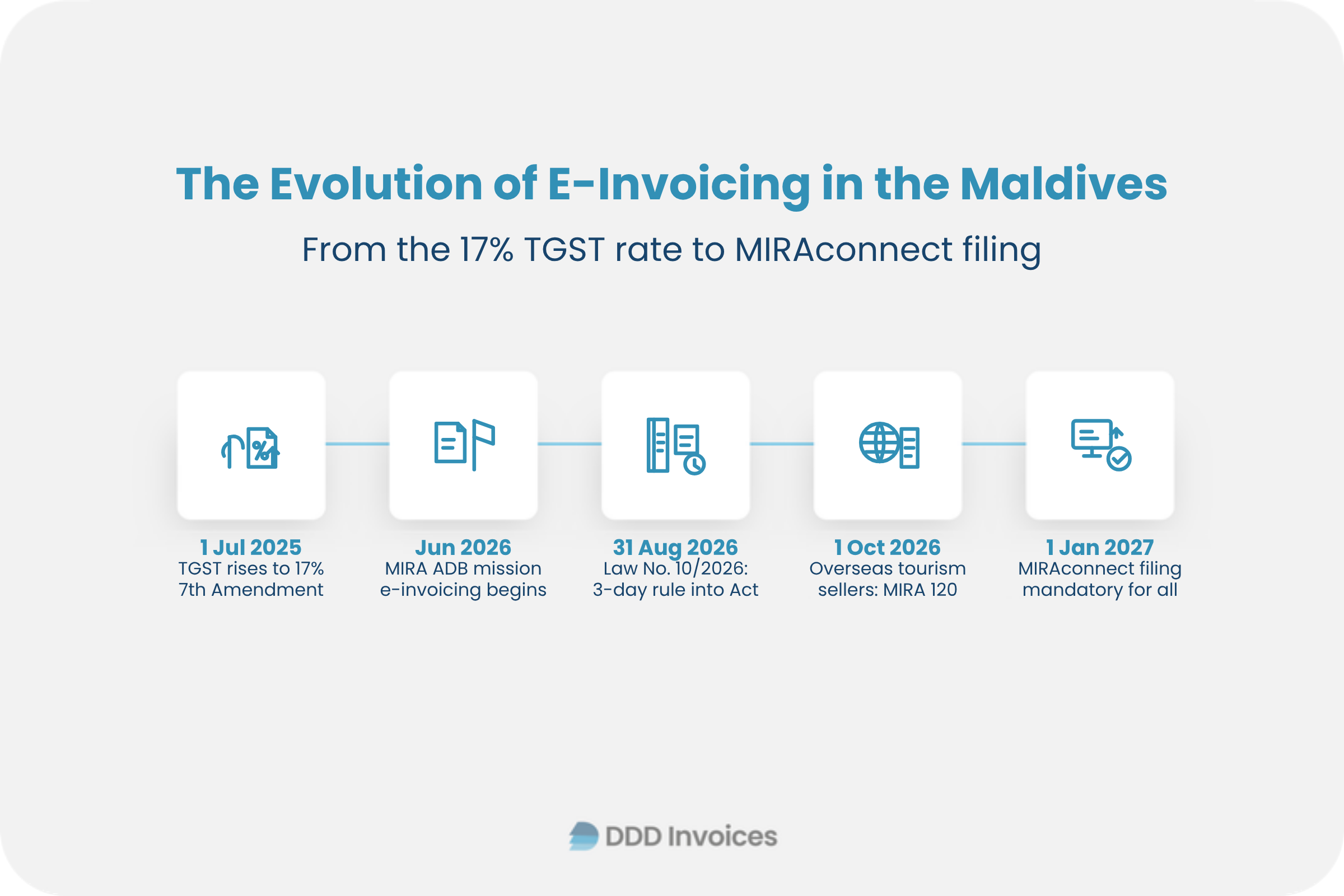
- July 1, 2025: TGST rises to 17% under the Seventh Amendment.
- June 2026: MIRA's ADB-funded e-invoicing mission begins.
- August 31, 2026: the Eighth Amendment, Law No. 10/2026, moves the 3-day invoice rule into the Act.
- October 1, 2026: overseas tourism sellers must register on form MIRA 120.
- January 1, 2027: MIRAconnect filing becomes mandatory for all registered persons.
B2G e-invoicing in the Maldives
There is no B2G e-invoicing mandate or government portal, unlike many countries in our global B2G guide. Suppliers to State offices follow the general GST invoice and receipt rules.
B2B e-invoicing in the Maldives
B2B e-invoicing is not yet mandatory, and MIRA has published no technical specification. Under GST Act section 42, a tax invoice must show:
- Title: "Tax Invoice", written prominently.
- Parties: supplier and buyer names, addresses and TINs (Taxpayer Identification Numbers).
- Reference: a pre-printed or software-generated number and issue date.
- Supply: quantity and details of goods or services.
- Amounts: value before tax, GST and total, or a GST-inclusive note.
Since August 31, 2026, the Act requires a tax invoice or receipt within 3 days of supplying goods or completing services. Registered buyers can request a tax invoice, due within 28 days, and credit or debit notes follow within 3 days of identifying a change.
- Register: file MIRA 105, or MIRA 120 for overseas tourism sellers.
- Connect: request a MIRAconnect account with form MIRA 111.
- Check: test templates against section 42 and the 3-day rule.
- Monitor: follow MIRA notices for e-invoicing specifications.
B2C e-invoicing in the Maldives
There is no B2C e-invoicing mandate or real-time sales reporting. Under section 43 of the Act, businesses may give unregistered buyers a receipt instead of a tax invoice. Overseas tourism sellers need not show GST separately on invoices. Elsewhere, consumer sales often run through e-invoicing or fiscalization.
A GST receipt must include the supplier’s name, address and TIN; payment date; receipt number; goods or services supplied; tax-exclusive value; GST charged; and the tax-inclusive total or permitted tax-inclusive statement.
E-reporting and GST compliance in the Maldives
Under periodic e-reporting, returns and payments are due by the 28th of the month after each taxable period, per MIRA's GST FAQ. Under MIRA's taxable period rules, businesses averaging over MVR 1 million in monthly sales file monthly, and others quarterly.
From January 1, 2027, the GST Regulation makes MIRAconnect, MIRA's filing and payment portal, mandatory for all registered persons. Overseas tourism sellers have been covered since October 1, 2026, and payment may also go by MRTGS.
The general GST rate is 8%, and TGST is 17%, paid in US dollars. Registration applies above MVR 1 million in taxable supplies over 12 months, but tourism suppliers and commercial importers register regardless.
Exports are zero-rated under section 22(b) of the Act, and MIRA's zero-rating guide explains when services count as consumed abroad. Overseas tourism sellers register on form MIRA 120, with no threshold, and file MIRA 211 returns. These rules do not cover foreign digital services generally. Records must be kept for 5 years after the taxable period, in Dhivehi or English.
Penalties for non-compliance in the Maldives
GST fines are set by the Tax Administration Act, its regulation and MIRA tax ruling TR-2015/G30.
Offence | Fine |
|---|---|
Invoice, receipt or certificate breach not fixed after notice | MVR 2,000 |
Late GST return | 0.5% of the tax payable, plus up to MVR 50 a day |
Late GST payment | 0.05% of the unpaid tax a day |
Failing to register or keep records | Up to MVR 5,000 each |
Your trusted partner for e-invoicing in the Maldives
E-invoicing is not yet mandatory, but MIRA plans direct links to taxpayer platforms, so resorts and their POS or ERP providers should plan integrations. DDD Invoices' unified e-invoicing APIalready handles outgoing and incoming invoices in covered markets from one standardized payload, plus compliant archiving. New countries join that same integration as mandates go live, and the Maldives can follow once it reaches our country coverage list.
{{__CTA:TalkToUsCta__}}
FAQs
When will e-invoicing become mandatory in the Maldives?
MIRA has not announced a mandatory date, format or rollout plan for e-invoicing in the Maldives yet. Its ADB-funded project began in June 2026, so businesses should treat any go-live date as unconfirmed.
What must a Maldives tax invoice include?
It must show the words Tax Invoice, both parties' names, addresses and TINs, and an invoice number. It also needs the issue date, goods or services supplied, the value before tax, GST and the total.
How do businesses file GST returns in the Maldives?
GST returns are due by the 28th day of the month after each monthly or quarterly taxable period. From January 1, 2027, every registered business must file through MIRAconnect and pay through MIRAconnect or MRTGS.
Why is the Maldives introducing e-invoicing?
MIRA wants e-invoicing to automate tax compliance, curb tax evasion and modernize its services for taxpayers. The planned system would also give MIRA direct visibility of taxpayers' transactions and invoice documents.