
E-Invoicing in Uruguay: CFE Rules and DGI Requirements
Author
Bishma

Uruguay has a mature, mandatory e-invoicing system. Issuers create electronic fiscal receipts, called Comprobantes Fiscales Electrónicos (CFE), that the tax authority (DGI) validates. Since 1 January 2025, nearly all VAT taxpayers, including those on the minimum VAT regime, have had to take part.
The model is clearance. A CFE is built in XML, digitally signed by the issuer and authorised by the DGI through online validation before it reaches the buyer. A PDF sent by email is not enough.
Latest News
Embeds a monitoring pages group for this blog article
{{__MONITORING_PAGES_GROUP:blog_articles_599__}}Resolution 2548/2023 set 31 December 2024 as the deadline for the remaining VAT taxpayers to join.
{{__CTA:IntegrationStepsCta__}}
What Is E-Invoicing in Uruguay?
E-invoicing in Uruguay is the electronic issue of invoices, tickets and credit notes as Comprobantes Fiscales Electrónicos (CFE). A CFE has the same tax validity as the paper document it replaces. Electronic issuers must document sales with CFE and cannot issue manual documents for those operations, except in justified contingency cases.
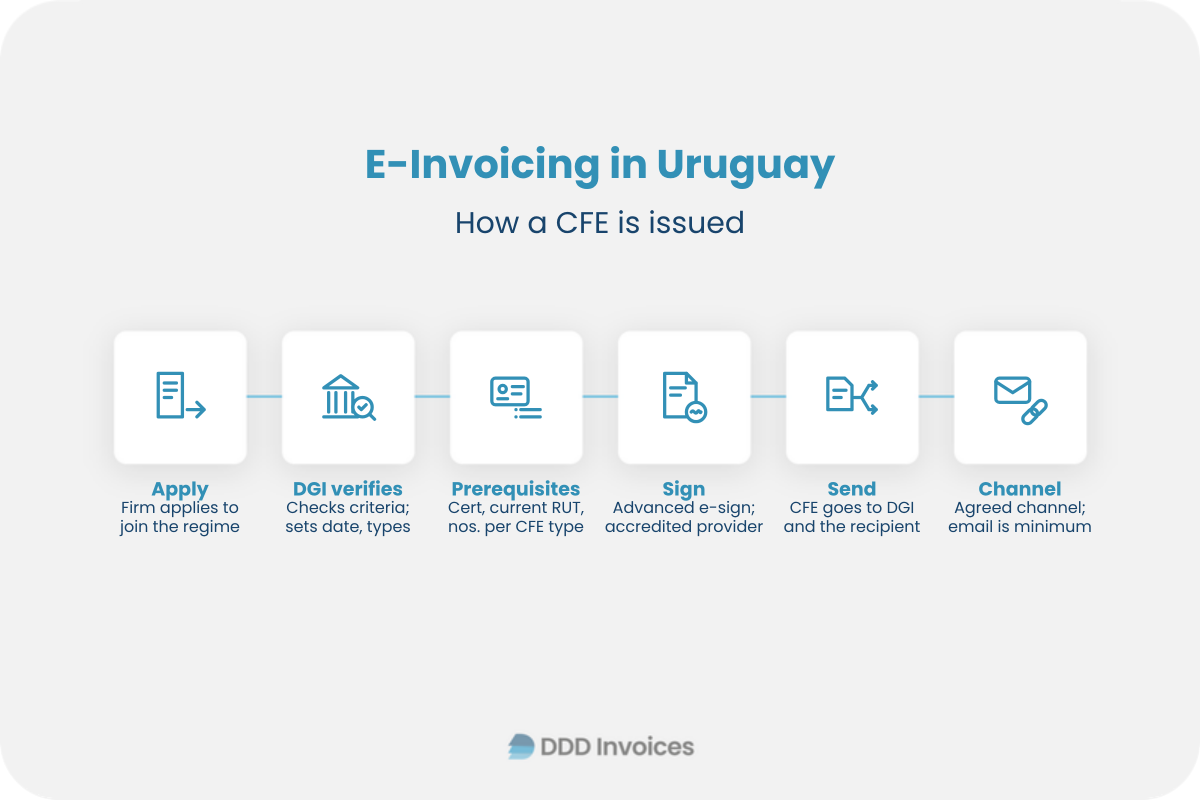
A company applies to join the regime. Once the DGI verifies the requirements, it tells the company the date from which it may issue CFE and which document types are authorised. Issuers need a valid electronic certificate, a current RUT and numbering authorisations for each CFE type.
Each CFE is signed with an advanced electronic signature from an accredited provider. The issuer sends it to the DGI and to the electronic recipient. Resolution 798/2012 requires an agreed channel, with email as the minimum accepted protocol.
E-Invoicing Timeline
- 30 November 2023: DGI Resolution 2548/2023 extended the deadlines for mandatory inclusion.
- 1 January 2025: All VAT taxpayers, including minimum VAT, must be in the regime.
Who Is in Scope?
All VAT taxpayers must issue CFE, subject to a few exceptions. The DGI lists these as still exempt:
- Taxpayers with only agricultural activity and income below UI 4,000,000 in the year.
- Those who carry out only the taxed acts for added value in construction on property.
- Non-resident income tax (IRNR) taxpayers.
- Taxpayers fully exempt from DGI-administered taxes, except free-zone users.
B2G E-Invoicing in Uruguay
Suppliers to public entities in Uruguay issue invoices as CFE (Comprobante Fiscal Electrónico) under the same DGI regime as all other sales. Electronic issuers cannot use manual documents for these sales, except in justified contingency cases. Because public bodies have a RUT (tax ID), B2G sales are documented with an e-Factura.
Each e-Factura must be sent to the DGI for validation before it goes to the recipient. DGI-certified invoicing software can handle this exchange. Issuers must also keep issued and received CFE in their original electronic format for the tax limitation period. Businesses should check each tender or contract for extra requirements, since the purchasing agency ARCE sets procurement terms.
B2B E-Invoicing in Uruguay
B2B sales in Uruguay are documented with CFE (Comprobante Fiscal Electrónico) under the DGI regime. Sales to taxpayers with a RUT (tax ID) use the e-Factura, and electronic issuers cannot use manual documents except in justified contingency cases.
The issuer must send each e-Factura to the DGI before sending it to the recipient. A customer that isn’t an electronic recipient receives a legally valid printed representation of the CFE. Issuers must keep CFE in their original electronic format for the tax limitation period.
B2C E-Invoicing in Uruguay
B2C sales in Uruguay are documented with the e-Ticket, a type of CFE (Comprobante Fiscal Electrónico) issued to final consumers. Electronic issuers cannot use manual documents for these sales, except in justified contingency cases.
Issuers must publish every e-Ticket as a PDF on their website by 18:00 the next business day. They must keep it online for at least 90 days so customers can verify it. Printed CFE must carry the DGI-supplied QR code.
A customer who isn’t an electronic recipient receives a printed representation of the CFE, which has legal validity. Issuers must keep CFE in their original electronic format for the tax limitation period.
E-Reporting and Tax Compliance
Uruguay has periodic electronic tax filing. Taxpayers use the DGI online services to file declarations, such as the IVA Servicios Personales return (Form 1302) with pre-filled data. Due dates follow the DGI calendar, with monthly dates for IVA Mínimo and bimonthly payments for personal-services VAT.
Issuers must keep issued and received CFE in their original electronic format for the tax limitation period.
Penalties for Non-Compliance
In Uruguay, failing to meet e-invoicing duties is a tax contravention (contravención) under Article 95 of the Código Tributario. For 2026, the fine ranges from $680 to $13,220 Uruguayan pesos. Decreto 344/025 of 30 December 2025 set those limits for contraventions under Articles 95 and 98.
The DGI decides the amount within that range for each case. Decreto 597/988 sets the maximum contravention fine in force on the date of the breach for breaches of its documentation rules. If the issuer doesn’t fix the omission by the deadline, the DGI can also suspend its activities for up to six business days.
Your E-Invoicing Partner
Uruguayan businesses need four things to stay compliant: reliable XML generation, digital signature handling, DGI validation and secure storage. DDD Invoices is an API-first platform that creates structured XML invoices, applies country-specific tax rules and archives documents. It is built to take the manual work out of e-invoicing, so your team can focus on the business.
Compliance is easier with a partner that follows each rule change as it happens. DDD Invoices keeps your invoicing process accurate, auditable and ready for the DGI. Start your e-invoicing in Uruguay with confidence.
{{__CTA:TalkToUsCta__}}
FAQs
Who must issue e-invoices in Uruguay?
All VAT taxpayers, with limited exceptions.
What is issued under the e-invoicing system?
The CFE (comprobante fiscal electrónico), the electronic fiscal document.
When did e-invoicing become mandatory?
VAT taxpayers have had to issue CFE since 1 January 2025.
What format does Uruguay require?
XML, following the DGI’s CFE schema.
How does the DGI validate invoices?
The DGI authorises each CFE through online validation before it is delivered.
Why do consumers receive e-invoices too?
Consumer sales are covered by the CFE regime and are issued as e-tickets.