
E-Invoicing in Jamaica: Current Status and GCT Requirements
Author
Ameera

Jamaica's economy leans on tourism, imports and exports, so invoice accuracy matters for both trade and tax. Tax Administration Jamaica (TAJ) administers General Consumption Tax (GCT), the country's value-added tax, through an online portal. Discussion of e-invoicing in Jamaica is active, but the legal framework still rests on paper-style tax invoices and online returns.
Jamaica has no binding nationwide structured e-invoicing mandate in the sources reviewed. GCT-registered taxpayers must issue tax invoices for taxable supplies and keep records. They must also file monthly GCT returns online, generally by the last working day of the following month. No start date for e-invoicing has been confirmed.
Latest news
Embeds a monitoring pages group for this blog article
{{__MONITORING_PAGES_GROUP:blog_articles_618__}}On March 19, 2026, during the 2026/27 Budget Debate, the Prime Minister answered an opposition proposal for e-invoicing. He said implementation first needs digital infrastructure, including public key infrastructure and data centres. The Budget Debate speech describes e-invoicing as something already "contemplated".
This is a political statement, not a law. It sets no date, no taxpayer group and no format. Your current GCT invoicing and filing duties do not change.
Has Jamica adopted e-invoicing?
Jamaica has not adopted e-invoicing yet. The official discussion links it to tax compliance. No clearance, post-audit or network model has been announced.
e-invoicing timeline in Jamaica
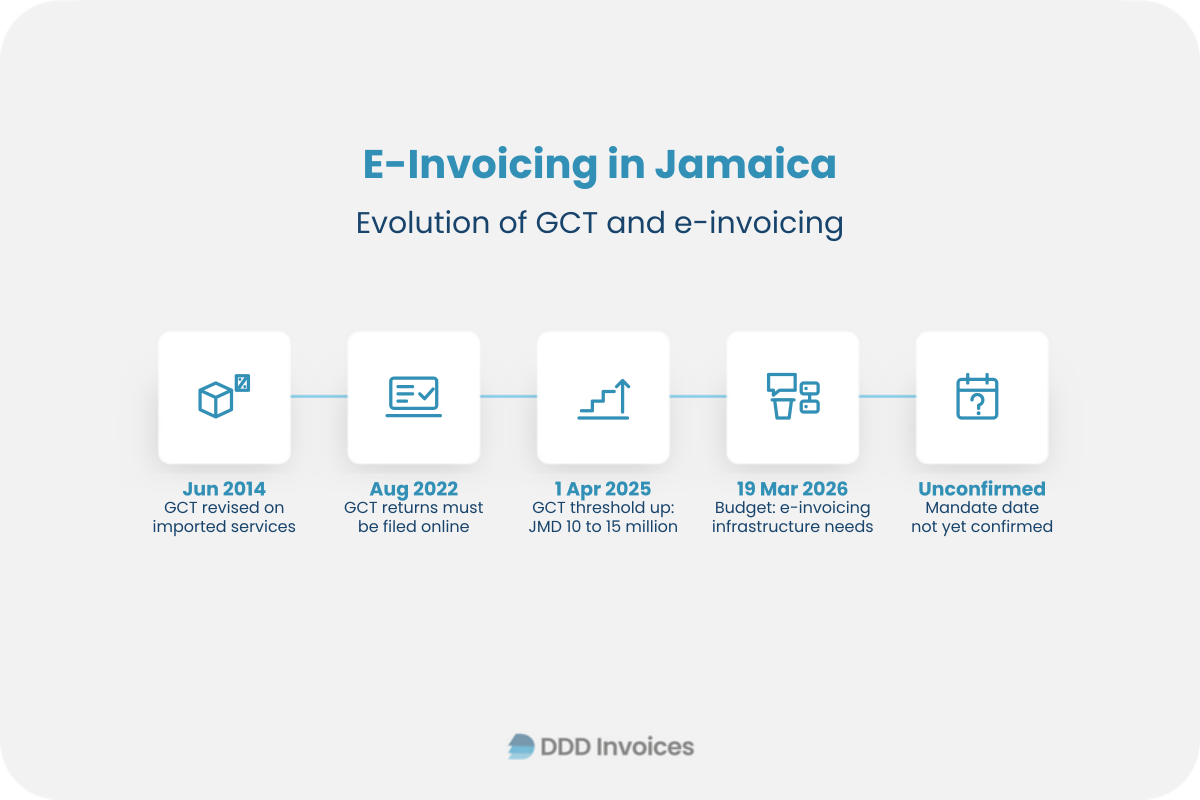
- June 2014: The Government revised GCT on imported services. Registered taxpayers account for the tax themselves.
- August 2022: TAJ reminded taxpayers that GCT returns must be filed online and are not accepted at tax offices.
- April 1, 2025: The general GCT registration threshold rose from JMD 10 million to JMD 15 million of annual taxable supplies.
- March 19, 2026: Budget Debate remarks on infrastructure prerequisites for e-invoicing (see Latest news).
B2G e-invoicing in Jamaica
No separate B2G e-invoicing mandate has been identified. Government buyers are treated as customers under the same GCT invoicing rules. Treat a government purchase like any other taxable supply and confirm any extra requirements in the purchase order or tender documents.
The Ministry of Finance publishes GCT payment procedures for some public-sector payments, including withholding tax certificates.
B2B e-invoicing in Jamaica
B2B e-invoicing is not mandatory. The GCT rules do apply, though.
Who must register: Businesses must register for GCT above the JMD 15 million annual threshold, effective April 1, 2025. Older TAJ guidance still shows JMD 10 million, so do not rely on it.
Who gets a tax invoice: Only registered taxpayers can issue tax invoices, which let registered customers claim input tax credit. Sales to other customers need an invoice or receipt.
Required particulars: A tax invoice must show:
- The words "Tax Invoice"
- Supply date and serial number
- Supplier name, address and GCT registration number
- Recipient name and address
- Description and quantity of the supply
- Consideration
- GCT rate and amount
- Total payable
Timing and format: Issue the invoice within seven days of the supply. A computer-generated tax invoice must contain the same information as a manual one.
Imports and exports: Imports carry GCT at customs, and customs entries support the input tax claim. Qualifying exports are zero-rated (Group 5), so keep export documentation. For imported services, registered taxpayers account for GCT themselves under the reverse charge.
Corrections: Under the GCT Regulations, debit and credit notes must state their type, date and parties. They must also reference the original tax invoice, give the tax amounts and explain the reason. Both issuer and recipient keep a copy. Each adjusts the output or input tax in the relevant return.
Steps to prepare:
- Confirm registration: Check your GCT status and threshold position.
- Map documents: List invoices, credit and debit notes, customs entries and export proofs.
- Align your ERP: Make sure computer-generated invoices carry every particular.
- Reconcile monthly: Tie sales, purchases and adjustments to the return.
B2C e-invoicing in Jamaica
No B2C e-invoicing or fiscal device mandate has been identified. Registered sellers issue an invoice or receipt for sales to non-registered customers.
E-reporting and GCT compliance
Jamaica relies on periodic summary filing, not invoice-level reporting. Taxpayers total their figures and file on fixed schedules, using the TAJ portal for online services.
- Monthly: GCT returns, even when the tax payable is nil, and PAYE. Payment is due by the last working day of the month after the tax was collected.
- Quarterly: Estimated income tax instalments.
- Annually: Final income tax returns.
Your trusted partner for e-invoicing
Jamaica requires GCT tax invoices and online returns, not structured e-invoicing.
DDD Invoices offers a unified e-invoicing API covering more than 30 countries. Jamaica is not yet listed on our coverage page, so support is pending.
{{__CTA:TalkToUsCta__}}
FAQs
Is e-invoicing mandatory in Jamaica?
No binding nationwide mandate has been identified. Registered taxpayers still follow GCT tax invoice, filing and record rules.
What must a GCT tax invoice include?
It must carry the "Tax Invoice" title, supply date, serial number, supplier and recipient details, description, consideration, GCT rate and amount, and total.
When must I file my GCT return?
File online monthly. Return and payment are generally due by the last working day of the following month.
Are computer-generated invoices valid?
Yes, if they hold the same information as manual tax invoices. Keep the records and their change history.

E‑invoicing in Malta is primarily encouraged in the public sector, where public entities must be able to receive electronic invoices.
Mandatory B2B and B2G e-invoice reporting through certified myDATA providers, with fiscalization for B2C receipts and simplified invoices.

E‑invoicing is the process of sending and receiving structured e‑invoices. See how it works and how it improves tax control and automation.