
E-Invoicing in Kiribati: Mandate Status, VAT Tax Invoices and the 2026 Digital Services Rules

Since January 1, 2026, Kiribati's VAT law covers its archipelagic waters, territorial sea and exclusive economic zone. E-invoicing in Kiribati is not required, and the Kiribati Tax Office of the Ministry of Finance and Economic Development (MFED) administers VAT.
Kiribati has no e-invoicing or fiscalization mandate for B2B, B2G or B2C. Businesses whose taxable supplies exceed AUD 100,000 in 12 months must register for VAT at 12.5% and file quarterly returns within 15 days. Since January 1, 2026, they give every buyer a tax invoice, and foreign digital suppliers follow new VAT rules.
Latest news
Embeds a monitoring pages group for this blog article
{{__MONITORING_PAGES_GROUP:blog_articles_666__}}Imports are now valued at CIF for VAT, and the Third Schedule Regulations zero-rate menstrual health and hygiene products.
{{__CTA:IntegrationStepsCta__}}
What is e-invoicing and has Kiribati adopted it?
E-invoicing is the exchange of structured invoice data between systems. Kiribati has not adopted it and sets no format, platform, clearance model or fiscal device.
Fiji, Samoa and Vanuatu run real-time fiscal systems and Papua New Guinea is building one, while Kiribati has announced none.
The evolution of e-invoicing in Kiribati
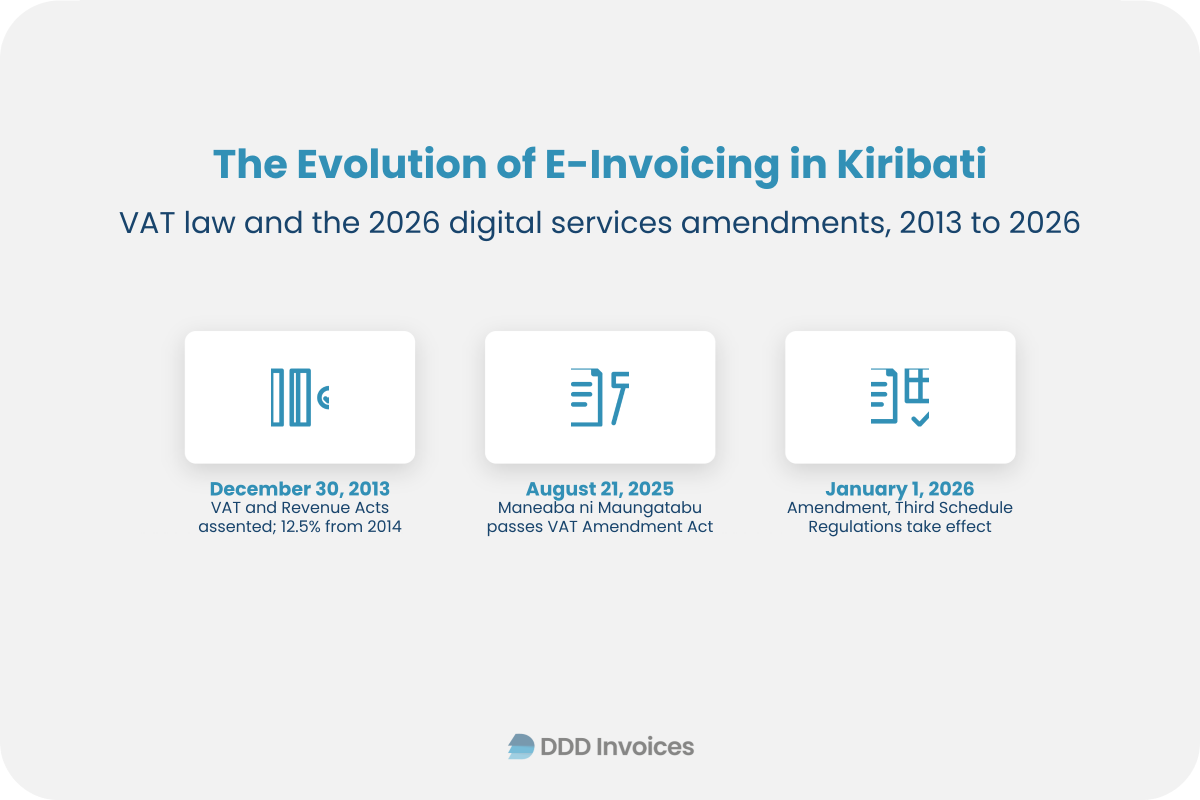
- December 30, 2013: the Value Added Tax Act 2013 and Revenue Administration Act 2013 receive assent, with 12.5% VAT from January 1, 2014.
- August 21, 2025: the Maneaba ni Maungatabu passes the VAT (Amendment) Act 2025, published in the official gazettes.
- January 1, 2026: the amendment and the Third Schedule Regulations take effect.
B2G e-invoicing in Kiribati
B2G e-invoicing is not required, and no B2G platform exists. Under section 8 of the VAT Act 2013, government entities that start making taxable supplies must register.
Since 2026, unregistered Government tender bidders must quote VAT-inclusive prices, and charge VAT if winning requires registration (section 48A).
B2B e-invoicing in Kiribati
B2B e-invoicing is not required, but registered persons must issue compliant tax invoices:
- Register: apply within 7 days once actual or expected taxable supplies exceed AUD 100,000 in 12 months. Voluntary registration is not available.
- Invoice: issue the original tax invoice at the time of supply, and prepare a recipient-created tax invoice for imported services.
- Correct: use credit notes for overstated VAT and debit notes for understated VAT.
- Publish details: show your VAT details on websites and social media, and report changes within 21 days.
- Prepare data: keep VAT numbers, sequential numbering and tax breakdowns in your ERP, and watch the Kiribati Tax Office for Regulations.
B2C e-invoicing in Kiribati
B2C e-invoicing is not required, and no fiscal device or e-receipt rule applies. Since 2026, registered sellers must give consumers a tax invoice for each taxable supply.
Foreign digital services suppliers follow the separate rules below.
E-reporting and VAT compliance in Kiribati
Kiribati has no periodic e-reporting. VAT is 12.5%, with zero-rated exports and international transport, and exempt financial, education and medical services.
Quarterly returns and payment are due within 15 days after each quarter, while import VAT is due at import. Input tax credits must be claimed within 12 months after the period they arise. The Revenue Administration Act 2013 requires records in Kiribati, in English, for 7 years.
Penalties for non-compliance in Kiribati
Penalties sit in the Revenue Administration Act 2013 and section 44 of the amended VAT Act.
Offence | Fine |
|---|---|
Not providing a tax invoice, credit note or debit note | AUD 100, then AUD 500 for repeat failures |
Issuing one other than as the VAT Act requires | AUD 100, then AUD 500 for repeat failures |
Late filing (section 63) | AUD 30 a month, up to AUD 500 |
Late payment (sections 34 and 64) | 15% of the unpaid tax, plus 15% a year interest |
Not keeping records (section 65) | 20% of the tax payable, or 75% if knowing or reckless |
Digital services and e-invoicing in Kiribati
These 2026 rules cover registration, place of supply and reverse charge, not e-invoicing. Under the VAT (Amendment) Act 2025, remote services from suppliers based outside Kiribati are taxed when the customer is resident. Residence needs two of six indicators, such as address, bank account or IP address.
- B2C: the foreign supplier registers once taxable supplies exceed AUD 100,000, then charges 12.5%. A non-resident platform counts as the supplier unless the underlying supplier is registered.
- B2B: business customers notify the supplier in writing at or before supply, then account for the VAT themselves.
- Filing: foreign suppliers file VAT returns without input tax credits and may convert to AUD at the Reserve Bank of Australia mid-rate.
Your trusted partner for e-invoicing in Kiribati
Australian and New Zealand parents with a Tarawa entity face voluntary e-invoicing, but every taxable sale now needs a tax invoice from their ERP. DDD Invoices handles VAT code mapping and exemption clauses through one API structure, then helps you issue, receive and archive invoices in live markets. Your developers can try the public API playground, then talk to us about Kiribati, which our country coverage list does not cover yet.
{{__CTA:TalkToUsCta__}}
FAQs
What is the VAT rate in Kiribati?
Kiribati charges VAT at 12.5% on taxable supplies and imports, and 0% on zero-rated supplies. Since January 1, 2026, menstrual health and hygiene products are also zero-rated under the Third Schedule Regulations.
When did Kiribati's digital services rules start?
The VAT (Amendment) Act 2025, passed on August 21, 2025, took effect on January 1, 2026. It reworks the remote services rules and can make electronic platforms liable for consumer sales.
How is VAT on foreign digital services handled in Kiribati?
Business buyers notify the foreign supplier in writing, then self-account for the VAT under reverse charge. Unregistered businesses above AUD 100,000 file a liability notice and pay within 15 days after the period.
Why did Kiribati change its VAT rules in 2026?
The amending Act's memorandum says it broadens the VAT base and updates the law for the digital economy. The World Bank links the reforms to fairer VAT on imports and VAT-free menstrual products.