
E-Invoicing in Kuwait: Mandate Status, VAT Outlook and Invoicing Rules
Author
Shamyudha

Kuwait's 2026/2027 state budget expects no revenue from taxes on goods and services, a Gulf rarity. The Ministry of Finance (MOF) runs income tax, and no invoicing platform exists, so e-invoicing in Kuwait has no legal basis yet.
Kuwait has no e-invoicing, e-reporting or clearance mandate, and no invoice format or go-live date exists. There is no VAT, general sales tax or excise in force. Businesses issue commercial invoices for income tax, Zakat and customs, and follow e-invoicing rules where their Gulf entities operate.
Latest news
On October 27, 2026, the Council of Ministers approved a draft decree-law on the GCC Unified Excise Tax Agreement. It now goes to the Amir, with no start date. Tobacco and soft drink importers should watch for registration rules.
Under the MOF's FY 2026/2027 budget rules, from April 1, 2026 public bodies hold a 5% retention until a tax clearance certificate is shown. Groups registered for the top-up tax with a valid tax card are exempt, so check before invoicing a ministry.
{{__CTA:IntegrationStepsCta__}}
What is e-invoicing and where does Kuwait stand?
E-invoicing is the exchange of invoices as structured data that software processes without retyping.
Kuwait uses no clearance, post-audit or Peppol model. Article 3 of Law No. 20 of 2014 on Electronic Transactions gives electronic documents the legal effect of paper ones.
Saudi Arabia's FATOORAH system has applied since December 4, 2021. Decision No. 244 of 2025 starts e-invoicing in the UAE on January 1, 2027 for revenue of AED 50 million or more. It uses a Peppol-based five-corner model.
Oman's Decision No. 189/2026 makes e-invoicing mandatory from April 1, 2027 above OMR 5 million in annual supplies, and from October 1, 2027 for others. Qatar's Cabinet approved a draft e-invoicing law on May 6, 2026, and Bahrain is preparing.
The evolution of e-invoicing in Kuwait
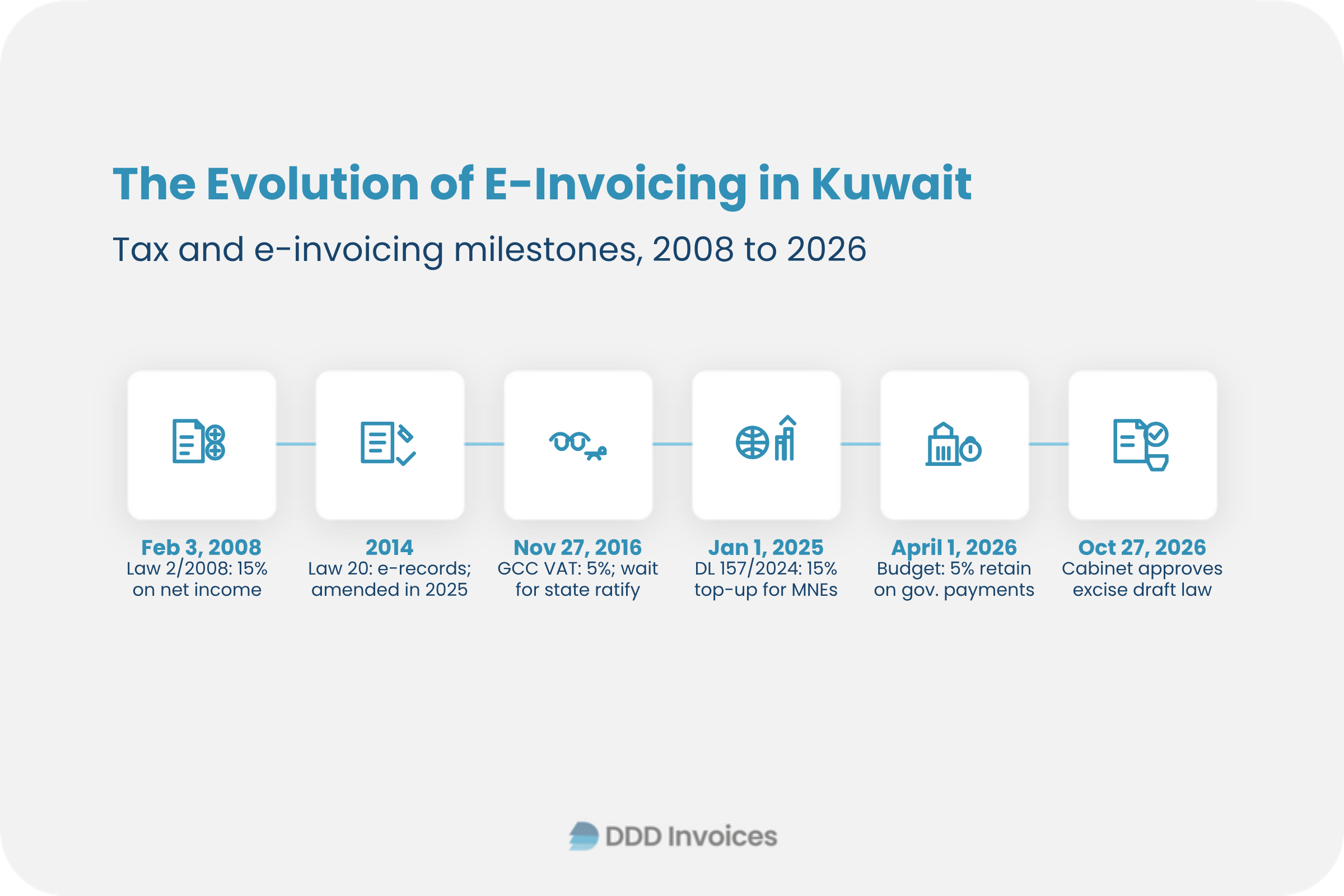
- February 3, 2008: Law No. 2 of 2008 sets income tax at 15% of net taxable income.
- 2014: Law No. 20 of 2014 recognises electronic records; Decree-Law No. 148 of 2025 amends it.
- November 27, 2016: the GCC Unified VAT Agreement sets a 5% basic rate, pending each state's ratification.
- January 1, 2025: Decree-Law No. 157 of 2024 starts a 15% top-up tax for large multinational groups.
- April 1, 2026: budget rules update the 5% retention on government payments.
- October 27, 2026: the Cabinet approves the excise draft decree-law.
B2G e-invoicing in Kuwait
B2G e-invoicing is not mandatory, and no portal or format exists; suppliers invoice ministries directly. Teams on B2G e-invoicing portals elsewhere need no Kuwaiti link.
B2B e-invoicing in Kuwait
B2B e-invoicing is not mandatory, and no law fixes invoice fields or requires a tax number on invoices. Under Article 4 of Law No. 20 of 2014, nobody must accept electronic dealing without consent.
Foreign corporate bodies pay 15% income tax and keep records that fairly reflect income. Kuwaiti shareholding companies pay 1% Zakat under Law No. 46 of 2006. Listed companies pay 2.5% National Labour Support Tax under Law No. 19 of 2000. Groups with consolidated revenue of EUR 750 million or more pay the top-up tax instead.
Imports pay a 5% customs duty on most goods, declared against the commercial invoice.
- Register: commercial registration, plus an MOF tax card for foreign entities.
- Agree: electronic invoicing with each customer in writing.
- Structure: ERP output as data fields, not only PDFs.
- Store: invoices unaltered and retrievable, per Article 9 of Law No. 20 of 2014.
- Track: GCC deadlines for entities outside Kuwait.
B2C e-invoicing in Kuwait
B2C e-invoicing is not mandatory, and no fiscal device, e-receipt or till rule applies to shops or online sellers. A POS integration needs no Kuwaiti certification.
E-reporting and VAT compliance in Kuwait
Kuwait has periodic tax reporting: covered taxpayers file income-tax declarations, generally annually, by the 15th day of the fourth month following the taxable period, with payment in four instalments. These obligations are set out in the Ministry of Finance’s income-tax legislation.
A separate mandatory periodic electronic invoice-data reporting requirement has not been verified in the government sources reviewed.
Penalties for non-compliance in Kuwait
Kuwait sets no e-invoicing penalties; income tax fines run at 1% per 30 days under Article 8 of Decree No. 3 of 1955.
Offence | Penalty |
|---|---|
No e-invoice issued | Not applicable, no mandate |
Late income tax declaration or payment (Art. 8) | 1% of the tax due per 30 days or part |
Falsified records or false statements (Art. 12) | Up to 2 years' imprisonment, a fine, or both |
Your trusted partner for e-invoicing in Kuwait
Kuwait asks for no e-invoice today, yet a Kuwaiti group billing from Riyadh, Dubai or Muscat faces three regimes by 2027. DDD Invoices gives your ERP one integration layer that maps one invoice model to each covered country's format. You issue, receive and archive invoices through it, test first, and leave validation updates to us. Kuwait is not yet on our country coverage list and the UAE is in progress, so a call helps us map your Gulf entities.
{{__CTA:TalkToUsCta__}}
FAQs
Is e-invoicing mandatory in Kuwait?
No, Kuwait has no e-invoicing, e-reporting or clearance mandate, and no start date has been set. Businesses still issue commercial invoices that must support income tax, Zakat, customs and audit records.
Does Kuwait have VAT in 2026?
No, Kuwait has no VAT, general sales tax or excise in force as of November 2026. It is a party to the 2016 GCC VAT Agreement, but no national VAT law exists.
What taxes do businesses pay in Kuwait?
Foreign corporate bodies pay 15% income tax, Kuwaiti shareholding companies pay Zakat, and listed companies pay NLST. Large multinational groups pay a 15% domestic minimum top-up tax instead from January 1, 2025.
Why should Kuwaiti groups prepare for e-invoicing now?
Saudi Arabia is already live, and the UAE and Oman start mandatory e-invoicing during 2027. Structured invoice data in your ERP also makes any future Kuwaiti VAT or e-invoicing rollout faster.