
E-Invoicing in the Marshall Islands: Mandate Status, Consumption Tax Invoices and the October 2026 Tax Reform

The Marshall Islands enacted its first national consumption tax in 2025, after a 2012 draft never became law. E-invoicing in Marshall Islands is not required, and the Ministry of Finance's Division of Customs, Treasury, Revenue and Taxationadministers the tax.
The Marshall Islands has no e-invoicing mandate for B2B, B2G or B2C. From October 1, 2026, businesses with $300,000 or more of taxable supplies in 12 months must register for the 12% Consumption Tax. They issue tax invoices at the time of supply and file monthly returns within 21 days.
Latest news
Embeds a monitoring pages group for this blog article
{{__MONITORING_PAGES_GROUP:blog_articles_665__}}The Consumption Tax Act 2025 covers supplies and imports from October 1, 2026, yet no Regulations under it were found by November 17, 2026.
{{__CTA:IntegrationStepsCta__}}
What is e-invoicing and has the Marshall Islands adopted it?
E-invoicing is the exchange of structured invoice data between systems. The Marshall Islands has not adopted it and sets no format, platform or clearance model. Section 939 of the Consumption Tax Act lets future Regulations allow electronic tax invoices.
Fiji, Samoa and Vanuatu run real-time fiscal systems, and Palau introduced a goods and services tax in January 2023. The Federated States of Micronesia still runs a gross revenue tax.
The evolution of e-invoicing in Marshall Islands
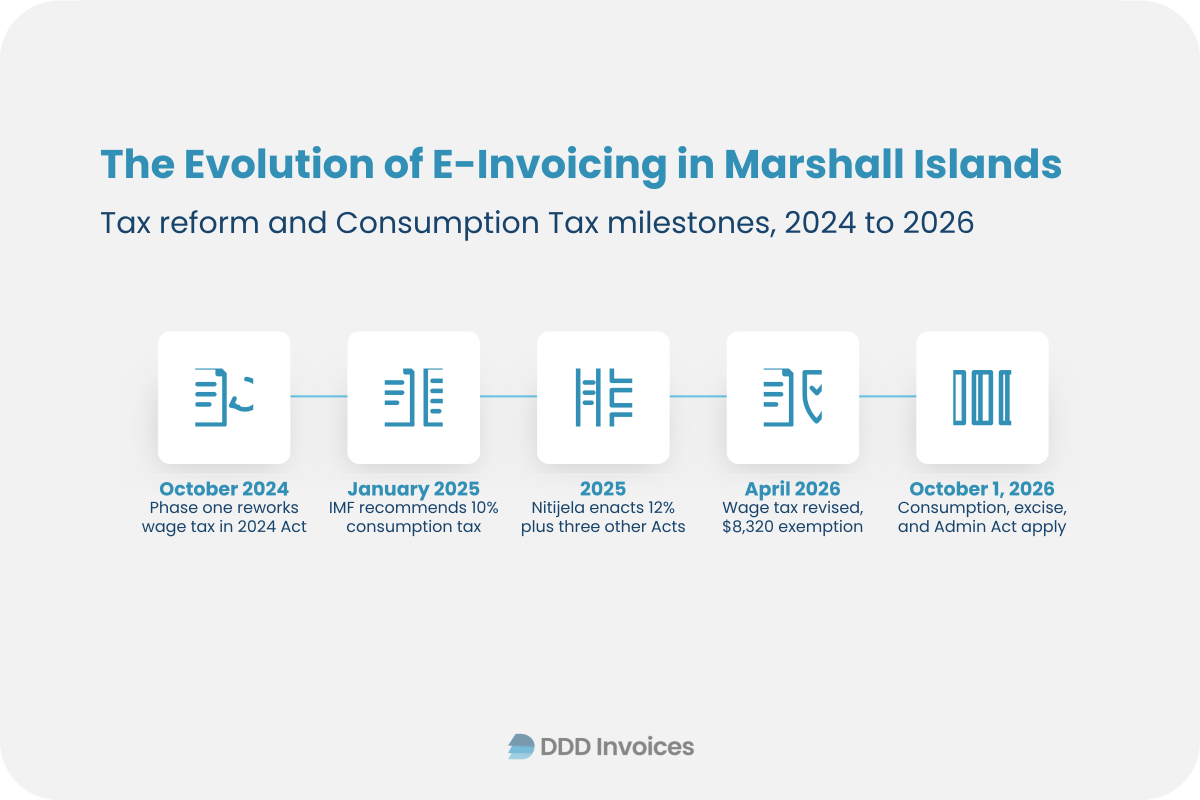
- October 2024: phase one, the Income Tax (Amendment) Act 2024, reworks wage tax.
- January 2025: an IMF technical assistance report recommends a 10% consumption tax.
- 2025: the Nitijela enacts the Consumption Tax Act 2025 (P.L. 2025-47) at 12%, plus three companion Acts.
- April 2026: the Income Tax (Amendment) Act 2026 revises wage tax and sets an $8,320 exemption.
- October 1, 2026: the Consumption Tax, excise tax and Tax Administration Act apply.
B2G e-invoicing in Marshall Islands
B2G e-invoicing is not required, and no B2G platform exists. Government entities and state-owned enterprises that make taxable supplies must register too.
Under the Procurement Code Act 2023, bidders must be current with tax payments or have a payment agreement. For donor and Compact projects, section 954 of the Consumption Tax Act overrides exemptions in other Acts or agreements.
B2B e-invoicing in Marshall Islands
B2B e-invoicing is not required, and only registered suppliers may issue tax invoices:
- Register: apply within 7 days once actual or expected taxable supplies reach $300,000 in 12 months.
- Invoice: give the buyer one original tax invoice at the time of supply, and prepare recipient-created invoices for reverse-charged supplies.
- Correct: issue credit notes for over-charges and debit notes for under-charges in the adjustment event's period.
- Watch notices: check the Customs, Treasury, Revenue and Taxation division for invoice Regulations.
B2C e-invoicing in Marshall Islands
B2C e-invoicing is not required. As written, section 939's tax invoice rule also covers consumer sales by registered sellers.
Section 139 of the Tax Administration Act 2025 lets Regulations require electronic fiscal devices with real-time sales data, but no such Regulations were found.
E-reporting and tax compliance in Marshall Islands
The Marshall Islands has no periodic e-reporting. The Consumption Tax Act 2025 sets 12%, with zero-rating for exports and international transport.
Monthly returns and payment are due within 21 days after each month. Input tax credits need the tax invoice and lapse if unclaimed 6 months after their period. Registered persons keep invoices, notes and trade documents for 6 years (Tax Administration Act, section 137).
Penalties for non-compliance in Marshall Islands
Under the Tax Administration Act 2025, issuing a fraudulent Consumption Tax document risks up to $10,000, 3 years in prison, or both.
Offence | Fine |
|---|---|
Not providing a tax invoice, credit note or debit note (section 176) | $500 |
Issuing one improperly (section 176) | $1,000 |
Late return showing tax payable (section 170) | 20% of the tax payable |
Late payment (sections 168 and 171) | 25% of the unpaid tax, plus 6% a year interest |
Not keeping proper records (section 172) | 20% of the tax payable, or 75% if knowing or reckless |
Tax reform and e-invoicing in Marshall Islands
The Net Profit Tax Act 2025 sets a 16% tax for tax years starting from October 1, 2026. It replaces the gross revenue tax, which survives for unregistered businesses trading solely in the Marshall Islands with annual gross revenue under $300,000.
They pay $80 for the first quarter plus 3% of gross revenue above $10,000 each quarter. Section 955 of the Consumption Tax Act repeals local government tax provisions and the holiday and resort tax.
Your trusted partner for e-invoicing in Marshall Islands
A missing tax invoice risks a $500 penalty and a delayed input tax credit, so get your ERP data right while e-invoicing is voluntary. DDD Invoices lets you add countries to one unified API without changing your core integration, keeping issuing, receiving and archiving together. Pending Marshall Islands support, US entities can use covered flows on our country coverage list, and we can discuss your Majuro needs.
{{__CTA:TalkToUsCta__}}
FAQs
When does the Marshall Islands Consumption Tax start?
The Consumption Tax Act 2025 applies to supplies and imports made from October 1, 2026. No Regulations setting tax invoice particulars were found by November 17, 2026, so watch notices.
What is the Marshall Islands Consumption Tax rate?
The rate is 12%, and exports, international transport and services consumed abroad are zero-rated. Financial services, unimproved land, excise goods, passenger transport and residential leases of 2 months or more are exempt.
How do I register for Marshall Islands Consumption Tax?
Apply within 7 days once actual or expected taxable supplies reach $300,000 in a 12-month period. Businesses with annual taxable supplies above $10,000 may register voluntarily if they meet section 914 conditions.
Why is the Marshall Islands introducing a Consumption Tax?
IMF staff say completing the reform is critical to modernize taxes and strengthen domestic revenue for fiscal sustainability. Registered businesses can claim input tax credits, so the tax falls on final consumption.