
E-Invoicing in Mongolia: eBarimt and VAT Invoice Requirements
Author
Ameera

Mongolia has e-invoicing, delivered through eBarimt, the electronic payment receipt system run by the Mongolian Tax Administration (General Department of Taxation). It combines system-validated payment receipts for every sale with VAT invoices between VAT withholding taxpayers. It is not documented as a Peppol, UBL or pre-clearance model.
VAT withholding taxpayers must issue a uniquely numbered payment receipt for every sale, on paper or electronically, through a connected user system. Between VAT withholding taxpayers, a VAT invoice must also be created. Receipt data must generally reach the integrated system within three days, and B2B VAT-invoice data within seven days.
Latest news
Embeds a monitoring pages group for this blog article
{{__MONITORING_PAGES_GROUP:blog_articles_630__}}On June 26, 2026, parliament amended the Law on Value Added Tax. From 1 January 2027 the mandatory VAT-registration threshold rises from MNT 50 million to MNT 400 million of annual sales. Voluntary registration stays at MNT 10 million.
Businesses below the new threshold will no longer be required to register. Existing registrants are not deregistered automatically: the VAT Law ties deregistration to 12 consecutive months of returns.
This is a VAT registration change only. It does not remove the broader duty to document sales through the approved receipt system.
{{__CTA:IntegrationStepsCta__}}
How eBarimt works
Mongolia's model centres on eBarimt, the electronic payment receipt system run by the General Department of Taxation. Sales data flows from each seller's connected system into a central database. The aim is stronger VAT control and reliable input-tax claims.
Official sources describe a registered, system-validated receipt. They do not document eBarimt as a Peppol, UBL or pre-clearance system.
evolution of e-invoicing in Mongolia
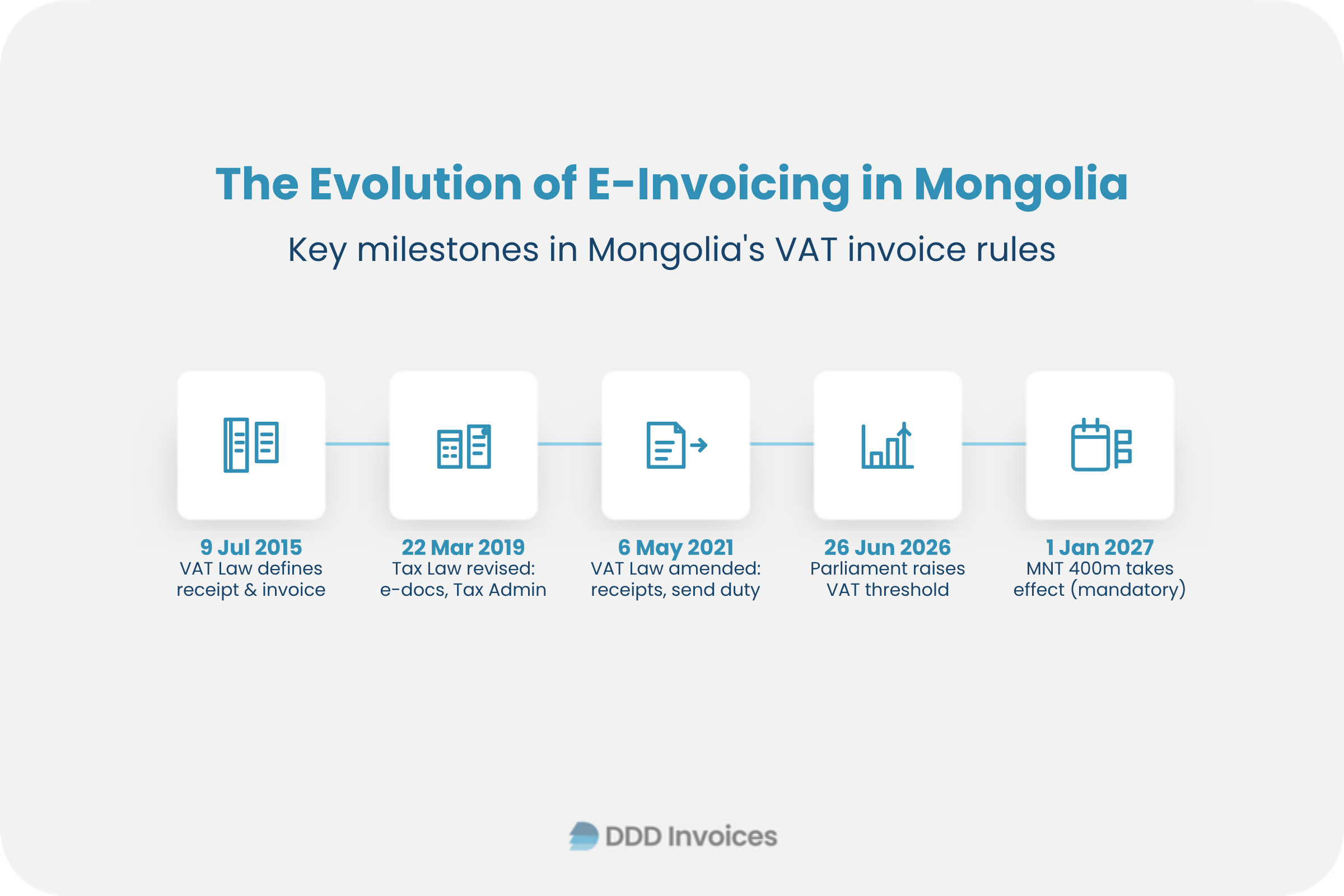
- July 9, 2015: the revised Law on VAT defines the payment receipt, VAT invoice, user system and integrated system.
- March 22, 2019: the General Law on Taxation is revised, defining electronic tax documents and the Tax Administration.
- May 6, 2021: the VAT Law is amended on receipts, VAT invoices and transmission duties.
- June 26, 2026: parliament raises the VAT registration threshold.
- 1 January 2027: the MNT 400 million mandatory threshold takes effect.
B2G e-invoicing in Mongolia
No separate B2G e-invoicing mandate is confirmed in the sources reviewed. Sales to public bodies follow the same rules as other sales: a payment receipt for each sale and, where both sides are VAT withholding taxpayers, a VAT invoice.
Government buyers are not described as using a dedicated invoice-routing channel. Services provided by government organisations are VAT-exempt under Article 13.5.12.
B2B e-invoicing in Mongolia
Under Article 14.3, a receipt is required for each sale between VAT withholding taxpayers. A VAT invoice is then issued for one receipt or for several combined. The buyer's input-tax deduction depends on that VAT invoice (Article 14.4).
Article 17.3.4 requires B2B VAT-invoice records to be sent to the integrated system within seven days. A plain PDF, a scan or a standalone ERP record does not meet this requirement.
Typical onboarding steps:
- Registration: confirm VAT withholding status and taxpayer registration number with the General Department of Taxation.
- Connection: link your ERP or billing system to eBarimt through an approved user system supplier.
- Data mapping: map receipt and invoice fields: taxpayer ID, unique payment number, item code, quantity, price, payment and tax amounts.
- Testing: check that receipts and VAT invoices reach the integrated system, then reconcile them with accounting records.
A unified e-invoicing API can take over the connection and data-mapping steps for software providers working across several markets.
B2C e-invoicing in Mongolia
Under Article 17.3, a VAT withholding taxpayer must record each payment in the user system and issue a receipt for each sale to the buyer. Receipt data must reach the integrated system within three days.
Each receipt carries a unique payment number, built from the seller's registration number, branch number, payment date and sequence number. Receipts include taxpayer identification, item details, and payment and tax amounts. Cash registers and POS terminals count as registration machines.
Imports, exports and non-resident services:
- Imports: VAT of 10% applies to imports. The base is customs value plus duty and excise (Articles 9 and 11). VAT arises on the customs declaration date.
- Exports: qualifying exports, declared goods and services to non-residents are zero-rated under Article 12.
- Non-resident services: supplies by a non-resident to a resident are taxable under Article 7.2.5. Detailed reverse-charge mechanics are not confirmed here.
E-reporting and VAT compliance
Mongolia has no separate periodic e-reporting regime confirmed beyond eBarimt transmission and VAT returns. Electronic invoice reporting does not replace the monthly VAT return.
VAT is 10% standard, with 0% for qualifying exports. Under the VAT Law, VAT is paid and the return filed by the 10th of the following month.
Corrections, cancellations and returns must follow official eBarimt procedures. Reconcile eBarimt data with your ledgers every month. Under Article 11 of the Accounting Law, accounting documents and financial statements must be kept for at least 10 years.
Penalties for non-compliance
Penalties sit in the VAT Law and the Law on Violations. The Tax Administration's VAT guide lists the figures below. Verify them against current law before publication.
Offence | Fine | Escalation or closure |
|---|---|---|
Failure to provide payment receipts | 2% of previous month's sales | Not confirmed |
Receipt issued at a different price from the selling price | 20% of previous month's sales | Not confirmed |
Unpaid tax | 0.1% of unpaid tax per day | Not confirmed |
Underpaid or unregistered VAT | 40% of the tax imposed | 50% if repeated after audit |
Your trusted partner for e-invoicing
Every sale in Mongolia needs an eBarimt receipt, and every B2B sale between VAT withholding taxpayers needs a VAT invoice. Getting both right, on time, across your ERP and POS, is where most teams lose hours.
DDD Invoices removes that work with one unified e-invoicing API. You issue, receive and archive compliant invoices in 30+ countries, without building each local integration yourself. Mongolia is not yet on our coverage page, so support is pending.
{{__CTA:TalkToUsCta__}}
FAQs
Who must use eBarimt in Mongolia?
VAT withholding taxpayers must issue a receipt for each sale through a connected user system. Between them, a VAT invoice supports the buyer's input-tax deduction.
When must eBarimt data be sent?
Receipt data must generally reach the integrated system within three days. B2B VAT-invoice data must be sent within seven days.
What changes on 1 January 2027?
The mandatory VAT registration threshold rises from MNT 50 million to MNT 400 million. Voluntary registration remains at MNT 10 million.
Does eBarimt replace the VAT return?
No. Monthly VAT returns are still filed and paid by the 10th of the following month, alongside eBarimt reporting.
Mandatory B2B and B2G e-invoice reporting through certified myDATA providers, with fiscalization for B2C receipts and simplified invoices.

E‑invoicing in Malta is primarily encouraged in the public sector, where public entities must be able to receive electronic invoices.
Electronic invoices are structured digital documents. Learn what an e‑invoice is, how it works, and why it matters for tax and compliance.