
E-Invoicing in Nicaragua: Current DGI Requirements & Tax Rules
Author
Shuaa

E-invoicing in Nicaragua falls within the fiscal-invoicing framework administered by the Dirección General de Ingresos (DGI). Taxpayers must issue invoices or legally recognized fiscal documents as required under the Tax Code, not only when collecting IVA. Businesses using computerized invoicing require prior DGI authorization under Disposición Técnica No. 09-2007, published in La Gaceta on 16 July 2007.
The computerized-invoicing regulation and DGI’s system-authorization guidance establish authorization and fiscal-document controls. They do not establish a nationwide structured e-invoicing rollout date or prescribe nationwide XML, JSON, Peppol, digital-signature, or real-time invoice-clearance requirements.
Latest News
Embeds a monitoring pages group for this blog article
{{__MONITORING_PAGES_GROUP:blog_articles_588__}}DGI’s published Sistema de Autorización de Comprobantes Fiscales e Imprentas (SACFI) guidance describes computerized-invoicing authorization through the Ventanilla Electrónica Tributaria (VET). The process includes an application and DGI inspection. Authorization is valid for one year and requires annual renewal. DGI expressly states that authorization covers the computerized system, not the ranges of fiscal documents it issues.
What Is E-Invoicing and Why Is Nicaragua Adopting It?
E-invoicing supports electronic invoice processing, while Nicaragua’s established framework focuses on authorized systems and reliable fiscal records.
Disposición Técnica No. 09-2007 regulates businesses choosing computerized invoicing. It requires controlled user access, backups of daily operational information, Spanish-language technical and user manuals, and continuous, unalterable invoice numbering. Each computerized invoice must display the DGI authorization number in its lower-right corner.
The Evolution of E-Invoicing in Nicaragua
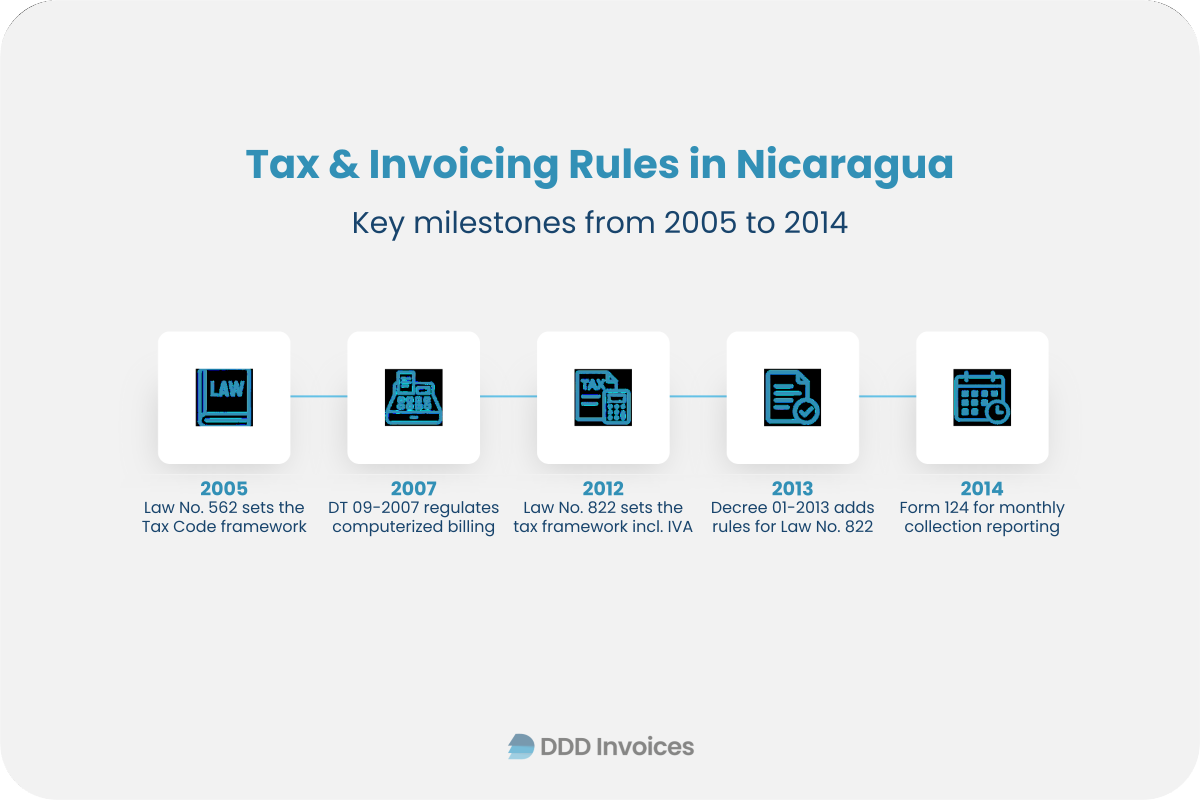
- 2005 — Law No. 562, Código Tributario de la República de Nicaragua, established the Tax Code framework. It was published in La Gaceta No. 227 on 23 November 2005.
- 2007 — Disposición Técnica No. 09-2007 established authorization requirements and operational controls for computerized invoicing. It was published in La Gaceta No. 134 on 16 July 2007.
- 2012 — Law No. 822, Ley de Concertación Tributaria, established the broader tax framework, including IVA. It was published in La Gaceta No. 241 on 17 December 2012.
- 2013 — Decree No. 01-2013 introduced implementing regulations for Law No. 822. It was published in La Gaceta No. 12 on 22 January 2013.
- 2014 — DGI introduced Form 124 for monthly collection and advance-payment reporting, effective for September 2014 operations. See DGI’s guidance, Question 17 — PMD y formulario 124, which identifies DAG 03-2014 as the legal basis.
These milestones document tax legislation, computerized-invoicing controls, and tax reporting. They should not be presented as implementation phases of a nationwide structured e-invoicing mandate.
B2G Electronic Invoicing in Nicaragua
Government suppliers must issue invoices meeting applicable legal requirements. Where withholding applies, the purchasing public institution acts as the withholding agent: it deducts the applicable income-tax withholding from the supplier’s payment and reports and remits it to DGI. The supplier receives a withholding certificate, known as a constancia de retención, documenting the amount deducted and supporting any applicable tax credit.
The rate depends on the transaction and supplier’s tax status, not simply on having a government customer. DGI’s withholding catalogue lists the transaction codes and rates withholding agents must use, including 2% for general purchases of goods and services and 10% for professional or higher technical services supplied by an individual, subject to the applicable rules and exceptions.
B2B Electronic Invoicing in Nicaragua
B2B suppliers must issue compliant fiscal invoices for taxable transactions. DGI guidance requires IVA collectors to record the buyer’s RUC when the customer is an IVA or ISC collector, an IR withholding agent, or a fixed-quota taxpayer. Required buyer identification also affects IVA credit eligibility.
Key invoice information includes:
- Issue date, seller identification, RUC, and business contact details.
- Consecutive invoice numbering.
- Buyer identification where required.
- Description and quantity of goods or services.
- Unit prices, transaction value excluding IVA, and applicable discounts.
- Separately stated IVA or the reason for exemption.
The standard IVA rate is 15%, subject to applicable exemptions and zero-rating under Law No. 822. Generating an invoice through an ERP does not remove the requirement for DGI authorization of the computerized-invoicing system.
B2C E-Invoicing in Nicaragua
Consumer sales remain subject to applicable fiscal-document requirements. DGI guidance requires IVA collectors to document taxable transactions through compliant manual or electronic processes. Computerized invoicing requires prior DGI authorization.
Under section 3.2 of Disposición Técnica No. 09-2007, cash receipts used instead of invoices for collecting service payments must meet invoicing requirements and separately show the transaction value and IVA. For credit sales, cash receipts instead acknowledge partial or full payment against the underlying invoice.
E-Reporting and VAT Compliance in Nicaragua
Nicaragua has periodic electronic tax reporting through the Ventanilla Electrónica Tributaria (VET). DGI guidance identifies Form 124 as the monthly declaration for general-regime taxpayers, covering IVA and applicable advance-payment or minimum-definitive-payment (PMD) obligations. This periodic filing process should not be confused with real-time electronic invoice clearance.
Relevant forms include:
- Form 124 — The consolidated monthly collection and advance-payment declaration, generated using income and tax-credit schedules.
- Form 110 — The IVA form that DGI’s Question 41 permits for amendments limited to tax-credit information. Where increased income affects both IVA and advance payments or PMD, DGI recommends amending through Form 124.
- Form 122 — Identified in DGI’s historical transitional guidance as “Retenciones efectuadas Ley de Concertación Tributaria.” Businesses should confirm the applicable withholding form in VET rather than treat this historical reference as a universal current instruction.
Businesses should use the forms assigned to their registered tax obligations and prepare the required supporting schedules. Form 110 should not be presented as the default monthly IVA filing route where the consolidated Form 124 procedure applies.
Cross-border transactions
Exports of goods require an invoice or another document stating their commercial value. Qualifying exports receive 0% IVA treatment under Article 109 of Law No. 822. Imports require customs declarations and supporting documentation, including commercial invoices, subject to applicable exceptions, and remain subject to the relevant customs duties and IVA treatment.
Corrections, contingency, and retention
Retain annulled invoices with originals and copies marked “ANULADO.” Later-day returns or cancellations require credit notes under Disposición Técnica No. 09-2007.
During equipment or power failures, use preprinted contingency invoices with separate numbering reported to DGI. After recovery, record transactions in the system and link them to the manual invoices.
DGI guidance identifies a four-year general tax-record retention period linked to prescription, subject to applicable Tax Code exceptions.
What Happens If Businesses Don’t Comply?
Failure to meet computerized-invoicing requirements can attract a fine of 50–70 penalty units and annulment of the affected acts or activities. Omitted or late tax declarations can attract fines of 70–90 penalty units, with penalties applied separately to each tax obligation reported in Form 124.
Under the Tax Code amendments, each penalty unit equals C25,makingthesefinesC1,250–C1,750andC1,750–C$2,250 respectively. Overdue IVA attracts a surcharge of 5% per month or part-month on the unpaid balance, capped at 50%.
Missing the buyer’s required RUC can also prevent the buyer from claiming IVA credit, according to DGI’s invoice guidance.
Your Trusted Partner for E-Invoicing in Nicaragua
DDD Invoices helps businesses and software providers simplify invoice creation, exchange and archiving through a single API across supported markets. Its standardized integration connects existing ERP, accounting and billing systems to streamline multi-country invoicing workflows.
DDD Invoices does not currently support Nicaragua; country support is pending. Businesses can contact the DDD team to discuss integration needs and enquire about future availability.
Displays a content card with title, subtitle, list/body, and action button
{{__CTA:GenericCtaJson:{"type":"content","contentCta":{"layout":"cardList","title":"Talk to us!","subtitleHtml":"Still have questions?","button":{"href":"https://calendly.com/ddd-invoices/30min-intro","label":"Book a free 30min call","color":"white"},"bodyHtml":"In the <strong>30min free call</strong> we will discuss:","listHtml":"<ul><li><strong>your requirements</strong> in invoicing</li><li>how integration works</li><li><strong>demo</strong> of the product</li><li>next steps</li></ul>"}}__}}FAQs
Is e-invoicing mandatory in Nicaragua?
Disposición Técnica No. 09-2007 requires prior DGI authorization for businesses choosing computerized invoicing. It does not establish a nationwide structured e-invoicing mandate.
Does Nicaragua require XML or Peppol?
The reviewed computerized-invoicing regulation does not prescribe XML, JSON, or Peppol formats.
What is VET used for?
VET provides access to electronic tax declarations and SACFI authorization procedures, including computerized-invoicing system applications.
How long must businesses retain invoices?
DGI guidance, Question 7, identifies a four-year general tax-information retention period linked to prescription. Applicable extensions and exceptions should be checked under Article 43 and related Tax Code provisions.