
E-Invoicing in North Korea: Tax System and Sanctions
Author
Shamyudha

Since 2006, UN Security Council sanctions have restricted trade with North Korea. Its budget runs on state enterprise payments collected by financial organs, not taxes, so e-invoicing in North Korea has no national system.
North Korea has no B2B, B2C, B2G or cross-border e-invoicing mandate, no e-reporting obligation, no official invoice format and no announced start date. Taxes were abolished in 1974, so there is no VAT chain to protect. For foreign companies, UN, US, EU and UK sanctions set the binding rules on any dealings with North Korea.
Latest news
Embeds a monitoring pages group for this blog article
{{__MONITORING_PAGES_GROUP:blog_articles_610__}}On October 28, 2026, the US Treasury announced new OFAC designations of 10 individuals and one entity in North Korea and Russia. They facilitate schemes that get North Korean IT workers hired abroad under fake identities. Contractor invoices therefore need screening too, as OFAC can impose civil penalties on a strict liability basis.
EU firms must screen against the EU list, updated October 12, 2026.
{{__CTA:IntegrationStepsCta__}}
What is e-invoicing and why hasn't North Korea adopted it?
E-invoicing is the exchange of invoices in a structured format that software can process without re-entry. Governments usually mandate it to secure VAT collection.
North Korea has no VAT to secure, because Article 25 of the Constitution states that taxes have been abolished. No clearance, post-audit or Peppol model applies.
The evolution of e-invoicing in North Korea
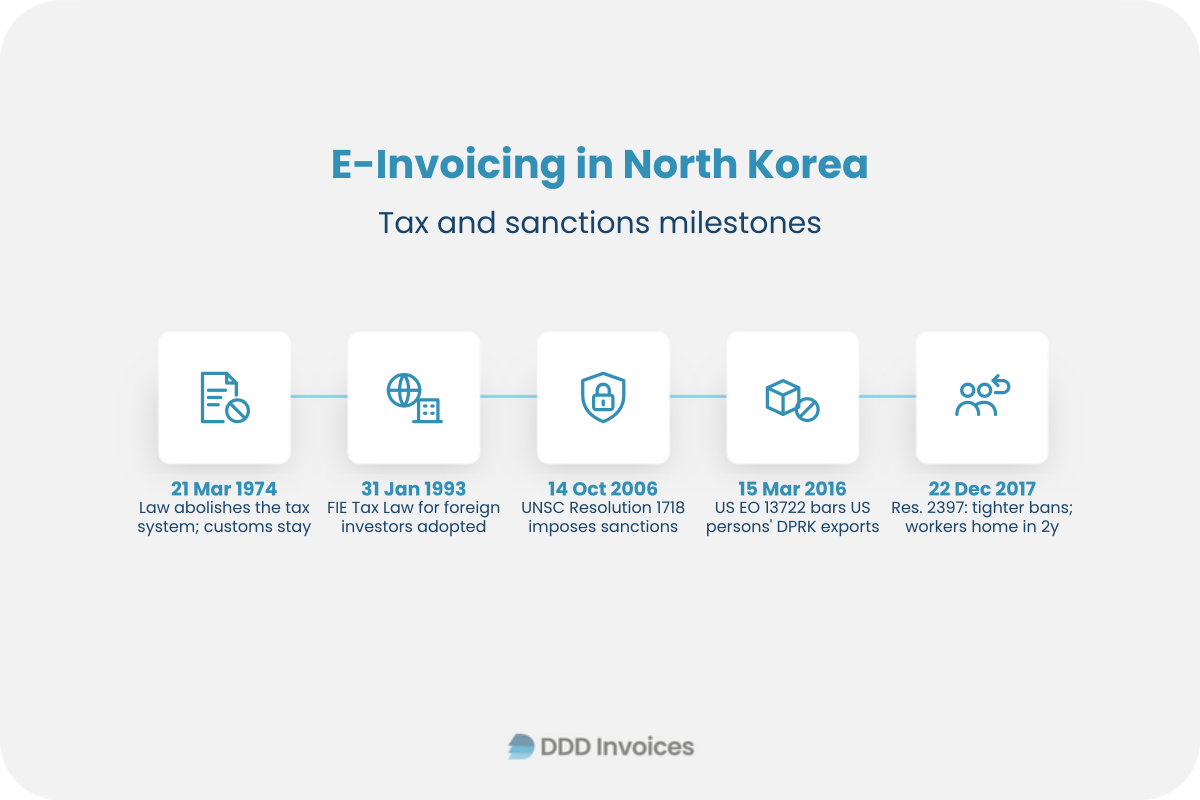
There are no e-invoicing milestones, only tax and sanctions dates.
- March 21, 1974: The Supreme People's Assembly adopts the law abolishing the tax system; from April 1, 1974, only customs duties and enterprise payments remain.
- January 31, 1993: The FIE Tax Law for foreign-invested enterprises and foreign individuals is adopted, alongside today's Rason Economic and Trade Zone Law.
- October 14, 2006: UN Security Council Resolution 1718 imposes UN sanctions and creates the 1718 Committee.
- March 15, 2016: US Executive Order 13722 bars US persons from exporting goods, services or technology to North Korea.
- December 22, 2017: Resolution 2397 tightens UN trade bans and requires states to send North Korean workers home within 24 months.
B2G e-invoicing in North Korea
There is no B2G e-invoicing mandate, unlike countries with mandatory B2G e-invoicing, and no published route for invoicing North Korean public bodies. Executive Order 13722 blocks the property of the Government of North Korea and its controlled entities, so US persons may not deal in it.
B2B e-invoicing in North Korea
There is no B2B e-invoicing mandate for local enterprises, foreign-invested businesses or cross-border supplies. The FIE Tax Law sets no invoice, receipt or electronic-document rule.
The real question is whether you may invoice a North Korean counterparty at all. The UN 1718 Committee oversees bans on trade, financial services and joint ventures, and the US, EU and UK add their own regimes.
- Screen first: check customers, suppliers, banks and vessels against the 1718 Sanctions List and national lists.
- Escalate any DPRK link: stop and take legal advice before quoting, invoicing or paying.
- Follow home rules: your registration country sets invoice content, VAT and archiving.
- Monitor official sources: sanctions lists change often, as October 2026 showed.
B2C e-invoicing in North Korea
North Korea has no B2C e-invoicing rules: no e-receipt format, fiscal device, certified POS or offline mode has been published. The usual retail split between e-invoicing and fiscalization therefore does not arise. Online and other consumer sales face the same sanctions checks.
E-reporting and VAT compliance
A national requirement for periodic electronic reporting or VAT returns remains unconfirmed in publicly available sources. This does not mean enterprises have no periodic payment or reporting obligations.
North Korea’s domestic budget-revenue system differs from the tax framework applicable to foreign-invested enterprises. These should not be presented as a single VAT or GST system.
Penalties for non-compliance
North Korea sets no e-invoicing penalties; the exposure is sanctions penalties at home, such as 31 CFR Part 505.
Offence | Fine |
|---|---|
US civil breach under 31 CFR Part 505 | Greater of US$377,700 or twice the transaction value, per violation |
US willful breach under 31 CFR 505.401 | Up to US$1,000,000, 20 years in prison for individuals, or both |
UK civil breach under the Policing and Crime Act 2017, section 146 | Greater of £1,000,000 or 50% of the funds involved; strict liability |
UK finance or trade offence under regulation 110 | Up to 7 years (finance) or 10 years (trade) in prison, a fine, or both |
EU breach | Set by each EU Member State |
Your trusted partner for e-invoicing
North Korea has no e-invoicing mandate, so what matters is sanctions screening and compliant invoicing where you can trade. DDD Invoices gives you one API to issue, receive and archive compliant invoices across every country we support, so your ERP or billing software connects once and we keep each country's format, validation and deadline rules up to date for you. North Korea is not on our country coverage list because there is no mandate to connect to.
{{__CTA:TalkToUsCta__}}
FAQs
Why is there no e-invoicing in North Korea?
North Korea abolished taxes in 1974, so there is no VAT for e-invoices to secure or report. Its budget relies on state enterprise payments under a 2005 law that contains no invoice rules.
What taxes do foreign investors pay in North Korea?
Foreign-invested enterprises and foreign individuals pay income, property and other taxes under the 1993 FIE Tax Law. Rason adds zone incentives, but neither law requires e-invoices, and UN sanctions prohibit joint ventures.
How do sanctions affect invoicing a North Korean company?
Sanctions decide whether an invoice can be issued at all, before format or tax treatment matter. UN, US, EU and UK rules prohibit or restrict most trade, services and payments involving North Korea.
When will North Korea introduce e-invoicing?
No date exists, because no e-invoicing or e-reporting framework has been officially published by Pyongyang. This guide is reviewed regularly and will be updated as soon as any official framework appears.