
E-Invoicing in Pakistan: FBR Digital Invoicing Rules
Author
Shamyudha

With e-invoicing in Pakistan, each invoice carries a QR code built from a number the tax authority assigns. The Federal Board of Revenue (FBR) oversees FBR Digital Invoicing, operated by Pakistan Revenue Automation (PRAL) and reached through IRIS.
Every sales-tax-registered person in Pakistan must issue e-invoices through FBR Digital Invoicing, for taxable and exempt supplies. Each invoice reaches FBR in real time, via PRAL or a licensed integrator, and shows the FBR invoice number. The last phase ended on December 31, 2025; federal excise and Islamabad Capital Territory services followed on September 29, 2026.
Latest news
Embeds a monitoring pages group for this blog article
{{__MONITORING_PAGES_GROUP:blog_articles_621__}}On September 29, 2026, S.R.O. 1666(I)/2026 extended the e-invoicing rules to federal excise duty (FED) and Islamabad Capital Territory (ICT) services. Integrated businesses need no new integration, and one e-invoice can cover all three taxes. Excise payers must map six new FED fields, and advance receipt invoices now go out electronically.
On October 26, 2026, S.R.O. 1904(I)/2026 set conditions for claiming the 10% income tax credit on integration costs under section 64D.
{{__CTA:IntegrationStepsCta__}}
What is e-invoicing and why has Pakistan adopted it?
E-invoicing means issuing invoices as structured data in a set format. Pakistan uses a clearance model: under Rule 150R of the Sales Tax Rules, FBR's system numbers each invoice before printing. FBR's FAQs say it eases exchanging invoices and debit or credit notes.
The evolution of e-invoicing in Pakistan
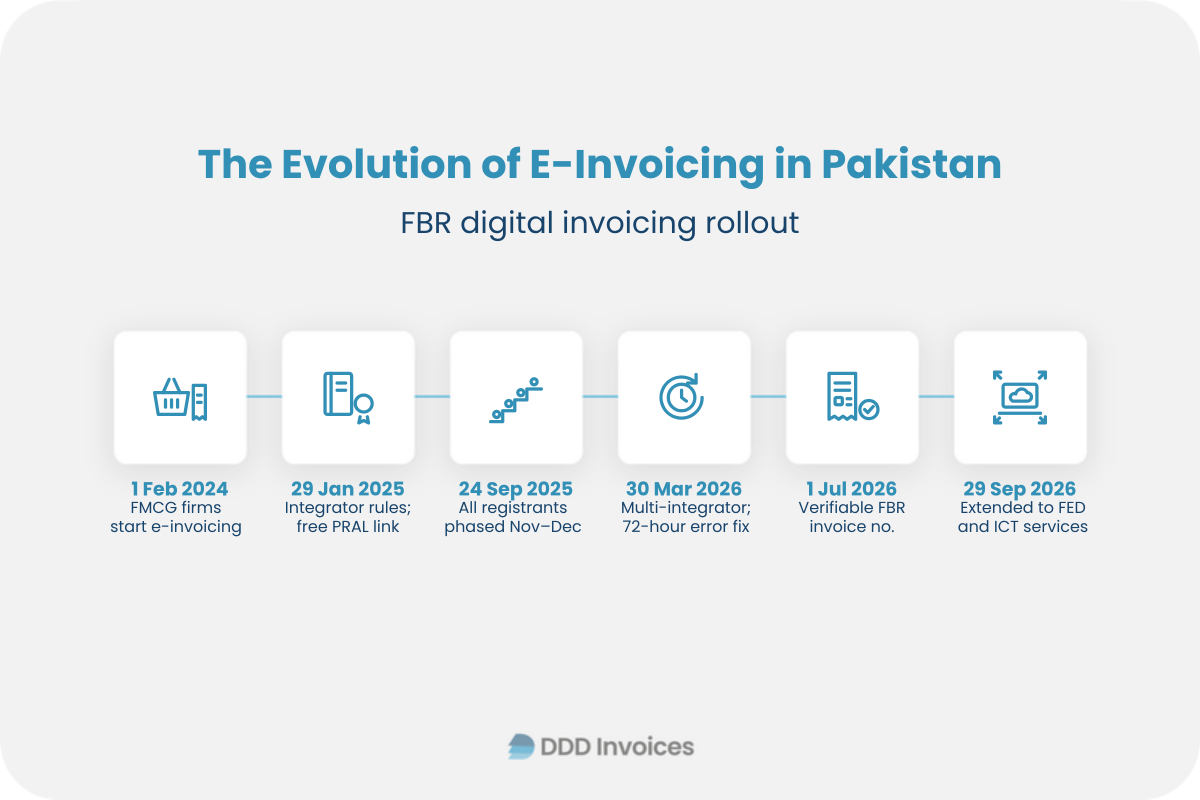
- February 1, 2024: FMCG importers, manufacturers, wholesalers and distributors start e-invoicing under S.R.O. 28(I)/2024.
- January 29, 2025: S.R.O. 69(I)/2025 rewrites Chapter XIV of the Sales Tax Rules, covering integrator licensing and free PRAL integration.
- September 24, 2025: S.R.O. 1852(I)/2025 phases in all registered persons from November 1, 2025 to December 31, 2025.
- March 30, 2026: STGO 01 of 2026 allows several licensed integrators and a 72-hour window to correct bona fide mistakes.
- July 1, 2026: the Finance Act 2026 requires a verifiable FBR invoice number on taxable and exempt supply invoices, from a time FBR notifies.
- September 29, 2026: S.R.O. 1666(I)/2026 extends the e-invoicing rules to FED and ICT services.
B2G e-invoicing in Pakistan
B2G e-invoicing is mandatory on B2B terms, with no separate government portal or format. Public buyers can check that an invoice reached FBR through the verification facility required by Rule 150XB.
B2B e-invoicing in Pakistan
B2B e-invoicing is mandatory for every sales-tax-registered person, with no turnover threshold. Invoices travel as JSON through FBR's Digital Invoicing API. Rule 150R(13) requires seller and buyer details, HS code, sales tax, sales tax withheld at source, extra tax and further tax.
Exports are zero-rated under section 4 but still need e-invoices, since FBR's FAQs require one for every sale in Annexure-C, the return's sales annex. Imports are taxed at the border, and importers e-invoice their onward sales.
- Register: in IRIS, open Digital Invoicing and choose PRAL, which is free, or another licensed integrator, which may charge.
- Test: after IP whitelisting, pass the sandbox scenarios for your activity and sector.
- Go live: switch to the production token issued after testing.
B2C e-invoicing in Pakistan
B2C e-invoicing is mandatory for registered persons, and online sellers must register their website or app with FBR. The buyer's CNIC or NTN is optional for unregistered customers, except unregistered distributors of manufacturers or importers.
Under Rule 150XC, invoices issued offline during internet or power failures are uploaded within 24 hours of restoration. Tier-1 retailers whose point-of-sale systems already report to FBR count as integrated.
E-reporting and VAT compliance in Pakistan
Pakistan has periodic reporting: e-invoices auto-fill Annexure-C of the monthly return under Rule 150R(5). Under Rule 18, tax is due by the 15th and the return by the 18th of the next month. The Sales Tax Act 1990 sets sales tax at 18%, plus 4% further tax on supplies to unregistered or inactive buyers.
Under STGO 01 of 2026, invoices issued by bona fide mistake can be cancelled, deleted or edited in FBR's system within 72 hours. Later changes need the Commissioner Inland Revenue's prior approval, while returns or price changes use electronic debit or credit notes.
Keep records for six years after the tax period, or until pending proceedings end, under section 24 and Rule 150S. Draft S.R.O. 288(I)/2026 of February 18, 2026 would apply similar income tax rules to restaurants, private schools and other listed businesses.
Penalties for non-compliance in Pakistan
Section 33 of the Sales Tax Act 1990 sets e-invoicing penalties from Rs 500,000, and section 21 allows suspension.
Offence | Fine |
|---|---|
Not integrating or not issuing e-invoices (S. No. 25A) | Rs 500,000, then Rs 1 million, Rs 2 million and Rs 3 million at 15-day intervals after each order; premises may be sealed |
Invoice lacking a valid FBR invoice number or QR code (S. No. 24) | Rs 500,000 or 200% of the tax involved, whichever is higher |
Breaching section 23(5) and (6) (section 21, since July 1, 2026) | Suspension or blacklisting, and input tax on the supplier's invoices is not entertained |
Your trusted partner for e-invoicing in Pakistan
Pakistan's 72-hour edit window means invoice data should be right first time, and e-invoicing is mandatory for each sales-tax-registered person.
DDD Invoices checks your data before processing through one unified e-invoicing API, so your ERP can send, receive and store invoices in covered countries. Our country coverage list does not include Pakistan yet, so test other markets free and tell us about your Pakistani entities.
{{__CTA:TalkToUsCta__}}
FAQs
When did e-invoicing become mandatory in Pakistan?
For all sales-tax-registered persons, it phased in from November 1, 2025, ending on December 31, 2025. FMCG importers, manufacturers, wholesalers and distributors started earlier, on February 1, 2024, under earlier rules.
What is an FBR invoice number?
It is the unique number FBR's Digital Invoicing API returns in real time for each accepted invoice. The invoice prints it with a matching QR code and the Digital Invoicing logo.
How do you cancel an e-invoice in Pakistan?
Invoices issued by bona fide mistake can be cancelled, deleted or edited in FBR's system within 72 hours. Later changes need prior Commissioner Inland Revenue approval, while returns use debit or credit notes.
Why should buyers verify FBR invoice numbers?
Section 8 of the Sales Tax Act denies input tax that cannot be verified in the supply chain. Input tax on invoices from a supplier suspended for not integrating is also not entertained.