
E-Invoicing in Saint Kitts and Nevis: IRD Rules and VAT Invoices
Author
Shamyudha

Saint Kitts and Nevis replaced its consumption tax with a 17% VAT in November 2010, then moved tax filing online in 2024 through the SMARTS system. That modernisation covers returns and payments, not invoice exchange. The Inland Revenue Department (IRD), led by the Comptroller of Inland Revenue, administers VAT. SMARTS supports online tax filing and payment, but these services are separate from structured e-invoicing
No structured e-invoicing mandate exists for B2B, B2C or B2G transactions in Saint Kitts and Nevis. VAT-registered suppliers must issue a pre-numbered tax invoice to registered customers and a sales receipt to everyone else, in any format (paper, PDF or electronic). Businesses registered compulsorily above the EC$150,000 threshold (EC$96,000 for prescribed professional services and commercial or time-share leasing) must keep records electronically, file a VAT return every month and pay by the 15th of the following month.
Latest news
Embeds a monitoring pages group for this blog article
{{__MONITORING_PAGES_GROUP:blog_articles_602__}}The most recent official VAT change is the IRD’s August 2026 Discounted VAT Rate Days. Approved businesses charged 5% on goods on August 28 and 29, 2026 and had to report those sales on the August return through the SKN MyGovernment Portal, with a sales report due by September 11, 2026, per the IRD business guidance for the August 2026 DVR Days. Only VAT-registered businesses with all returns filed and no outstanding liabilities could apply to take part.
Before that, the standard rate returned to 17% on July 1, 2025 after a temporary 13% rate for the first half of 2025.
{{__CTA:IntegrationStepsCta__}}
Is e-invoicing used in Saint Kitts and Nevis?
E-invoicing means exchanging invoices as structured, machine-readable data. Saint Kitts and Nevis has not adopted it. The Federation runs a post-audit VAT model: businesses issue invoices in their own systems, keep records for inspection and report totals monthly. The IRD’s digitalisation effort focuses on SMARTS, launched on February 5, 2024, which offers online filing and payment through the My Government Portal, according to the SKNIS announcement.
VAT and digital-filing timeline
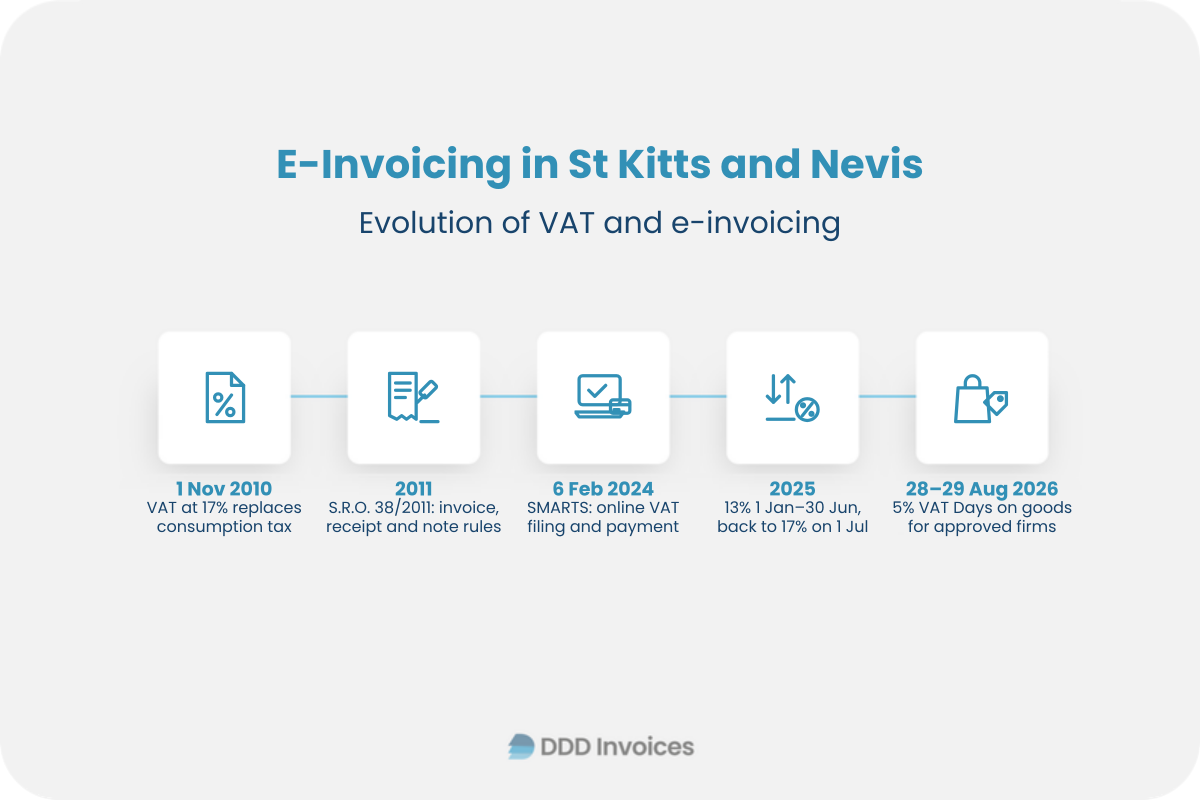
- November 1, 2010: VAT comes into force at 17% under the Value Added Tax Act, No. 3 of 2010, replacing the consumption tax.
- 2011: The VAT Regulations (S.R.O. 38/2011) set the particulars for tax invoices, sales receipts, credit and debit notes, and electronic recordkeeping.
- February 5, 2024: SMARTS launches with online VAT filing and payment through the My Government Portal.
- January 1 to June 30, 2025: Temporary 13% standard rate under the IRD’s VAT reduction guidelines, then back to 17% on July 1, 2025.
- August 28 to 29, 2026: Discounted VAT Rate Days at 5% on goods for approved businesses.
B2G e-invoicing in Saint Kitts and Nevis
No general structured B2G e-invoicing mandate has been identified. Under section 7(2)(c) of the VAT Act, government and public-authority activities are generally excluded from taxable activity. Exceptions include conducting auctions, hiring equipment, renting space, leasing land and activities commonly conducted for profit. Suppliers must apply the appropriate VAT-document rules according to the transaction and the buyer’s registration status.
B2B e-invoicing in Saint Kitts and Nevis
B2B e-invoicing is voluntary. What is mandatory is the tax invoice. Under section 44 of Cap. 18.47 and Schedule 2 of the Regulations, a registered supplier must give a registered recipient one original, pre-numbered tax invoice showing the full names and trade name of both parties, both taxpayer identification numbers (TINs), a description and quantity of the goods or services, the consideration, the VAT due, the issue date and the total. A recipient who has not received one may request it in writing within 60 days, and the supplier must comply within 14 days.
A valid tax invoice showing the supplier’s TIN is the only proof the IRD accepts for input tax deductions, as its business information leaflet stresses. Corrections use a pre-numbered tax credit note or tax debit note that identifies the original supply, shows the old value, the adjusted value, the difference and the related VAT, and explains the reason. Only one note may be issued per adjustment, and the adjustment is reported on the VAT adjustments line of the return.
Getting ready in practice:
- Register: apply within 14 days of exceeding the threshold using the IRD’s registration guide; voluntary registration is possible at the Comptroller’s discretion.
- Configure invoicing: make sure your issued invoices carry every Schedule 2 particular and a unique sequence number.
- Capture purchases: store received invoices with supplier TINs so input credits survive an audit.
- Archive electronically: compulsorily registered businesses must keep records in approved electronic tills, POS or accounting systems (Regulation 17(3)), so a compliant archive is part of the obligation.
B2C e-invoicing in Saint Kitts and Nevis
Sales to unregistered customers need a sales receipt, not a tax invoice. The receipt shows the supplier’s name, trade name and TIN, a description of the supply, the consideration, the VAT, the date and the total. All advertised prices must be VAT inclusive.
For cash sales of EC$50 or less to a registered customer, a sales receipt may replace the tax invoice. No fiscal device certification, QR code or real-time transmission applies. Compulsorily registered retailers must still run electronic tills or POS systems approved by the Comptroller and keep till and audit rolls, which is where a connected POS integration and fiscalization-ready setup pay off later.
E-reporting and VAT compliance
Saint Kitts and Nevis has monthly periodic reporting. VAT-01 returns and payment are generally due by the 15th of the following month, including nil returns. Reconcile sales, purchases, output VAT, input credits and adjustments. Correct errors in the affected return rather than netting them against later returns.
VAT is 17% standard and 10% for qualifying accommodation, tour and restaurant services. Qualifying exports are zero-rated with supporting Customs evidence; imported goods attract VAT at Customs. Imported-service liability depends on statutory use and exemption conditions, not simply purchasing from a foreign supplier.
Penalties for non-compliance
VAT non-compliance can attract civil penalties, interest and, for specified offences, criminal prosecution. The applicable provision depends on the breach.
Offence | Penalty |
|---|---|
Late return | EC$100 per month or part month |
Late payment | 10% of tax due plus 1.25% monthly interest |
Failure to register | Double the output tax due from the date registration was required |
False or missing tax invoice, receipt or credit/debit note | Up to EC$25,000 |
Failure to keep records | EC$50 per day |
Failing to issue an invoice within 60 days (criminal) | Up to EC$20,000 or one year in prison |
Unfiled returns for two or more periods (criminal) | Up to EC$50,000 or three years in prison |
Repeat offences after written warning | Court-ordered closure for 3 to 30 days |
Your trusted partner for e-invoicing
Saint Kitts and Nevis requires compliant VAT invoices, electronic records and monthly returns, with no clearance platform yet.
DDD Invoices does not currently cover the Federation, but one API already issues, receives and archives compliant invoices across more than 100 countries and absorbs rule changes as they land. Software providers can see how the ERP integration and API documentation work today and register interest for this market.
{{__CTA:TalkToUsCta__}}
FAQs
Is e-invoicing mandatory in Saint Kitts and Nevis?
No, no structured e-invoicing mandate applies to B2B, B2C or B2G transactions in the Federation. VAT-registered businesses must still issue compliant tax invoices and file monthly VAT returns with the IRD.
What must a VAT invoice in Saint Kitts and Nevis include?
A tax invoice must be pre-numbered and show both names, both TINs, description, quantity, consideration, VAT and date. Without these particulars the IRD will refuse the buyer’s input tax deduction during an audit.
When is the VAT return due in Saint Kitts and Nevis?
The return and payment are due by the 15th of the following month. Late filing costs EC$100 per month and late payment adds 10% plus 1.25% monthly interest.
How long must invoices be kept in Saint Kitts and Nevis?
Tax invoices, credit and debit notes, customs documents and accounting records must be kept for six years. Compulsorily registered businesses must hold them electronically, which a compliant archiving service handles.