
E-Invoicing in Saint Lucia: Status & VAT Invoice Rules (2026)
Author
Bishma

As of 28th October 2026, Saint Lucia has no announced national e-invoicing mandate, and no format or clearance model has been published. Invoice duties sit in the Value Added Tax Act, which the VAT Section of the Inland Revenue Department (IRD) administers. These rules cover tax invoices and sales receipts, not a government e-invoice format or clearance platform.
For businesses, that means invoicing stays a matter of getting the standard VAT documents right. Registered businesses issue tax invoices or sales receipts, file periodic VAT returns and keep their records in Saint Lucia. Any electronic invoicing is a voluntary commercial practice, not a regulatory requirement. This guide covers the current status, invoice rules, VAT compliance and how to prepare if a framework is announced.
Latest News
Embeds a monitoring pages group for this blog article
{{__MONITORING_PAGES_GROUP:blog_articles_608__}}Businesses should treat IRD notices as the source for any future change.
What Is E-Invoicing in Saint Lucia?
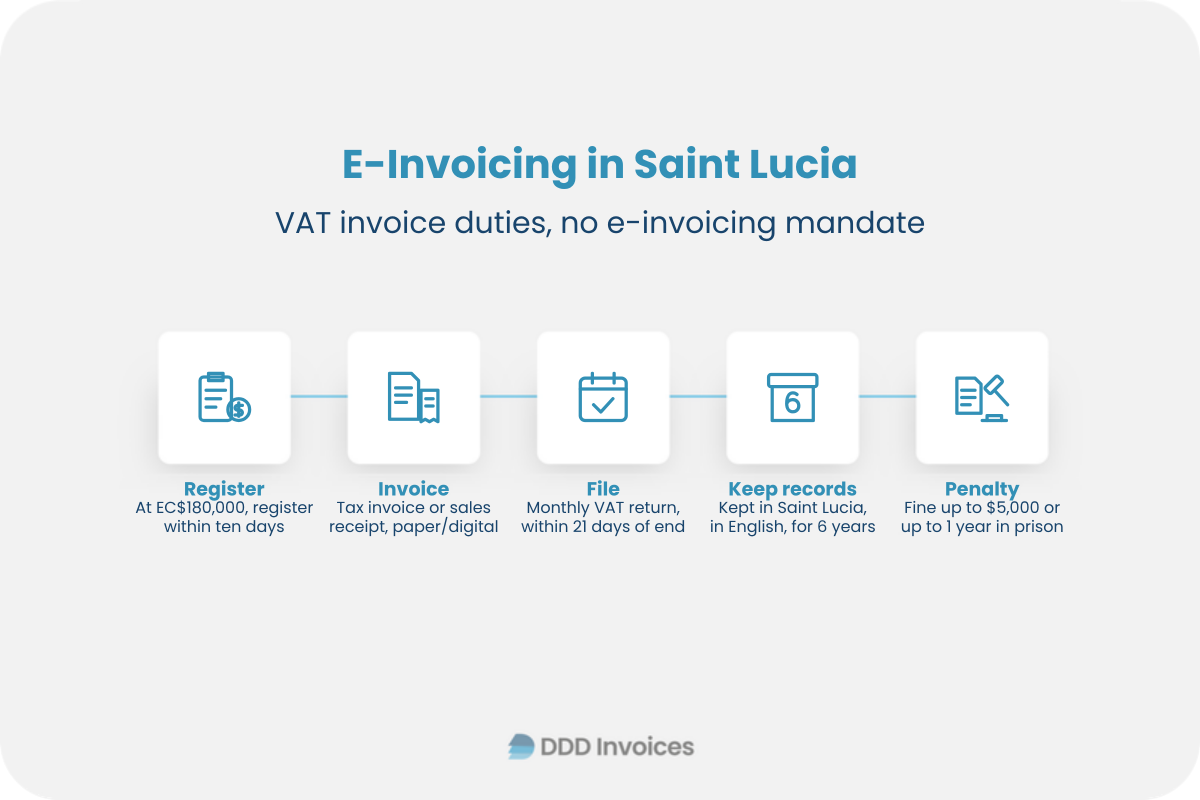
Saint Lucia has not published an e-invoicing system. Businesses follow the standard VAT invoice rules in the Value Added Tax Act, administered by the Inland Revenue Department (IRD).
A VAT-registered person issues a tax invoice to other registered businesses and a sales receipt to unregistered customers. Details include the supplier’s Tax Identification Number (TIN), the buyer’s TIN where applicable, a description, the price and the total VAT.
Registration is required once taxable supplies reach EC$180,000, within ten days of reaching it. Voluntary registration is available below that. Invoices may be issued on paper or electronically, but there is no government platform, format or clearance step.
E-Invoicing Timeline
28 October 2026: No e-invoicing implementation date, pilot or format has been published.
B2G E-Invoicing in Saint Lucia
B2G e-invoicing does not exist in Saint Lucia. Suppliers to government bodies issue standard VAT tax invoices. The contract or tender sets the purchase-order, delivery and payment terms.
B2B E-Invoicing in Saint Lucia
B2B e-invoicing is not mandatory. Businesses may send invoices by email or accounting software by agreement, which is a voluntary commercial practice. The compliance point is a correct tax invoice, with the buyer's details where the buyer is registered.
B2C E-Invoicing in Saint Lucia
B2C e-invoicing does not exist in Saint Lucia. Retailers don't have to use fiscal devices or issue e-receipts, and they don't report sales to the IRD in real time. VAT-registered businesses issue a sales receipt to consumers.
E-Reporting and Tax Compliance
Saint Lucia has periodic reporting in the form of VAT returns. A registered person must account for and pay VAT for each tax period, and the return and payment are due within 21 days after the period ends.
The return is submitted with the VAT records, including tax invoices, sales receipts, and debit and credit notes. Monthly returns are the norm. These are summary returns, not lists of individual invoices.
Records must be kept in Saint Lucia, in English, for 6 years after the end of the tax period. They include original and copy tax invoices, sales receipts, tax credit and debit notes, customs documents and accounting records.
Penalties for Non-Compliance
Saint Lucia’s VAT Act sets out penalties for record-keeping failures rather than e-invoicing-specific offences. Under section 91, failure to maintain the required records attracts an administrative penalty of $100 for each day or part of a day that the failure continues. Separately, section 69(4) makes non-compliance with record-keeping requirements a criminal offence, punishable on summary conviction by a fine of up to $5,000 or imprisonment for up to one year. The Act addresses failure to file VAT returns separately.
Your E-Invoicing Partner
Businesses in Saint Lucia need accurate tax invoices, consistent numbering and a secure archive, even without an e-invoicing mandate. VAT records must be kept in Saint Lucia for six years after the tax period ends.
DDD Invoices is an API-first platform that lets business software issue, receive, archive and manage locally compliant invoices through one integration. It can centralise billing data, manage corrections and credit notes, and retain audit-ready records. Saint Lucia support is pending, so check any setup against current IRD guidance.
{{__CTA:TalkToUsCta__}}
FAQs
What is the VAT registration threshold in Saint Lucia?
It is $180,000 in taxable supplies or sales.
When are VAT returns and payments due?
Returns are monthly, with payment due within 21 days after the period ends.
What is the penalty for failing to keep records?
A fine of up to $5,000 or imprisonment for up to one year.
Where do businesses file returns?
Through the IRD VAT Section and the online e-Filing portal. This is a tax filing system, not an invoice platform.