
E-Invoicing in Samoa and VAGST Tax Invoice Rules
Author
Shamyudha

Samoa's economy runs on tourism and imports, so most invoices cross a hotel desk or shop counter. The Ministry of Revenue (MOR) taxes those sales through VAGST and monitors them through TIMS, a fiscal invoice system. E-invoicing in Samoa, in the Peppol or clearance sense, does not exist yet.
Samoa has no Peppol, UBL or clearance e-invoicing mandate. VAGST-registered businesses must give registered buyers a tax invoice in the approved form within 28 days of supply. Businesses registered on TIMS must issue a fiscal invoice for every sale, and since 2026 the Ministry no longer grants extensions.
Latest news
Embeds a monitoring pages group for this blog article
{{__MONITORING_PAGES_GROUP:blog_articles_654__}}The Ministry's TIMS refresher notice set training for all TIMS-registered taxpayers from April 30 to May 7, 2026, ahead of a system upgrade. It also said the Ministry will apply penalties and other enforcement to taxpayers not issuing fiscal invoices, and will no longer allow extensions.
Buyers are affected too: check that supplier fiscal invoices are valid before claiming input tax.
{{__CTA:IntegrationStepsCta__}}
What is e-invoicing and why has Samoa adopted it?
E-invoicing is the exchange of structured invoice data between seller and buyer systems. Samoa has not adopted it: the VAGST Act 2015 requires a tax invoice in the approved form but does not mention electronic invoices.
Samoa chose fiscalization instead. Section 29A of the Tax Administration Act 2012 lets the Inland Revenue Services run electronic monitoring systems, and TIMS is one.
The evolution of e-invoicing in Samoa
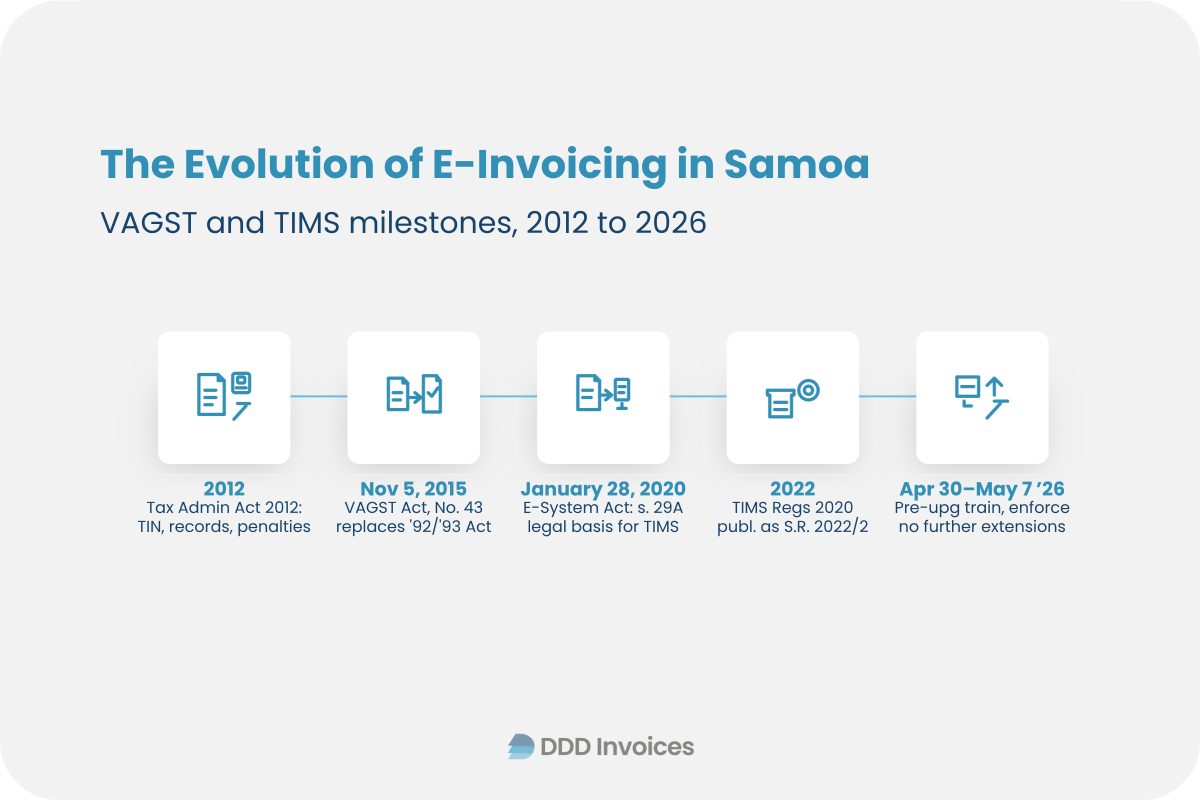
- 2012: The Tax Administration Act 2012 sets TIN, records and penalty rules.
- November 5, 2015: The VAGST Act 2015, No. 43, replaces the 1992/1993 Act.
- January 28, 2020: The Electronic System Amendment Act inserts section 29A, the legal basis for TIMS.
- 2022: The TIMS Regulations 2020 are published as S.R. 2022/2.
- April 30 to May 7, 2026: Refresher training ahead of the upgrade, then enforcement with no further extensions, per the Ministry notice.
B2G e-invoicing in Samoa
B2G e-invoicing is not mandatory, and no government e-invoicing portal exists. The VAGST Act binds the Government, so suppliers invoice ministries with a normal VAGST tax invoice. Government bodies registered for VAGST need it to claim input tax, as for any buyer.
B2B e-invoicing in Samoa
B2B e-invoicing is not mandatory. Under section 33 of the VAGST Act, registered suppliers give registered buyers an original tax invoice in the approved form within 28 days. Supplies under SAT 20 need none.
Each person holds only one TIN (taxpayer identification number), so use the entity's TIN, never a partner's personal one. Correct errors with a credit note when VAGST was overcharged and a debit note when it was undercharged (section 36).
Businesses outside TIMS may issue PDFs. TIMS-registered businesses issue every sale, B2B included, as a signed fiscal invoice reported to the Ministry. To get set up:
- Register for VAGST: file Form IR31 within 15 working days once turnover passes the registration threshold.
- Confirm TIMS status: check with the TIMS Support Center whether TIMS applies to you.
- Build compliant invoices: use the approved form, sequential numbers, both parties' TINs and the VAGST amount.
- Register for eTax: enrol on Samoa eTax before your first return.
B2C e-invoicing in Samoa
B2C e-invoicing is not mandatory. Consumers get receipts, and TIMS-registered businesses issue a fiscal invoice for every sale. See how fiscalization and POS software handle signed receipts.
E-reporting and VAT compliance
Samoa has periodic e-reporting: VAGST-registered businesses file a return every two months through Samoa eTax, which also handles payment. Electronic tax reporting covers returns, not invoices.
VAGST is 15%, with exports of goods and services consumed outside Samoa zero-rated. Customs collects VAGST on imports, and registered buyers of imported services self-account with a recipient-created tax invoice. Registration is required above SAT 130,000. Non-residents without a fixed place in Samoa appoint a GST representative, and international companies get no exemption.
Returns and payment are due within 15 working days after each two-month period, under the VAGST Act 2015. Input tax is deferred until you hold the tax invoice. Keep invoices and credit and debit notes for 7 years under section 29 of the Tax Administration Act.
Penalties for non-compliance
Invoice offences sit in section 46 of the VAGST Act 2015, in penalty units worth SAT 100 each under the Fines Act 1998.
Offence | Fine |
|---|---|
Not giving a registered buyer a tax invoice | Up to SAT 500, then SAT 700, then SAT 1,000 |
Issuing duplicate invoices | Up to SAT 3,000 from third conviction |
Other VAGST offences without a set fine | Up to SAT 5,000 |
Return unfiled one month after due date | SAT 300 for companies, SAT 100 for others |
Tax unpaid one month after due date | 10% of the unpaid tax |
Tax evasion | Up to three times the tax evaded |
Your trusted partner for e-invoicing
Samoa asks for correct tax invoices and fiscal invoices, not structured e-invoices, yet regional groups still juggle many formats. DDD Invoices gives finance teams a single API that connects your ERP once to send, receive and archive e-invoices in more than 30 countries. Samoa is not yet on our country coverage list, so talk to us about where your Samoan entity fits in a Pacific rollout.
{{__CTA:TalkToUsCta__}}
FAQs
Is e-invoicing mandatory in Samoa?
No, Samoa has no Peppol, UBL or clearance e-invoicing mandate for any business today. Registered suppliers must still issue VAGST tax invoices, and TIMS-registered businesses must issue fiscal invoices for every sale.
What must a Samoan VAGST tax invoice contain?
A tax invoice must follow the Commissioner's approved form and reach the registered buyer within 28 days. Show both TINs, a sequential number, the date and the VAGST amount, and confirm the current form.
How does TIMS affect input tax claims?
TIMS-registered suppliers must issue a signed fiscal invoice for every sale, including sales to businesses. Buyers should check supplier invoices are valid before claiming, because input tax waits until the invoice is held.
When are Samoan VAGST returns due?
VAGST returns and payment are due within 15 working days after each two-month taxable period ends. Most businesses file and pay online, and API-based invoicing keeps sales data ready for each return.