
E-Invoicing in South Korea: The NTS e-Tax Invoice
Author
Bishma

South Korea has required electronic tax invoices since 2011. The National Tax Service (NTS) runs e-invoicing in South Korea through Hometax, built around the e-Tax Invoice (전자세금계산서).
All corporations must issue e-Tax Invoices under VAT Act Article 32. Individual businesses qualify at a prior-year supply value of KRW 80 million or more per place of business (taxable and exempt supplies combined), a threshold in force since July 1, 2024. Each invoice must reach the NTS by the day after issuance.
Latest news
Embeds a monitoring pages group for this blog article
{{__MONITORING_PAGES_GROUP:blog_articles_605__}}They keep the KRW 80 million threshold and scope. One item would rename the invoice date fields to supply date (공급 연월일) and issue date (발급일) from July 1, 2027, affecting billing templates.
{{__CTA:IntegrationStepsCta__}}
What is e-invoicing and why has South Korea adopted it?
In South Korea, e-invoicing means issuing the tax invoice (세금계산서) electronically as a signed digital document and sending its details to the National Tax Service (NTS). The system started in 2010. Corporations have had to use it since 2011, and individual businesses have been added in stages by size. The legal basis is Article 32 of the VAT Act, and the details are in the VAT Enforcement Decree, Art. 68.
The evolution of e-invoicing in South Korea
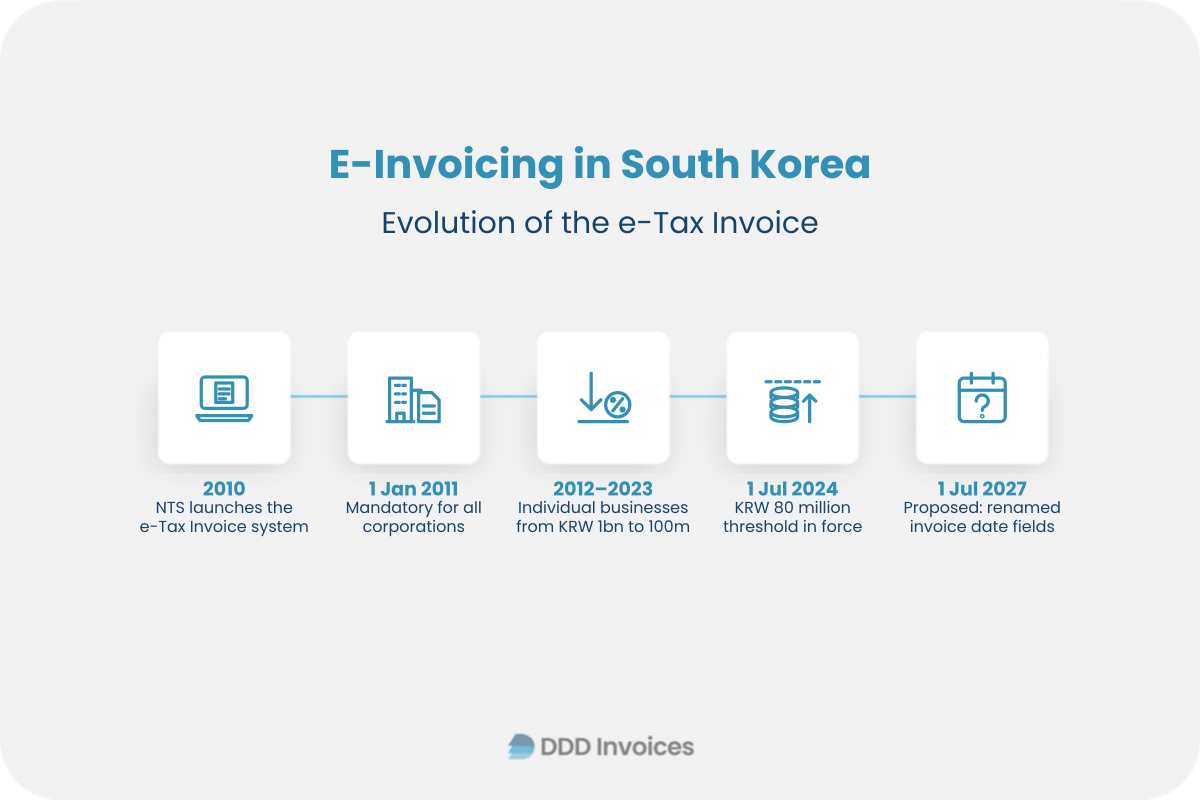
- 2010 to 2011: launched in 2010 and mandatory for all corporations from January 1, 2011.
- 2012 to 2023: individual businesses added at falling thresholds, from KRW 1 billion (2012) to KRW 100 million (July 2023), when the duty became permanent.
- July 1, 2024: KRW 80 million threshold, in force.
- July 1, 2027 (proposed): renamed invoice date fields
B2G e-invoicing in South Korea
B2G e-invoicing is mandatory for in-scope suppliers. Public bodies without a business registration number use their unique number (고유번호) under VAT Act Article 32(1) and retrieve invoices in Hometax, which lists them by month and quarter.
B2B e-invoicing in South Korea
B2B e-invoicing is mandatory for corporations. Individual businesses are in scope with a prior-year supply value of KRW 80 million or more per place of business (taxable and exempt supplies combined). They start the following July 1 and stay obliged if supplies drop.
VAT-exempt sales need a separate electronic invoice (전자계산서), with the same threshold for individuals. Exports and sales to foreign buyers without a Korean place of business are generally exempt, unless the buyer proves business status and asks. Local letter of credit supplies need a zero-rated e-Tax Invoice. Foreign companies with a Korean place of business follow domestic rules; customs issues import tax invoices (수입세금계산서) (VAT Act Article 35).
- Certificate: a business, e-Tax Invoice or ASP joint certificate (공동인증서) signs each invoice (NTS issuance guide).
- Registration: join Hometax or an NTS-registered ASP (issuance agent), or register your ERP.
- Transmission: automatic in Hometax; ERP and ASP flows must send by the next day.
- Testing: confirm each invoice in Hometax.
B2C e-invoicing in South Korea
There is no B2C e-Tax Invoice mandate: consumer-facing businesses issue receipts, card slips or cash receipts (현금영수증), none of which is an e-Tax Invoice. Business buyers can generally demand a tax invoice, so POS systems need both flows.
E-reporting and VAT compliance in South Korea
South Korea has periodic reporting through VAT returns. The year is split into two tax periods, January to June and July to December.
• Corporations: They file a preliminary return and a final return in each period. The preliminary return for 1 January to 31 March is due on 25 April, and the final return for 1 April to 30 June is due on 25 July. The second period works the same way, with the preliminary return due on 25 October and the final return on 25 January.
• Individual general taxpayers: They file one final return per period, due on 25 July and 25 January. They do not file a preliminary return. Instead, they pay the amount shown on a preliminary notice.
• Simplified taxpayers: They file once a year, by 25 January.
If the 25th falls on a weekend or public holiday, the deadline moves to the next business day.
The e-Tax Invoice is reported to the National Tax Service (NTS) separately, by the day after the issue date, under VAT Enforcement Decree Art. 68(7). Late or missing transmission is penalised at 0.3% or 0.5% of the supply value, depending on whether it reaches the NTS by the final return deadline.
Penalties for non-compliance in South Korea
Penalties run from 0.3% to 4% of supply value. (NTS penalty table) Issuance penalties replace transmission penalties.
Offence | Penalty (% of supply value) |
|---|---|
Late issuance (by final return deadline) | 1% (buyer 0.5%) |
Non-issuance | 2%; buyer generally loses input VAT deduction |
Paper invoice by a mandated issuer | 1% |
Late transmission (after next day, by final return deadline) | 0.3% |
No transmission by final return deadline | 0.5% |
Invoice without a real supply | 4% (3% before January 1, 2026) |
Cap per violation type | KRW 50 million (SMEs), KRW 100 million (others); none if intentional |
Your trusted partner for e-invoicing in South Korea
South Korea makes e-Tax Invoices mandatory for corporations and in-scope individual businesses. DDD Invoices gives you one API to issue, receive and archive compliant invoices across every country we support, so your ERP or billing software connects once and DDD keeps each country's format, validation and deadline rules up to date. South Korea is on our country coverage list as collecting interest, and talking to us is the fastest way to move it up the roadmap.
{{__CTA:TalkToUsCta__}}
FAQs
What is an e-Tax Invoice in South Korea?
An e-Tax Invoice (전자세금계산서) is a signed XML tax invoice built to the NTS standard. Corporations and individual businesses at or above KRW 80 million in prior-year supplies must use it.
When must an e-Tax Invoice reach the NTS?
Each e-Tax Invoice must be transmitted to the NTS by the day after its issue date. Hometax transmits automatically, while ERP and ASP users must confirm their own transmission (NTS filing Q&A).
How do you correct an e-Tax Invoice in South Korea?
You issue an amended e-Tax Invoice, because a transmitted invoice cannot be deleted or replaced. Returns, cancellations and price changes take the change date, while errors keep the original date (NTS amendment guide).
Why can't a cash receipt replace an e-Tax Invoice?
Cash receipts and card slips are consumer receipts under VAT Act Article 36, not tax invoices. If a business buyer shows its registration and asks, the seller must generally issue a tax invoice.