
E-Invoicing in Uzbekistan: EHF Clearance and Risk Scoring
Author
Shamyudha

Uzbekistan scores e-invoices for tax risk the moment they are issued. E-invoicing in Uzbekistan runs on the EHF (elektron hisobvaraq-faktura), a digitally signed invoice sent through approved platforms. The Tax Committee of the Republic of Uzbekistan (Soliq) oversees the system.
Since January 1, 2020, legal entities and individual entrepreneurs must issue EHFs for B2B and B2G sales. A state operator checks each EHF in real time and returns non-compliant ones to the seller. Since January 1, 2026, self-employed sellers must issue EHFs too, and VAT payers' EHFs are rated low or high risk. On a high-risk EHF, the buyer can claim VAT only once it is paid, by the supplier or the buyer as tax agent.
Latest news
Embeds a monitoring pages group for this blog article
{{__MONITORING_PAGES_GROUP:blog_articles_641__}}Published on July 21, 2026, Cabinet Resolution No. 393 adds a real-time license check to EHF issuance. Sellers of goods in licensed, permit or notification-based activities need a valid document on record first, so check yours.
{{__CTA:IntegrationStepsCta__}}
What is e-invoicing and why has Uzbekistan adopted it?
E-invoicing means issuing invoices as structured data that systems check automatically.
Uzbekistan uses a clearance model: under Resolution No. 522, the state roaming operator rejects rule-breaking EHFs before delivery. Official benefits include speed, lower costs and billing software integration.
The evolution of e-invoicing in Uzbekistan
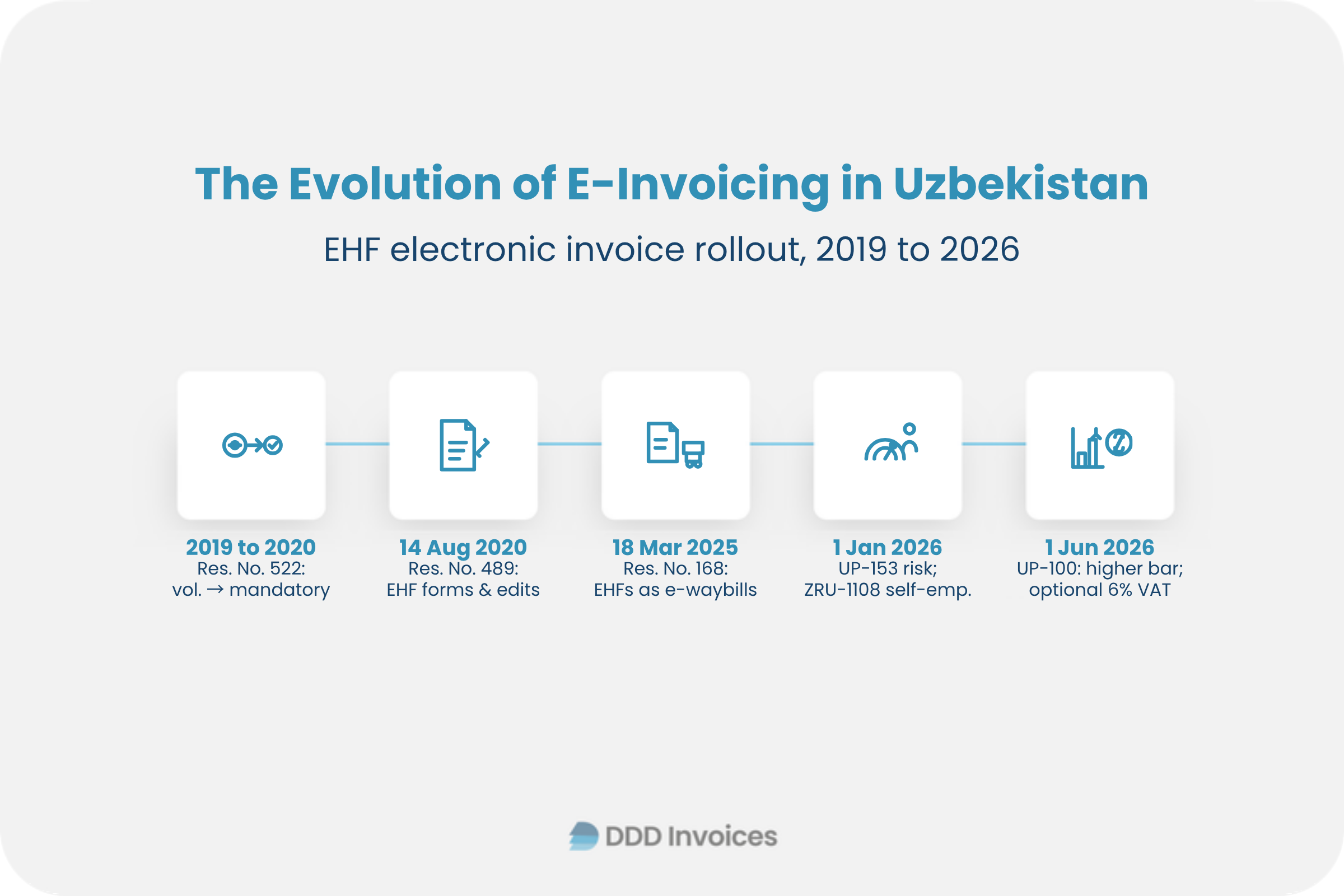
- 2019 to 2020: Resolution No. 522 makes EHFs voluntary from July 1, 2019 and mandatory from January 1, 2020.
- August 14, 2020: Resolution No. 489 sets EHF forms and correction rules.
- March 18, 2025: Resolution No. 168 lets EHFs double as e-waybills.
- January 1, 2026: risk scoring ordered by Decree UP-153 starts under Resolution No. 830, and Law ZRU-1108 adds self-employed sellers.
- June 1, 2026: Decree UP-100 raises the general-regime threshold and adds optional 6% VAT.
B2G e-invoicing in Uzbekistan
B2G e-invoicing has been mandatory since January 1, 2020, without the separate portal some B2G e-invoicing regimes use. Budget organizations confirm EHFs like any buyer.
Under Resolution No. 489, EHFs to them show the exchange-trade lot number, and budget-funded construction has had its own form since October 1, 2024. Paper is reserved for state secrets and confirmed outages.
B2B e-invoicing in Uzbekistan
B2B e-invoicing is mandatory under Article 47 of the Tax Code for legal entities, individual entrepreneurs and, since January 1, 2026, self-employed persons.
EHFs go through one of 29 authorized operators, such as Didox or Faktura.uz, or the Tax Committee's E-factura service. Issue EHFs on the shipment date, though Resolution No. 168 lets utilities, telecoms, rail, forwarding and pipelines invoice monthly by the next month's 10th.
Buyers accept or reject within 10 calendar days, or one day for digitally marked goods, and claim VAT only through EHFs.
Since January 1, 2026, Resolution No. 830 scores each EHF low or high risk at issuance, without blocking it. On a high-risk EHF, buyers credit VAT only once the supplier, or the buyer voluntarily as tax agent, pays it in full.
- Register: open your taxpayer personal cabinet.
- Get an EDS: one electronic digital signature per signer.
- Connect: link your ERP to an operator or E-factura.
- Map codes: align product and marking codes.
B2C e-invoicing in Uzbekistan
B2C e-invoicing is not mandatory where a cash register receipt replaces the invoice, as Article 47 allows. Without one, as on bank transfers, the seller signs the EHF alone.
Decree UP-5813 has required online or virtual cash registers for all cash-revenue businesses since January 1, 2022. Receipts carry a QR code and fiscal mark but no buyer details.
Offline receipts must reach the fiscal data operator within 24 hours, so your POS software needs reliable sync.
E-reporting and VAT compliance
Uzbekistan uses periodic reporting. Since January 1, 2026, the tax authorities pre-fill VAT, turnover, social and personal income tax returns under Law ZRU-1108. Taxpayers must correct any mismatch within five days, or the draft is treated as accepted and filed.
VAT is 12%, with exports zero-rated. The Tax Committee says rates will not rise before January 1, 2028. From June 1, 2026, Decree UP-100 sets the general-regime threshold at 12,000 base calculation values. Until January 1, 2030, trade, catering and service businesses may opt into a 6% VAT without input credit.
Penalties for non-compliance
Invoice and register fines under Chapter 28 of the Tax Code run from 1% of the value shown to 20% of quarterly revenue.
Offence | Fine |
|---|---|
Wrong product codes on an EHF or receipt (Art. 223) | 1% of the value shown |
VAT shown where none applies (Art. 225) | 20% of that VAT, also payable |
No required cash register or receipt (Art. 221) | UZS 5 million; UZS 7 million if unregistered; UZS 20 million if non-compliant |
Breaching fiscal, integration or marking rules (Art. 227-1) | 2% of last quarter's net revenue; 20% if repeated within a year |
Your trusted partner for e-invoicing
EHF issuance has been mandatory since January 1, 2020, and a high-risk score holds back your buyer's VAT credit until the tax is paid. DDD Invoices keeps your other markets on the same API structure, handling 99% of government changes while your ERP issues, receives and archives invoices. Because Uzbekistan is missing from our country coverage list, a short call about your Uzbek entities helps us judge where it fits.
{{__CTA:TalkToUsCta__}}
FAQs
What is an EHF in Uzbekistan?
An EHF is an electronic invoice, signed with an electronic digital signature and sent through an authorized operator. The roaming operator checks it, and once the buyer confirms, it carries a QR code.
Do foreign e-service providers issue EHFs in Uzbekistan?
No, foreign providers selling e-services to individuals register for VAT instead and issue no EHFs. They register within 30 days of starting, with no threshold, and file quarterly by the next month's 20th.
How do you correct an EHF in Uzbekistan?
Returns, discounts and price or quantity changes need an additional EHF within one year, or the warranty period. For errors, a corrected EHF cancels the original and keeps its number and date.
Why does a high-risk EHF matter to buyers?
Buyers can credit VAT on a high-risk EHF only after that VAT is fully paid to the budget. The supplier can pay it, or the buyer can pay it voluntarily as tax agent.