
Fiscalization and Real-Time Reporting in Argentina
Author
Shamyudha

Argentina's tax authority, the Agencia de Recaudación y Control Aduanero (ARCA), replaced AFIP in October 2024. Fiscalization in Argentina pairs real-time electronic invoices with fiscal devices used at shop tills since the 1990s.
Fiscalization in Argentina is mandatory: each sale needs an electronic invoice with an ARCA code (CAE) or a nueva tecnología controlador fiscal tique. Since August 1, 2026, the advance code (CAEA) covers contingencies only, and taxpayers not subject to VAT go electronic-only from March 1, 2027.
Latest news
Embeds a monitoring pages group for this blog article
{{__MONITORING_PAGES_GROUP:blog_articles_692__}}Since November 1, 2026, monotributo social and monotributo promovido taxpayers must issue electronic invoices or use a controlador fiscal under Resolución General 5893/2026. Printed booklets now serve contingencies only, so check these sellers have a Comprobantes en línea point of sale. On December 1, 2026, banks and card issuers must invoice loans and cardholder charges.
Ley 27.826, in force since October 9, 2026, cuts formal fines by 25% for MiPyMEs, individuals and non-profits that are not Grandes Contribuyentes Nacionales.
What does fiscalization mean in Argentina?
Fiscalization means the tax authority secures each sale record when it is issued. Argentina offers two routes, and most sellers may use either or both.
The factura electrónica needs a CAE (Código de Autorización Electrónico) for each document. Your system, ARCA's Comprobantes en línea or the Facturador app requests it in real time.
The controlador fiscal is an ARCA-homologated till or printer that issues tiques and stores them in its fiscal memory.
{{__CTA:IntegrationStepsCta__}}
Timeline
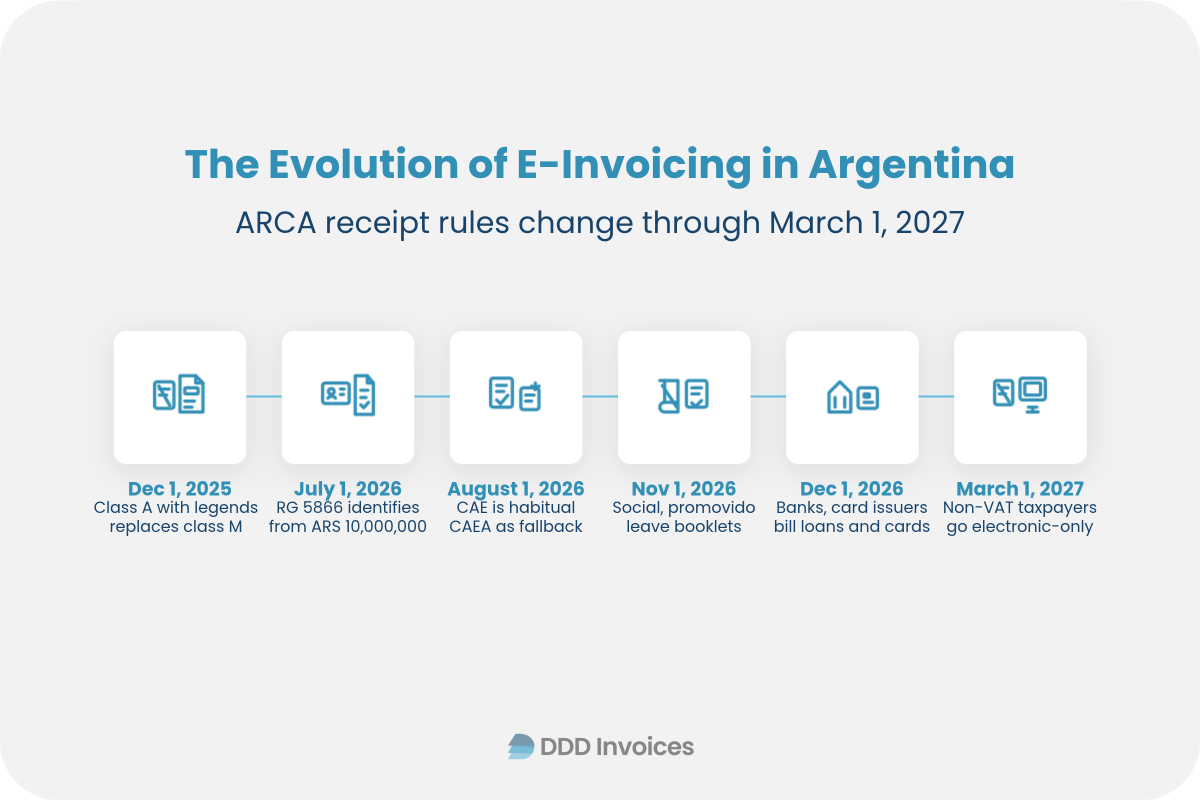
- December 1, 2025: class A with legends replaces class M.
- July 1, 2026: Resolución General 5866/2026 applies.
- August 1, 2026: CAE becomes the habitual mode and CAEA contingency-only.
- November 1, 2026: monotributo social and promovido leave printed booklets.
- December 1, 2026: banks and card issuers invoice loans and cardholder charges.
- March 1, 2027: taxpayers not subject to VAT issue electronic documents only.
Before each date, confirm every sales channel's route, test a CAEA outage flow and retire class M templates on a fiscalization-ready platform.
What fiscal regulations are affecting the businesses in Argentina?
Resolución General 3561 (controladores fiscales)
Resolución General 3561, published on December 17, 2013, admits only homologated nueva tecnología devices. Users send ARCA two monthly reports, the Cinta Testigo Digital and the Resumen de Totales. If a device fails, sellers apply the contingency rules of Resolución General 4290.
Resolución General 4291 (electronic invoices)
Under Resolución General 4291, published on August 3, 2018, an invoice has fiscal effect only once ARCA grants the CAE. Since August 1, 2026, the CAEA advance code covers contingencies only, and those documents are reported to ARCA after each period.
Resolución General 5866/2026
Resolución General 5866/2026, in force since July 1, 2026, replaced Resolución General 5824. Final consumers are identified by DNI, CUIL or CDI from ARS 10,000,000, or by CUIT at any amount for income tax deductions.
Banks, insurers and card issuers join in phases until March 1, 2027 and may issue one monthly settlement per customer.
Resolución General 5893/2026
Resolución General 5893/2026, published on August 31, 2026, lets sellers use either route or both without telling ARCA. Taxpayers not subject to VAT must go electronic-only from March 1, 2027.
Who does fiscalization in Argentina affect?
B2C e-invoicing is not mandatory on its own: consumer sales need an electronic invoice or a controlador fiscal tique. The duty covers VAT-registered, exempt and monotributo sellers on all domestic sales.
- B2C sellers: shops, restaurants and online stores pick either route. In the City of Buenos Aires, receipts must also show Ingresos Brutos by January 1, 2027, and other provinces set their own dates.
- B2B and B2G sellers: class A goes to VAT-registered and monotributo buyers. Since December 1, 2025, class A with the legends "Operación sujeta a retención" or "Pago en CBU informada" replaces class M.
- Special sectors: banks, insurers and card issuers phase in until March 1, 2027, and MiPyMEs billing large companies must invoice electronically.
- Suppliers: only authorised suppliers sell controladores fiscales, while POS vendors and ticketing platforms connect to ARCA web services.
- Customers: scan the QR code on an electronic invoice to verify it.
Our guide covers business e-invoicing in Argentina. Chile's DTE, Uruguay's CFE, Brazil's NF-e and NFC-e and Mexico's CFDI follow separate rules that do not apply here.
What are the implications and penalties?
Ley 11.683 punishes missing receipts with closure and other formal breaches with fines, at amounts reset by Ley 27.799 on January 2, 2026.
Offence | Penalty |
|---|---|
No invoice or equivalent document for goods or services above ARS 20,000 (art. 40) | Closure for 2 to 6 days |
Repeat offence within two years (art. 40) | Minimum and maximum doubled |
Breaking a closure (art. 44) | Arrest of 10 to 30 days and a doubled closure |
Other formal breaches (art. 39) | Fine of ARS 150,000 to 2,500,000 |
MiPyMEs, individuals and non-profits that are not Grandes Contribuyentes Nacionales (art. 49 bis) | Formal fines cut by 25% since October 9, 2026 |
Fines follow UVA yearly from January 1, 2027, and records must be kept for 10 years.
Your Trusted Partner for Fiscalization
Fiscalization in Argentina is mandatory, and ARCA rewrote its CAE, consumer-receipt and issuer rules several times in 2026. DDD Invoices gives you one API to issue, receive and archive documents from one payload, so your ERP or POS never handles local formats. Argentina is still collecting interest on our country coverage list, so support is pending, and a call tells us which channels matter to you.
{{__CTA:TalkToUsCta__}}
FAQs
Is a controlador fiscal mandatory in Argentina?
No, most sellers may choose electronic invoices, a nueva tecnología controlador fiscal or both without notifying ARCA. Taxpayers not subject to VAT must issue electronic documents only from March 1, 2027.
What must a consumer receipt show in Argentina?
It shows the legend A CONSUMIDOR FINAL, the VAT contained in the price and other national indirect taxes. Sales of ARS 10,000,000 or more must also identify the buyer by DNI, CUIL or CDI.
What happens if the controlador fiscal or internet fails?
The seller switches to contingency under Title III of Resolución General 4290 and keeps issuing receipts. Web service users must try the CAEA advance code first, then report those documents to ARCA.
What is the penalty for not issuing a receipt in Argentina?
ARCA can close the premises for 2 to 6 days when the sale exceeds ARS 20,000. A repeat offence within two years doubles the minimum and maximum closure under Ley 11.683.