
Fiscalization and Real-Time Reporting in Indonesia
Author
Shamyudha

Indonesia's Directorate General of Taxes (Direktorat Jenderal Pajak, DJP) moved VAT invoicing onto its Coretax system in 2025. Fiscalization in Indonesia pairs national VAT receipts with regional till monitoring, with no national fiscal device.
VAT-registered retailers must give each consumer a retail tax invoice and report those sales monthly through Coretax, live since January 1, 2025. Buyers that are not end consumers need a full e-Faktur with their NPWP or NIK, and regional tapping boxes record restaurant and hotel sales.
Latest news
Embeds a monitoring pages group for this blog article
{{__MONITORING_PAGES_GROUP:blog_articles_697__}}DJP regulation PER-12/PJ/2026, signed on September 28, 2026, has applied since October 1, 2026. It changes how corrected Coretax returns are calculated, including the monthly VAT return that carries retail sales. Check your reporting tool before correcting any period from January 2025.
On September 7, 2026, Bengkulu City targeted 130 tapping boxes in hotels and restaurants by December 2026, so expect installation visits there.
What does fiscalization mean in Indonesia?
Fiscalization means the tax authority secures sales records at the point of sale. Indonesia has no national fiscal printer, certified cash register or real-time receipt reporting.
A Pengusaha Kena Pajak (PKP), a VAT-registered business, issues a faktur pajak (tax invoice) for every supply.
Consumers get a simplified faktur pajak digunggung (retail tax invoice). Other buyers get an e-Faktur showing their tax number (NPWP) or national identity number (NIK). The DJP approves it in Coretax under the PER-11/PJ/2025 invoice rules.
Regions also tax restaurant meals and hotel stays through PBJT (pajak barang dan jasa tertentu). Many connect a tapping box (alat perekam transaksi) to the till.
{{__CTA:IntegrationStepsCta__}}
Timeline
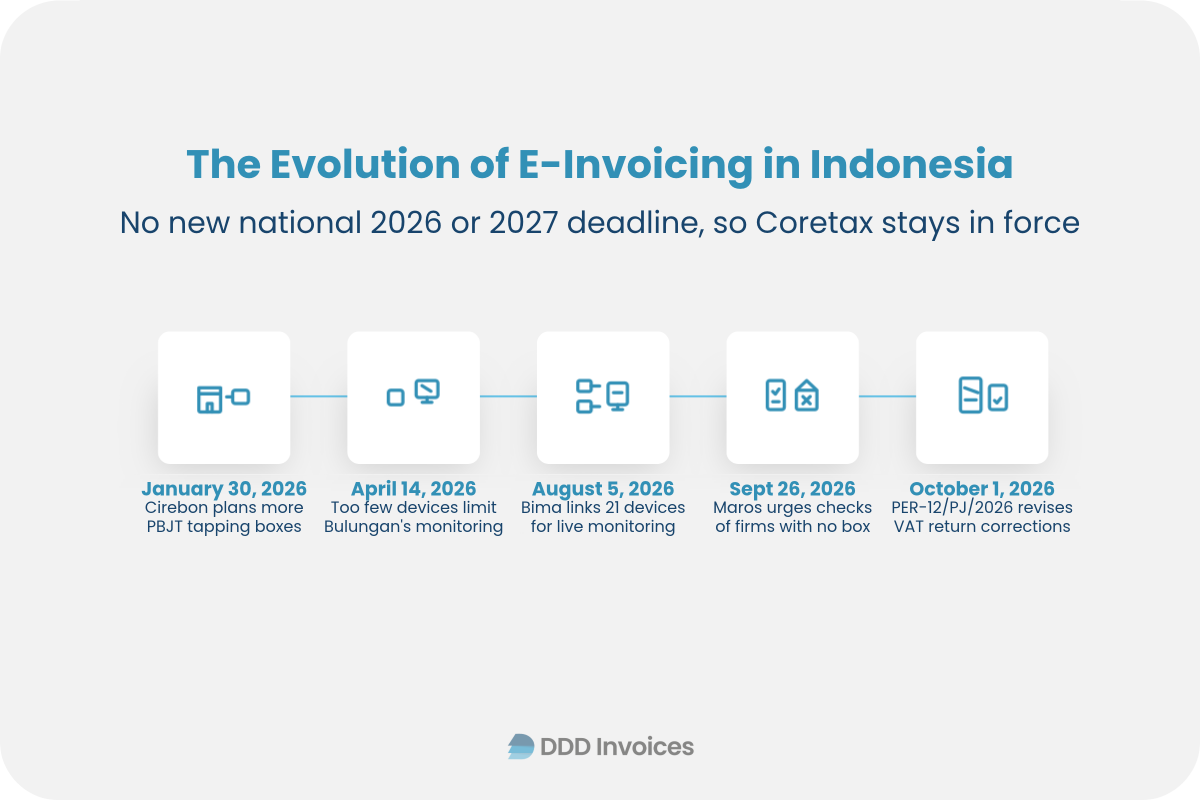
No new national deadline has been published for 2026 or 2027, so Coretax rules stay in force.
- January 30, 2026: Cirebon Regency plans more tapping boxes for restaurant PBJT.
- April 14, 2026: Bulungan Regency says too few devices limit monitoring.
- August 5, 2026: Bima City links 21 devices to real-time monitoring.
- September 26, 2026: Maros Regency's council urges checks on businesses without devices.
- October 1, 2026: PER-12/PJ/2026 changes return corrections.
Before your next return, reconcile till data with PBJT filings on a fiscalization-ready platform.
What fiscal regulations are affecting the businesses in Indonesia?
Laws No. 6 and No. 8 of 1983 (KUP Law and VAT Law)
The consolidated KUP Law makes businesses keep books and documents for 10 years. Law No. 7 of 2021, enacted on October 29, 2021, raised VAT to 12% by January 1, 2025.
PKP registration is compulsory above IDR 4.8 billion of annual turnover.
Law No. 1 of 2022 on Central and Regional Financial Relations (HKPD Law)
Law No. 1 of 2022, in force since January 5, 2022, created PBJT on food and drinks, hotel stays, parking, electricity and entertainment. Each region sets its rate, up to 10%.
PMK 81/2024 and PMK 131/2024 (Coretax and VAT rate)
PMK 81/2024, enacted on October 14, 2024, has governed Coretax since January 1, 2025. Monthly VAT returns stay due by the end of the following month.
PMK 131/2024, also effective January 1, 2025, applies 12% VAT to 11/12 of the price, an effective 11%. Luxury goods pay 12% on the full price.
DJP Regulations PER-1/PJ/2025 and PER-11/PJ/2025
Regulation PER-1/PJ/2025 of January 3, 2025 and DJP regulation PER-11/PJ/2025, effective May 22, 2025, let retailers omit buyer identity and signature on consumer invoices.
A retail tax invoice shows the seller's name, address and NPWP, the goods or services, price, discount, VAT, code, serial number and date. A till slip or electronic document qualifies, and sellers report it in that month's VAT return.
Who does fiscalization in Indonesia affect?
B2C e-invoicing is not mandatory: consumer sales need a retail tax invoice, not an e-Faktur each. Every PKP is covered.
- B2C sellers: shops, minimarkets and online stores issue retail tax invoices to end consumers, who buy for their own use.
- B2B and B2G sellers: issue an e-Faktur for every supply.
- Restaurants, hotels and entertainment venues: charge PBJT instead of VAT on meals, rooms and tickets. Jakarta's Governor Regulation No. 98 of 2019 makes them report all transaction data electronically.
- Software suppliers: POS vendors need compliant receipts, an e-Faktur switch and monthly totals. Regions install tapping boxes themselves or with partner banks.
- Customers: keep the receipt, but cannot credit its VAT.
Our guide to e-invoicing in Indonesia covers B2B flows.
What are the implications and penalties?
The KUP Law covers tax invoice and return failures, the HKPD Law covers unpaid regional tax, and regions set their own sanctions.
Offence | Penalty |
|---|---|
Missing, late or incomplete tax invoice (KUP Law, Article 14) | Tax due plus 1% of the tax base |
Tax invoice over three months late (PER-11/PJ/2025, Article 59) | Treated as not issued, with no VAT credit |
Late monthly VAT return (KUP Law, Article 7) | IDR 500,000 |
Regional tax unpaid (HKPD Law, Article 181) | Negligence: up to 1 year of confinement or a fine of up to twice the tax. Intent: up to 2 years in prison or up to four times the tax |
Till data not reported in Jakarta (Regulation No. 98 of 2019) | Tax assessed by the agency, three summonses, then licence suspension or revocation |
Operators also bear the work of connecting tills.
Your Trusted Partner for Fiscalization
Retail tax invoices are mandatory for every PKP, business buyers need an e-Faktur, and many regions add a tapping box.
DDD Invoices gives you one API and one standardised payload, so your ERP, POS or webshop can issue, receive and archive locally compliant documents. We do not serve Indonesia yet: our country coverage list shows it as collecting interest, so talk to us about Indonesia.
{{__CTA:TalkToUsCta__}}
FAQs
Is fiscalization mandatory in Indonesia?
No, Indonesia has no national fiscal device, certified cash register or real-time reporting of each receipt. VAT-registered sellers must still issue a tax invoice for every sale and report it monthly.
What must a retail tax invoice show in Indonesia?
It shows the seller's name, address and NPWP, the goods or services, price, discount and VAT. It also carries a code, serial number and date, but no buyer identity or signature.
Do Indonesian shops need an e-Faktur for every sale?
No, sales to end consumers are covered by retail tax invoices and reported together in the VAT return. A full e-Faktur showing the buyer's NPWP or NIK is required for business buyers.
What is a tapping box in Indonesia?
A tapping box is a recording device that a regional government connects to a restaurant or hotel till. It sends each transaction to the regional revenue agency for comparison with reported PBJT.