
Fiscalization and Real-Time Reporting in Mexico
Author
Shamyudha

Under the Código Fiscal de la Federación (CFF), fiscalization in Mexico runs on electronic invoices validated before issue. The Servicio de Administración Tributaria (SAT) oversees it, with CFDI 4.0 the only valid version since April 1, 2023.
Every business must cover each sale with a PAC-stamped CFDI 4.0, issued to the buyer's RFC or grouped into a factura global. Both are due within 24 hours of the sale or period close, and since January 1, 2026, CFDIs without real operations are false.
What does fiscalization mean in Mexico?
Fiscalization is recording each sale in an approved system that seals and reports it to the tax authority. In Mexico, it runs on the Comprobante Fiscal Digital por Internet (CFDI), an XML signed with the seller's Certificado de Sello Digital (CSD).
A PAC (Proveedor de Certificación de CFDI) validates it against Anexo 20, adds the timbre fiscal digital (UUID) and sends it to SAT. It first rejects buyer RFCs (tax IDs), names or postal codes that do not match SAT's register. Only the XML counts, as a printout merely presumes it exists (CFF article 29).
On July 10, 2026, Mexico's official gazette (DOF) published SAT's article 49 Bis notices naming sellers whose CFDIs are false. Buyers who used them get 30 calendar days to file corrected returns, or SAT restricts their CSD.
{{__CTA:IntegrationStepsCta__}}
Timeline
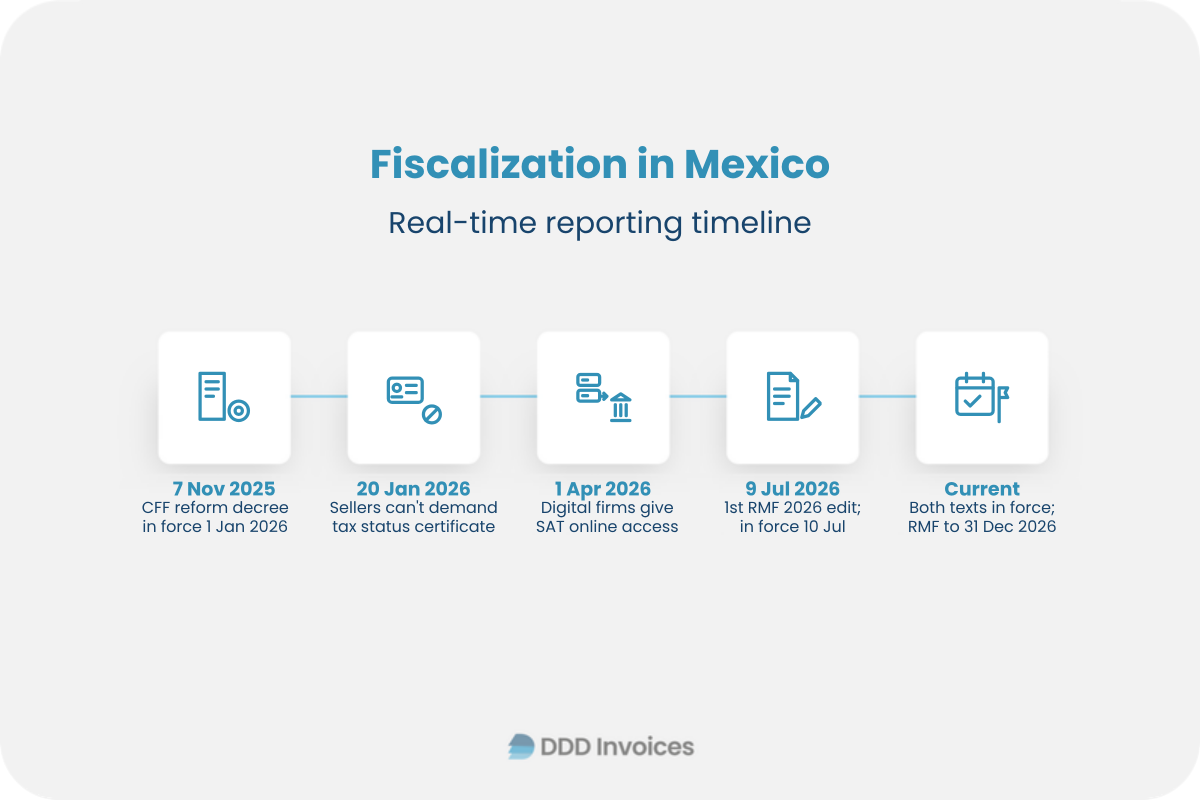
- November 7, 2025: The CFF reform decree was published, effective January 1, 2026.
- January 20, 2026: Comunicado SAT 04-2026 confirmed sellers cannot demand the Constancia de Situación Fiscal.
- April 1, 2026: CFF article 30-B made digital service providers give SAT online data access.
- July 9, 2026: The first RMF 2026 amendment was published, effective July 10.
- Current framework: Both texts are in force; RMF 2026 rules run until December 31, 2026.
What fiscal regulations are affecting the businesses in Mexico?
The CFF sets the duty to invoice, Anexo 20 defines the XML and the yearly RMF adds the operating rules.
Código Fiscal de la Federación, articles 29 and 29-A
Article 29 requires an e.firma (advanced e-signature), a CSD, pre-issue validation and XML delivery, and article 29-A sets the content.
Anexo 20: CFDI 4.0 technical standard
Anexo 20 sets the XML structure, catalogs and validations.
- Receipt content: both parties' tax data, product and unit keys, taxes, payment form and method.
- Reporting: each CFDI reaches SAT or a PAC within 24 hours of the sale under Reglamento del CFF article 39.
- Taxpayer duties: valid e.firma and CSD, XML to the customer, printout on request.
- Offline fallback: none, though the 24-hour window covers short outages.
- Retention: XML and records for five years from the related return (CFF article 30).
- Customer verification: printouts carry a QR code linking to SAT's verification service.
- January 1, 2022: CFDI 4.0 in force.
- April 1, 2023: CFDI 4.0 becomes the only valid version.
Resolución Miscelánea Fiscal para 2026
Rule 2.7.1.21 lets sellers group tickets of customers who want no CFDI into a daily, weekly or monthly factura global. It is due within 24 hours of the period's close.
- Receiver data: the factura global guide requires RFC XAXX010101000, PUBLICO EN GENERAL, regime 616, use S01 and an Información Global node (periodicity, month, year).
- POS tickets: a ticket shows the seller's RFC, date, items and total but supports no deduction and is optional under MXN 100 unless requested.
- Small taxpayers: Régimen Simplificado de Confianza (RESICO) individuals report only the period total.
- Cancellation: under SAT's cancellation rules, requests cite reason 01 to 04 and buyers get three business days to reply, with silence as acceptance. Factura global CFDIs need none.
- Deadline: cancellation works until the month the annual income tax (ISR) return for the year of issue is due.
- Corrections: returns and discounts take a CFDI de egreso (credit note), and errors a substitute CFDI (relation 04) before cancelling with reason 01.
Who does fiscalization in Mexico affect?
Companies and business individuals issue CFDIs under ISR law articles 76, 110 and 113-G, for cash, card and online sales.
- B2C sellers: shops, restaurants, hotels and ticket desks issue tickets, a CFDI on request and a factura global.
- B2B and B2G sellers: a CFDI to the buyer's RFC per sale, plus type P CFDIs for later payments.
- Special sectors: fuel sellers add the hydrocarbons complement, carriers add Carta Porte 3.1, and marketplace e-commerce platforms share data with SAT.
- POS vendors and PACs: SAT authorizes PACs, not hardware, and can revoke PACs that skip receiver-RFC checks.
- Customers: must request their CFDI under CFF article 29.
Our guide to e-invoicing in Mexico covers B2B flows.
What are the implications and penalties?
CFF articles 83 and 84 set the fines and article 113 Bis the prison terms.
Offence | Penalty |
|---|---|
Not issuing or delivering a CFDI or factura global | MXN 22,300 to MXN 127,530 (RESICO: MXN 1,910 to MXN 3,800), preventive closure of 3 to 15 days on repeat |
Conditioning a CFDI on the Constancia de Situación Fiscal | MXN 21,420 to MXN 122,440, preventive closure on repeat |
Issuing, buying or using false CFDIs | 2 to 9 years' imprisonment |
False CFDIs found in a 49 Bis visit | Invoicing suspended, CSD cancelled, CFDIs void |
Amounts follow Anexo 5 of RMF 2026, last reviewed November 2, 2026. Buyers lose deductions and VAT credits on false or non-compliant CFDIs.
Your Trusted Partner for Fiscalization in Mexico
Fiscalization in Mexico is mandatory, with every sale ending in a PAC-stamped CFDI 4.0 or factura global. DDD Invoices gives you one API to issue, receive and archive compliant invoices and receipts across every country we support, so your ERP, POS or billing software connects once while we keep each country's fiscal rules up to date. Mexico is still collecting interest on our country coverage list, so talk to us to prioritize it.
{{__CTA:TalkToUsCta__}}
FAQs
Does Mexico require fiscal cash registers?
No, Mexico does not require fiscal cash registers or fiscal memory devices for retail sales. Each sale is covered instead by a CFDI 4.0 that a SAT-authorized PAC validates and stamps.
What is a factura global in Mexico?
The factura global is one CFDI grouping a period's ticket sales under the generic RFC XAXX010101000. It reaches SAT or a PAC within 24 hours of each daily, weekly or monthly close.
Can a customer get a CFDI after the factura global?
Yes, sellers cancel the factura global with reason 04, reissue it without that ticket and invoice the buyer. This works until the month the annual ISR return for the year of issue is due.
What is the fine for not issuing a CFDI in Mexico?
The fine is MXN 22,300 to MXN 127,530 under CFF article 84, with lower amounts for RESICO individuals. Repeat offenders also risk a preventive closure of their premises for 3 to 15 days.