
Fiscalization and Real-Time Reporting in Peru
Author
Shamyudha

Peru's tax authority, the Superintendencia Nacional de Aduanas y de Administración Tributaria (SUNAT), has tracked sales through comprobantes de pago since 1992. Fiscalization in Peru moved from preprinted booklets to electronic receipts between 2014 and 2022, without fiscal printers.
Sellers in Peru's General, MYPE Tributario and Especial regimes must document every sale with an electronic boleta, factura or ticket POS. SUNAT's Sistema de Emisión Electrónica receives facturas within three calendar days and boleta summaries within seven.
Latest news
Embeds a monitoring pages group for this blog article
{{__MONITORING_PAGES_GROUP:blog_articles_698__}}The newest rule is Resolución de Superintendencia 000143-2026/SUNAT, published on July 31, 2026. It moved Resolución 000048-2026/SUNAT from August 1, 2026 to January 1, 2027. From that date, each electronic credit note can correct only one boleta or factura. Split pooled notes for returns or rebates per receipt before year-end.
What does fiscalization mean in Peru?
Fiscalization is the tax authority's control over how each sale is recorded and reported. Peru uses software: every sale produces a comprobante de pago electrónico (electronic receipt) in the Sistema de Emisión Electrónica (SEE).
Sellers choose a route into the SEE:
- SEE-SOL: SUNAT's free portal and APP Emprender SUNAT.
- Facturador SUNAT: a free SUNAT application.
- SEE-Del contribuyente: your own system sends files to SUNAT.
- SEE-OSE: an Operador de Servicios Electrónicos (OSE) validates files and forwards them.
- SEE Consumidor Final: a payment terminal issues a ticket POS for Nuevo RUS sellers, restaurants and bars.
{{__CTA:IntegrationStepsCta__}}
Timeline
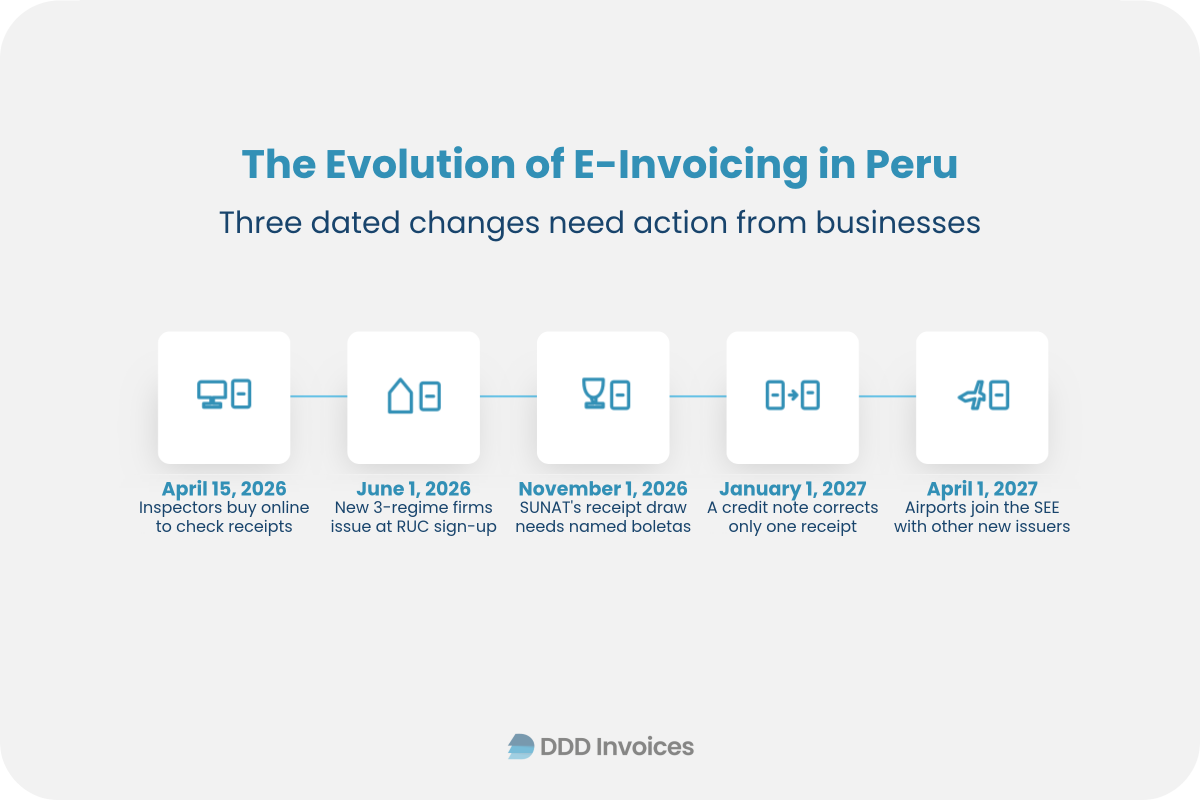
Three dated changes need action.
- June 1, 2026: Resolución 000075-2026/SUNAT makes new General, MYPE Tributario and Especial regime businesses issue electronically from their RUC (taxpayer registry) registration day.
- January 1, 2027: each credit note corrects one receipt.
- April 1, 2027: airport operators and other newly designated issuers join the SEE.
Decreto Supremo 058-2026-EF, published on April 15, 2026, lets SUNAT inspectors buy online as ordinary customers to check receipts. SUNAT's receipt draw rewards boletas issued from November 1, 2026 to January 31, 2027 with prizes up to S/ 100,000. Boletas must name the buyer to enter, so expect DNI (national ID) requests. A fiscalization-ready platform keeps POS and webshop data consistent.
What fiscal regulations are affecting the businesses in Peru?
Decreto Ley 25632 and Resolución de Superintendencia 007-99/SUNAT
Decreto Ley 25632, in force since September 1, 1992, obliges every seller to issue receipts, even on untaxed sales. Its 1999 Reglamento de Comprobantes de Pago requires the buyer's names and identity document on boletas above S/ 700. Consumer sales of up to S/ 5 go on one end-of-day boleta unless the buyer asks.
Resolución de Superintendencia 300-2014/SUNAT: Sistema de Emisión Electrónica
Signed on September 29, 2014, this resolution created the SEE, with signed XML receipts and a QR code on printed copies. Facturas reach SUNAT or the OSE within three calendar days after the issue date, under Resolución 000003-2023/SUNAT.
Boletas can go in a resumen diario (daily summary) by the seventh calendar day after issue. Contingency receipts, preprinted for outages beyond the seller's control, are reported by the same deadline. Records are kept at least five years.
Resolución de Superintendencia 155-2017/SUNAT: electronic issuers
Signed on June 26, 2017, this resolution and Resolución 279-2019/SUNAT designate electronic issuers. The income-based rollout ended on June 1, 2022. Since June 1, 2026, designation starts on registration day, or the month after leaving the Nuevo RUS.
Resolución de Superintendencia 000048-2026/SUNAT
Signed on March 26, 2026, this resolution brings airport-service documents and the documento de atribución into the SEE. It limits each credit note to one receipt and gives seven calendar days to void boletas by resumen diario. It applies from January 1, 2027, with new issuers designated from April 1, 2027.
Who does fiscalization in Peru affect?
Every seller must give receipts, but only three income tax regimes must issue them electronically.
- B2C sellers: B2C e-invoicing is mandatory for the General, MYPE Tributario and Especial regimes. Consumers get a boleta de venta electrónica or ticket POS, electronic or printed.
- B2B and B2G sellers: buyers with a RUC get a factura electrónica, which supports IGV (VAT) credit.
- Nuevo RUS taxpayers: they issue boletas, never facturas, and may still use printed boletas or cash register tickets.
- Hospitality and online sellers: guests need their DNI or RUC on the boleta to deduct the expense, and webshops face covert test purchases.
- Customers: anyone can check a receipt on SUNAT's portal.
Our Peru e-invoicing guide covers B2B flows.
What are the implications and penalties?
Article 174 of the Código Tributario punishes receipt offences, and SUNAT's graduated scale sets closures and fines. Figures are for General and MYPE Tributario regime sellers, at the 2026 UIT (tax unit) of S/ 5,500 set by Decreto Supremo 301-2025-EF. Repeat offences count for four years.
Offence | Penalty |
|---|---|
No receipt issued or handed over, in a shop (art. 174.1) | Closure for 3 days, then 6, then 10, which SUNAT may replace with a fine of up to 8 UIT (S/ 44,000) |
Same offence outside a shop, such as online sales | 65% UIT (S/ 3,575), then 85% UIT (S/ 4,675), then 1 UIT (S/ 5,500) |
Receipt missing required data or of the wrong type (art. 174.2, 174.3) | 25% UIT (S/ 1,375) or an Acta de Reconocimiento first, then closure for 5, 7 and 10 days |
False RUC data to enable electronic issuing, under Decreto Legislativo 1716 | 2 to 5 years in prison |
A factura sent late is not a valid factura electrónica.
Your Trusted Partner for Fiscalization in Peru
Electronic receipts are mandatory for Peru's General, MYPE Tributario and Especial regime sellers, and the rules changed several times in 2026. DDD Invoices gives you one API with one payload, so your ERP or POS can issue, receive and archive documents in every supported country. Peru is on our roadmap and listed as collecting interest on the country coverage list, so tell us your plans.
{{__CTA:TalkToUsCta__}}
FAQs
Does Peru require fiscal printers?
No, Peru requires no fiscal printers, because receipts are issued and reported through SUNAT's electronic system. Nuevo RUS taxpayers may still use printed boletas or tickets from ordinary cash registers.
When must a boleta identify the buyer?
A boleta must show the buyer's names and identity document when its total exceeds S/ 700. Below that amount, the seller adds those details only when the customer asks for them.
What if the POS system fails in Peru?
Designated issuers may switch to preprinted receipts from an authorised printer, marked as issued in contingency. They must report those receipts to SUNAT by the seventh calendar day after the issue date.
What is the fine for not issuing receipts in Peru?
Shops face closure for 3 days on a first offence, 6 on a second and 10 afterwards. General and MYPE regime sellers caught outside a shop pay fines from 65% of a UIT instead.