
Fiscalization and Real-Time Reporting in Saint Kitts and Nevis
Author
Shamyudha

Saint Kitts and Nevis has charged Value Added Tax (VAT) through its Inland Revenue Department (IRD) since November 1, 2010. Fiscalization in Saint Kitts and Nevis still rests on VAT documents and monthly returns, with no fiscal printers or live reporting.
Fiscalization in Saint Kitts and Nevis needs no fiscal devices, real-time reporting or e-invoicing. VAT-registered sellers issue tax invoices or sales receipts at 17%, 10% or 0%, and file returns within 15 days after each month.
Latest news
Embeds a monitoring pages group for this blog article
{{__MONITORING_PAGES_GROUP:blog_articles_689__}}On November 9, 2026, the IRD opened applications for the Christmas Discounted VAT Rate Days (DVRD) on December 11 and 19, 2026. Only approved businesses may charge the discounted rate, so apply by November 30, 2026 before reprogramming your tills.
The Government's 2026 DVRD schedule includes vehicles on the December dates. No device or e-invoicing rule exists, so the Value Added Tax Act remains in force.
What does fiscalization mean in Saint Kitts and Nevis?
Fiscalization means the tax authority secures each sale record, usually through certified devices or live reporting. Saint Kitts and Nevis uses neither, so compliance rests on three documents.
- Tax invoice: pre-numbered and issued to VAT-registered buyers.
- Sales receipt: issued to consumers and other unregistered buyers.
- Form VAT-01: the monthly VAT return, filed through SMARTS, the IRD's online tax system.
Any POS, ticketing or booking system can produce them with the right rates and fields.
{{__CTA:IntegrationStepsCta__}}
Timeline
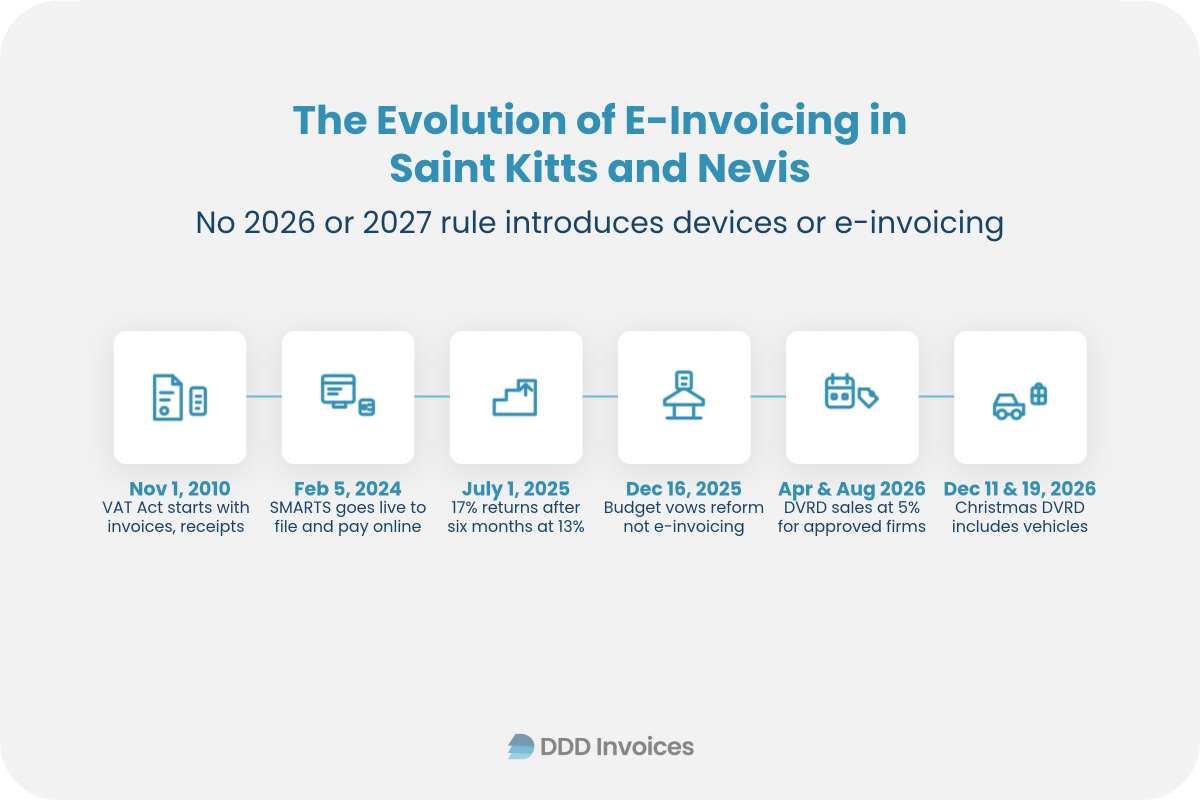
No 2026 or 2027 rule introduces devices or e-invoicing.
- November 1, 2010: the VAT Act starts, requiring tax invoices and sales receipts.
- February 5, 2024: SMARTS launches for online filing and payment.
- July 1, 2025: the standard rate returns to 17% after six months at 13%.
- December 16, 2025: the 2026 Budget Address promises VAT reform details during 2026, with no e-invoicing mention.
- April 17 and August 28 to 29, 2026: DVRD sales at 5% for approved businesses.
- December 11 and 19, 2026: Christmas DVRD, vehicles included.
For DVRD, a fiscalization-ready platform should switch rates by date, track written approval and report discounted sales separately.
What fiscal regulations are affecting the businesses in Saint Kitts and Nevis?
Value Added Tax Act, Cap. 18.47 (Act 3 of 2010)
The VAT Act took effect on November 1, 2010. Section 27 sets 17% as standard and 10% for qualifying accommodation, tour operator and restaurant services. Registration is compulsory above EC$150,000 in taxable supplies over 12 months.
Section 44 requires a tax invoice for registered buyers and a sales receipt for unregistered ones. Section 47 makes returns due within 15 calendar days after each month. Section 80 requires records in English, kept in the country for six years. Section 112 requires advertised prices to include VAT.
Value Added Tax Regulations (S.R.O. 38/2011)
Schedule 2 of the VAT Regulations, made in 2011 and amended in 2015, sets each document's content. A tax invoice shows both parties' names and TINs, a description with quantity, the consideration, the tax due, the date and the total.
A sales receipt shows the same fields without the buyer's details or quantity. Cash sales up to EC$50 to registered buyers may use a receipt instead. Regulation 17(3) requires compulsorily registered businesses to keep electronic records, such as tills or POS systems approved by the Comptroller.
IRD Discounted VAT Rate Day guidance (2026)
The April 2026 business guidance let approved VAT-registered businesses charge 5% on in-stock tangible goods normally taxed at 17%. Applicants needed all returns filed, no debts to the IRD or Customs, and written approval. Vehicles, guns, ammunition, cigarettes, alcohol and all services stayed at 17%.
Discounted sales go on the return's reduced rate line and a separate DVRD sales report. Goods exchanged after the day lose the 5% rate. The August 2026 notice repeated these rules, with reports due September 11, 2026.
Who does fiscalization in Saint Kitts and Nevis affect?
Duties follow VAT registration and buyer type.
- B2C sellers: B2C e-invoicing is not mandatory; shops, restaurants and ticket sellers issue sales receipts and display VAT-inclusive prices.
- Hotels and tourism: qualifying accommodation, tour and restaurant services carry 10%; DVRD never covers services.
- B2B and B2G sellers: issue pre-numbered tax invoices with the buyer's TIN for input tax claims.
- Software vendors: POS systems, online checkouts and booking tools need correct rates, fields and DVRD logic.
Our national e-invoicing guide covers business invoices. Regionally, the Dominican Republic's e-CF is live, while neighbouring Belize and Antigua and Barbuda have announced e-invoicing. Jamaica is debating it, and Saint Kitts and Nevis has announced nothing.
What are the implications and penalties?
The VAT Act sets the offences below, and the IRD's payment guide confirms the late filing and payment figures.
Offence | Penalty |
|---|---|
No invoice or receipt within 60 days (s. 44(10)) | Fine up to EC$20,000, one year in prison, or both |
False or missing tax invoice, sales receipt, credit or debit note (s. 99) | Civil penalty up to EC$25,000 |
Late return (s. 100) | EC$100 per month or part month |
Returns late for two or more periods (s. 47(6)) | Fine up to EC$50,000, three years in prison, or both |
Late payment (ss. 51(4) and 43) | 10% of the tax due, plus 1.25% interest per month |
Records not kept (s. 102) | EC$50 per day |
Repeat violations after a written warning (s. 107) | Court-ordered closure for 3 to 30 days |
No separate penalty for misusing the DVRD rate is published, so these rules apply. The IRD can also assess unfiled periods by estimate.
Your Trusted Partner for Fiscalization
Fiscal devices and e-invoicing are not mandatory in Saint Kitts and Nevis, yet sellers still answer for rates, receipt fields and monthly returns.
DDD Invoices connects your ERP or POS through one API to issue, receive and archive documents, reusing one integration in every market. Saint Kitts and Nevis appears on our country coverage list as collecting interest, so support is pending and your request helps us prioritise it.
{{__CTA:TalkToUsCta__}}
FAQs
Does Saint Kitts and Nevis require fiscal devices or real-time reporting?
No, Saint Kitts and Nevis has no fiscal printer, certified cash register or real-time reporting rule. VAT-registered sellers issue tax invoices or sales receipts and file a VAT return every month.
What must a sales receipt show in Saint Kitts and Nevis?
It shows the supplier's full name and TIN with a description of the goods or services. It also shows the consideration, the tax due, the issue date and the total amount charged.
How do Discounted VAT Rate Days work in Saint Kitts and Nevis?
Approved VAT-registered businesses charge a discounted rate, 5% so far in 2026, on eligible in-stock goods. They must apply to the Inland Revenue Department beforehand and report the discounted sales separately afterwards.
What is the penalty for not issuing a receipt in Saint Kitts and Nevis?
The civil penalty for a false or missing tax invoice or sales receipt reaches EC$25,000. Failing to issue one within 60 days risks a EC$20,000 fine, one year in prison, or both.