
Fiscalization and Real-Time Reporting in Saint Vincent and the Grenadines
Author
Bishma

Fiscalization in Saint Vincent and the Grenadines still rests on VAT documents and monthly returns, with no fiscal printers or live reporting.
Fiscalization in Saint Vincent and the Grenadines needs no fiscal devices or e-invoicing: registered sellers issue VAT invoices to businesses and receipts to consumers. Sales carry 16%, 11% on accommodation or 0% VAT, and monthly returns are due by the 15th of the following month.
Latest news
Embeds a monitoring pages group for this blog article
{{__MONITORING_PAGES_GROUP:blog_articles_685__}}The 2026 Budget Address set October 2026 as the target for VAT relief, covering a lower general rate, essentials and domestic electricity. No new rate has been published, and the IRD's tax page still lists 16%, so keep your tax codes until an official change appears.
What does fiscalization mean in Saint Vincent and the Grenadines?
Fiscalization means the tax authority secures each sale record, usually through certified devices or live reporting. Saint Vincent and the Grenadines uses neither, so compliance rests on three documents.
- VAT invoice: issued at the time of supply to a VAT-registered buyer.
- VAT sales receipt: issued to consumers and other unregistered buyers.
- Monthly VAT return: output VAT less input VAT, filed through the IRD's e-Tax platform.
Any POS or billing system can print them if it applies the right rate and required fields.
{{__CTA:IntegrationStepsCta__}}
Timeline
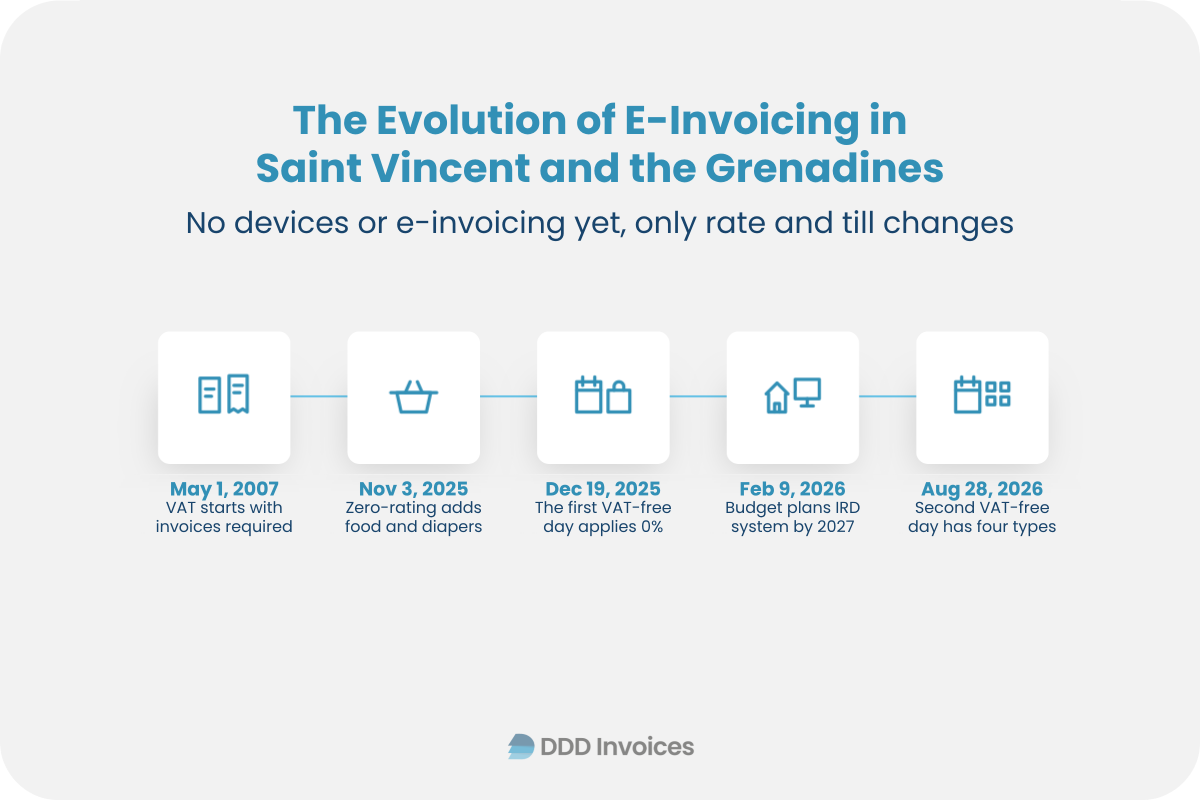
No 2026 rule introduces devices or e-invoicing; the changes touch rates and till logic.
- May 1, 2007: VAT starts, with invoices and sales receipts required from day one.
- November 3, 2025: chicken parts, cheddar, canned tuna and sardines, chicken sausages, cereals, lentils, health drinks and adult diapers become zero-rated.
- December 19, 2025: the first VAT-free day applies 0% to most tangible goods sold to consumers.
- February 9, 2026: the Budget promises no new taxes, reviews VAT relief and plans a new IRD tax system by 2027.
- August 28, 2026: the second VAT-free day covers four categories only.
Prepare your tills with a fiscalization-ready platform:
- Date-based rates: schedule 0% for eligible items on the declared day, then restore 16% at close.
- Eligibility rules: the December 2025 terms required goods in stock the evening before, paid in full, with hire purchase excluded.
- Exclusions: services, prepared meals at hotels and restaurants, tobacco, firearms and motor vehicles stayed taxable.
- Price checks: IRD and Consumer Affairs officers checked shelf prices on both days, so keep pre-event price records.
What fiscal regulations are affecting the businesses in Saint Vincent and the Grenadines?
Value Added Tax Act, 2006 (Act No. 25 of 2006, Cap. 445)
The VAT Act took effect on May 1, 2007. Section 32 requires a VAT invoice for taxable supplies to registered buyers, but cash sales up to EC$50 may get a sales receipt.
Section 33 bars VAT invoices to unregistered buyers, who receive a sales receipt. Section 39 requires a return for each monthly tax period within 15 days, even when nothing is owed. Section 57 requires VAT-inclusive advertised prices. Shelf tickets may omit the VAT amount if a "prices include VAT" notice hangs at the entrance and till.
The IRD's tax page lists 16% standard, 11% for accommodation and 0% for zero-rated supplies. Registration is compulsory from EC$300,000 in taxable sales, and hoteliers, guest houses, apartments and entertainment promoters must register regardless.
Value Added Tax Regulations (SRO 21 of 2007)
The First Schedule of the VAT Regulations sets each document's content. A VAT invoice shows "VAT INVOICE", both parties' names, addresses and TINs, and a serial number. It also gives issue and supply dates, a quantity description, the price and the VAT charged.
A sales receipt shows "VAT SALES RECEIPT", the supplier's name, address and TIN, the date, a description, the VAT-inclusive total and the VAT amount. Buyers need a valid VAT invoice to claim input tax, and the claim lapses six months after the return was due.
Tax Administration Act, 2019 (Act No. 30 of 2019)
The Tax Administration Act holds the penalty and record rules for VAT. Section 20(6) requires records for seven yearsfrom the transaction, or longer while an assessment remains open.
The IRD's VAT FAQs add that records stay at your place of business in Saint Vincent and the Grenadines, in English. Section 58 charges interest on late tax at 1.5% per month, compounded monthly.
Cabinet decisions on zero-rating and VAT-free days (2025 to 2026)
The November 2025 zero-rating and both VAT-free days rest on Cabinet approvals. The published notices cite no order or statutory instrument, so check each new list before loading it.
For December 19, 2025, Cabinet set 0% on eligible goods sold by VAT registrants to non-commercial customers. The August 28, 2026 edition narrowed eligibility to groceries, non-alcoholic beverages, school supplies and toiletries.
Who does fiscalization in Saint Vincent and the Grenadines affect?
No sector list or device rule exists, so obligations follow VAT registration and buyer type.
- B2C sellers: B2C e-invoicing is not mandatory; supermarkets, pharmacies, restaurants and shops issue VAT sales receipts.
- Hotels and tourism: register regardless of turnover and charge 11% on rooms; VAT-free days never cover their services.
- B2B and B2G sellers: issue VAT invoices showing the buyer's TIN, which the buyer needs for input tax.
- Software vendors: POS systems, online checkouts and booking platforms need no certification, only correct rates and fields.
- International groups: registered recipients account for VAT on imported services under the reverse charge.
Our guide to e-invoicing in Saint Vincent and the Grenadines covers business invoices. Grenada's e-invoicing rulesbelong to a separate state, so do not apply them here.
Around the region, the Dominican Republic's e-CF is live, while Belize and Antigua and Barbuda have announced e-invoicing. Jamaica is debating it, and Saint Vincent and the Grenadines has announced nothing.
What are the implications and penalties?
VAT document, filing and record failures fall under the Tax Administration Act, 2019, summarised on the IRD's penalties page.
Offence | Penalty |
|---|---|
False VAT invoice, receipt, credit or debit note, or failure to issue one (s. 74) | Up to EC$25,000 |
Late VAT return (s. 75) | Greater of 5% of tax owed plus 1% a month, or EC$500 plus EC$100 a month; capped at EC$10,000 per return |
Tax unpaid 14 days after the due date (s. 76) | 20% of the unpaid tax |
Late payment interest (s. 58) | 1.5% a month, compounded |
Records not kept after a warning notice (s. 79) | EC$50 a day |
Unreported changes or missed deregistration (s. 73) | Up to EC$2,500 |
No separate penalty covers VAT-free day abuse, but false receipts fall under section 74. Amounts are in Eastern Caribbean dollars.
Your Trusted Partner for Fiscalization in Saint Vincent and the Grenadines
E-invoicing and fiscal devices are not mandatory here, yet every VAT-registered seller must still get rates and receipt fields right. DDD Invoices gives you a single API to issue, receive and archive documents from any ERP or POS, reusing one integration across markets. Saint Vincent and the Grenadines is not yet on our country coverage list, so support is pending, and early requests help us shape it.
{{__CTA:TalkToUsCta__}}
FAQs
Does Saint Vincent and the Grenadines require fiscal printers or cash registers?
No, Saint Vincent and the Grenadines has no fiscal printer, certified cash register or real-time reporting rule. Ordinary POS software works when it prints every field the VAT Regulations require on sales receipts.
What must a VAT sales receipt show in Saint Vincent and the Grenadines?
It shows the words VAT sales receipt with the supplier's name, address, TIN and the issue date. It also describes the goods or services and gives the total including VAT and the VAT charged.
Is e-invoicing mandatory in Saint Vincent and the Grenadines?
No, the Inland Revenue Department has announced no e-invoicing mandate, format, pilot or start date yet. Businesses keep issuing VAT invoices and sales receipts and file a VAT return every month.
How long must VAT records be kept in Saint Vincent and the Grenadines?
Records must be kept for seven years from the transaction date, or longer while assessments remain open. The Inland Revenue Department expects them in English at your place of business in the country.