
Fiscalization and Real-Time Reporting in Morocco
Author
Ameera
-15.webp%3F2026-10-16T13%3A34%3A52.664Z&w=3840&q=100)
Morocco’s move towards digital tax compliance builds on requirements already embedded in its General Tax Code, known as the Code Général des Impôts (CGI). The country introduced a legal framework for computerised invoicing in its Finance Law for 2018, but the legislation leaves implementation arrangements to sector-specific regulations.
The important development for 2026 is the clarification of electronic accounting obligations, alongside changes to electronic communication with the tax administration. For businesses, this makes reliable sales records, correctly issued documents and accessible accounting data an immediate priority.
Latest News
Embeds a monitoring pages group for this blog article
{{__MONITORING_PAGES_GROUP:blog_articles_486__}}In 2023, CNC Opinion No. 24 clarified electronic accounting standards, followed by updated accounting requirements in 2026. Article 145-X also requires taxpayers, including those under certain simplified regimes, to maintain an email address for tax communication. However, a nationwide real-time POS reporting mandate remains unconfirmed.
What does fiscalization mean in Morocco?
Morocco is currently shifting toward real-time fiscalization by replacing its traditional periodic reporting with a mandatory electronic invoicing (e-invoicing) framework.
SIMPL-TVA is not a real-time fiscalization platform. It allows taxpayers to submit VAT declarations and access filing information, rather than validate individual sales at checkout.
What fiscal regulations apply
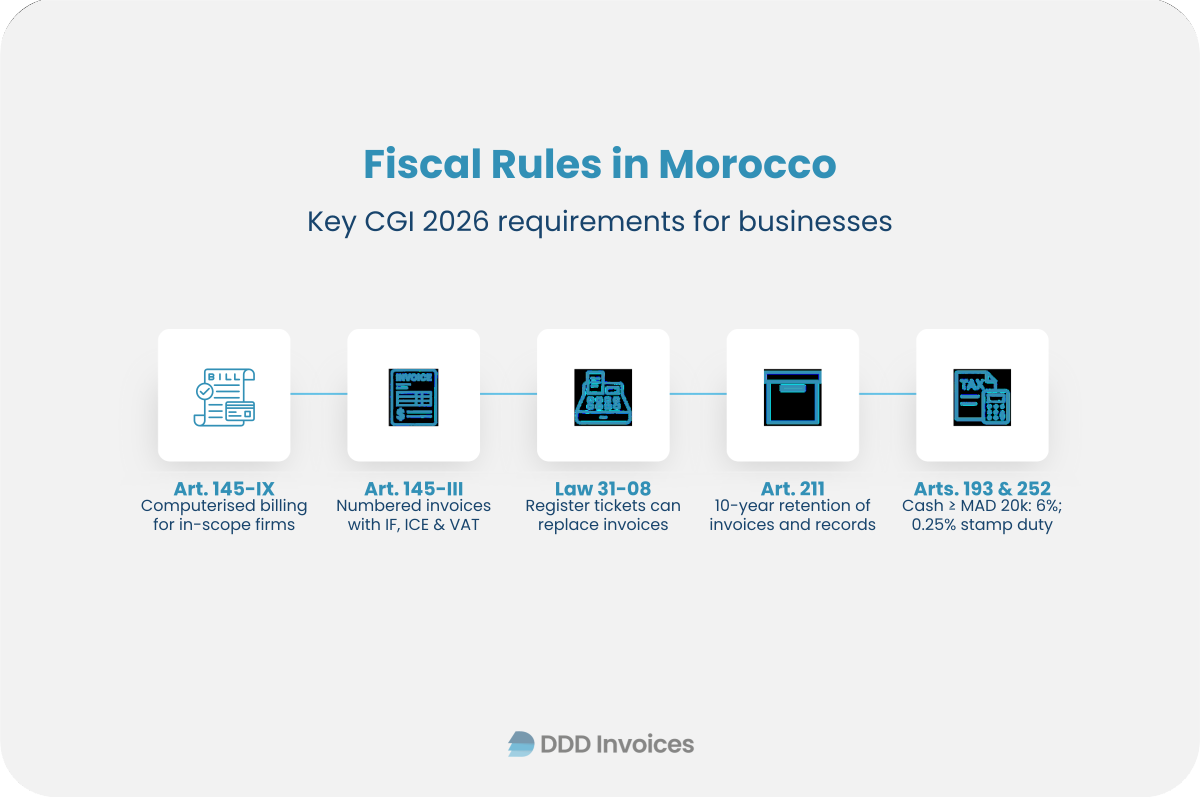
Computerised Billing: Article 145-IX
Article 145-IX establishes computerised billing requirements for corporate taxpayers, RNR/RNS taxpayers and VAT-liable businesses, subject to sector-specific rules.
Invoice Numbering and Mandatory Details
Article 145-III requires continuous invoice numbering, supplier and customer details, applicable tax identifiers (IF and ICE), transaction information, VAT and payment references. Consumer receipts follow separate requirements.
Consumer Receipts and Cash Registers
Under Law 31-08, businesses must provide proof of purchase showing transaction details, prices and applicable taxes. Article 145-III allows cash-register tickets to replace invoices for sales of goods to individuals, provided they contain the required information.
Ten-Year Record Retention
Article 211 requires ten-year retention of invoices, receipts and supporting accounting records. Businesses using electronic accounting must also preserve the relevant records electronically.
Payment Methods and Cash Receipt Stamp Duty
Under Article 193, certain transactions of MAD 20,000 or more settled outside permitted payment methods may incur a 6% penalty. Specified cash receipts and tickets are subject to 0.25% stamp duty, with statutory exemptions.
Who must comply?
Moroccan fiscalization rules apply broadly across domestic commerce, with specific obligations depending on business size and transaction classification:
- Large Enterprises and Public Suppliers: Companies subject to Corporate Tax (IS) with substantial annual turnover, along with suppliers engaged in Business-to-Government (B2G) public contracts, represent the primary group subject to clearance obligations.
- B2B Commercial Enterprises: Moroccan corporations and VAT-registered commercial entities transacting domestically must issue and receive compliant structured e-invoices, ensuring input VAT deductibility.
- B2C Retail and Point-of-Sale Operators: Retailers, ticketing operators, and consumer-facing establishments are governed by the billing requirements of Article 145. Commercial checkout devices and digital registers must record uninterrupted sequential receipts and produce fiscal transaction records ready for electronic transmission under the DGI's broader fiscalization roadmap.
- Foreign Entities Registered for Moroccan VAT: Non-resident companies maintaining a local tax registration must issue compliant documentation carrying local fiscal identifiers (ICE, IF) through authorised technical channels.
Penalties for fiscal non-compliance in Morocco
Morocco's existing penalties focus on documentary, accounting and payment compliance.
Violation | Potential penalty |
Missing or incorrect ICE | MAD 100 per omission or inaccuracy |
Failure to retain accounting records | MAD 50,000 per affected accounting year |
Failure to present required electronic accounting documents during an audit | MAD 50,000 per audited year, subject to statutory notice procedures |
Covered transactions of at least MAD 20,000 settled outside permitted payment methods | 6% of the transaction amount |
No universal penalty schedule specifically for uncertified fiscal devices or failed real-time POS transmissions was verified.
Your trusted partner for fiscalization in Morocco
Managing changing tax requirements shouldn't mean rebuilding your systems for every country. DDD Invoices provides a unified API for fiscalization and invoicing compliance across supported jurisdictions, simplifying local formats, validation workflows and tax-authority integrations.
For Morocco, specific country availability and integration scope should be confirmed before implementation. One integration. Less compliance complexity. More room to grow.
Displays a content card with title, subtitle, list/body, and action button
{{__CTA:GenericCtaJson:{"type":"content","contentCta":{"layout":"cardList","title":"Talk to us!","subtitleHtml":"Still have questions?","button":{"href":"https://calendly.com/ddd-invoices/30min-intro","label":"Book a free 30min call","color":"white"},"bodyHtml":"In the <strong>30min free call</strong> we will discuss:","listHtml":"<ul><li><strong>your requirements</strong> in invoicing</li><li>how integration works</li><li><strong>demo</strong> of the product</li><li>next steps</li></ul>"}}__}}FAQs
Do businesses need a certified fiscal printer or a qr code on every receipt?
A universal requirement of this kind was not established by the official material reviewed. Article 145-IX provides for technical criteria and sector-specific implementation but does not itself prescribe a fiscal-printer model, a QR-code payload or a list of approved providers. Businesses should request the applicable official specification before treating such features as mandatory.
Does producing pdf invoices satisfy the electronic accounting requirement?
Not by itself. Generating an invoice file and maintaining electronic accounts are different functions. The electronic-accounting framework includes accounting-system requirements and the FEC, while Article 210 addresses the presentation of electronic accounting records during tax control.
Can a consumer receipt replace an invoice?
Article 145-III permits a cash-register receipt to replace an invoice for sales of products or goods to individuals, provided the required information is included. Service transactions and other situations should be checked against the applicable tax and consumer-document rules rather than treated as automatically covered by that permission.
What should businesses prioritise now?
Start with continuous invoice numbering, complete identification and tax details, correct payment records, electronic accounting exports and a retrievable ten-year archive. These address existing obligations while leaving the system ready to accommodate future technical requirements when they are officially established.