
ONESOURCE E-Invoicing vs an API-First Alternative
Author
Shamyudha

If you are evaluating ONESOURCE e-invoicing, you are likely under pressure: more countries are mandating e-invoicing, and each mandate brings a new format, network and deadline. The provider you choose decides how much every future country launch will cost. DDD Invoices builds e-invoicing and fiscalization infrastructure for software providers, ERPs and SaaS platforms, so we know this decision from the inside.
This guide explains what ONESOURCE e-invoicing is, who it suits, how it compares with DDD Invoices and what switching involves.
What is ONESOURCE e-invoicing?
ONESOURCE e-invoicing is Thomson Reuters' e-invoicing compliance product, now offered as ONESOURCE Pagero and built mainly for multinational tax and finance teams. Software companies that need to embed e-invoicing inside their own product often compare it with API-first providers such as DDD Invoices, which issue, receive and archive invoices through one API.
Thomson Reuters announced ONESOURCE E-Invoicing in October 2023 as part of its ONESOURCE suite, an enterprise tax platform that also covers indirect tax determination and compliance filing. According to Thomson Reuters' own product overview, it offers pre-built integrations for SAP S/4HANA and Oracle ERP Cloud, plus API integrations for other systems.
Who ONESOURCE e-invoicing is built for
Thomson Reuters describes ONESOURCE Pagero E-invoicing as compliant across 80+ countries, with a network reaching over 14 million businesses. It supports B2B and B2G invoicing under the EU public procurement directive in formats including Peppol BIS, UBL, cXML and EDI.
The product is shaped around:
- Enterprise tax and finance teams managing e-invoicing for their own legal entities.
- SAP and Oracle customers, who get pre-built integrations.
- AP and AR automation buyers who want a large trading-partner network.
- Existing ONESOURCE customers who want tax and e-invoicing from one vendor.
Pricing is not published. Thomson Reuters offers tailored packages after a demo.
Who DDD Invoices is built for
DDD Invoices describes itself as e-invoicing and fiscalization infrastructure delivered through one API. Its public coverage list shows 37 countries as covered and 6 in progress, mostly in Europe, with Brazil, Mexico, India and the United States listed as collecting interest.
The product is shaped around:
- Software providers (ERP, SaaS, property management, POS and accounting tools) that embed e-invoicing in their own product.
- Multi-tenant platforms that need automated end-client onboarding and full white-labelling through the API.
- Resellers who want to bill end clients directly or pass costs through per customer.
- Teams that want to start small, with free self-served integration and free testing before deployment.
ONESOURCE vs DDD Invoices: side-by-side comparison
ONESOURCE and DDD Invoices take different approaches to e-invoicing, with clear differences in model, coverage, integration effort, pricing and support.
Criteria | ONESOURCE e-invoicing | DDD Invoices |
|---|---|---|
Model | E-invoicing module in the ONESOURCE tax platform, plus the Pagero network | API-first infrastructure built to embed in other software |
Primary buyer | Enterprise tax, finance and AP/AR teams | Software providers and the companies they serve |
Coverage (public claim) | 80+ countries, 14M+ businesses in network | 37 countries covered, 6 in progress |
Integration effort | Pre-built SAP and Oracle integrations; APIs for other ERPs | One REST API with a standard JSON payload; free self-served integration |
White-label | Not a stated focus | Via API or dashboard |
Pricing approach | Not published; tailored packages | Volume-based per-invoice plans; free to test |
Support | Dedicated support team and onboarding | Published support levels; paid integration help available |
When ONESOURCE is the better fit
Both platforms handle e-invoicing compliance, but they are built for different buyers. Match your situation to the table below to see which one is likely to suit you.
Your situation | Likely better fit |
|---|---|
You invoice from your own legal entities rather than serving end clients | ONESOURCE |
You run SAP S/4HANA or Oracle Cloud ERP and want a vendor-built integration | ONESOURCE |
You already use ONESOURCE for indirect tax | ONESOURCE |
You build software and need e-invoicing inside your product for many end clients | DDD Invoices |
You want one API instead of a project per country | DDD Invoices |
You need white-labelling and want to resell e-invoicing to customers | DDD Invoices |
You want to test for free without buying a tax suite | DDD Invoices |
Switching to DDD Invoices: what migration looks like
Changing providers is mostly a data and connectivity project. Here is how each step works if you move to DDD Invoices.
Migration checklist
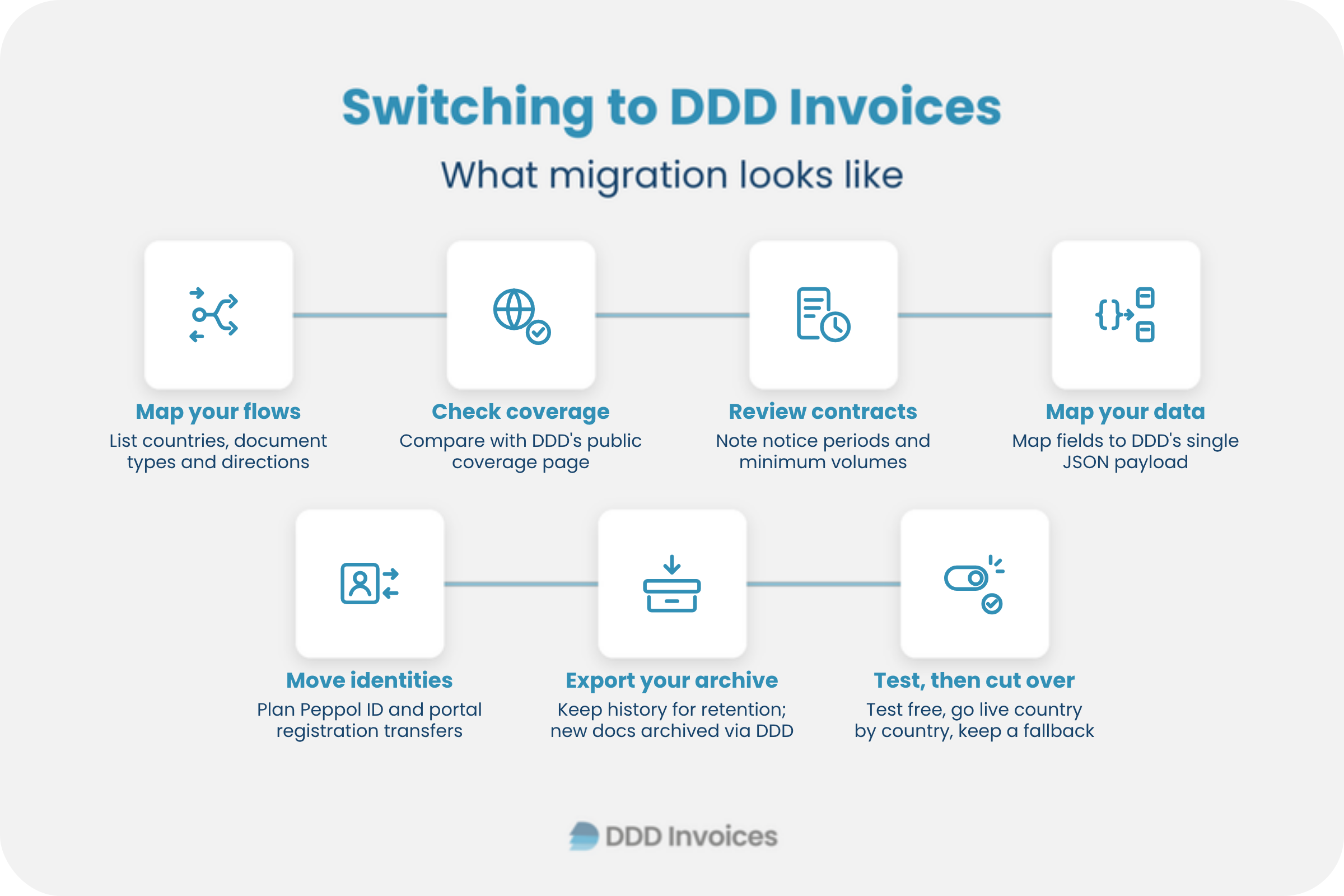
- Map your flows: list every country, document type and direction (issue, receive) you need today.
- Check coverage: compare that list with DDD's public coverage page, which shows each country as covered, in progress or collecting interest.
- Review contracts: note notice periods and minimum volumes with your current provider.
- Map your data once: match your invoice fields to DDD's single JSON payload, which is then converted into each country's format.
- Move network identities: plan how Peppol IDs and portal registrations transfer, with DDD acting as your Peppol service provider.
- Export your archive: keep historic e-invoices for each country's retention period; new documents are archived through the same DDD integration.
- Test, then cut over by country: test for free before deployment, then switch one country at a time and keep a fallback.
Self-served integration is free, and DDD offers hands-on help with integration projects for a setup fee. Rules differ by country, so treat this as administrative support and have your setup reviewed by a licensed tax adviser.
How DDD Invoices works for software companies
DDD Invoices is built for teams that need e-invoicing inside their own product. You send one standard JSON invoice to a single API, and DDD converts, delivers and reports it for each country, covering issuing, receiving, archiving and fiscalization.
Software providers also get white-labelling, automated end-client onboarding, API error handling and billing either through you or with a revenue share.
Displays a content card with title, subtitle, list/body, and action button
{{__CTA:GenericCtaJson:{"type":"content","contentCta":{"layout":"cardList","title":"Talk to us!","subtitleHtml":"Still have questions?","button":{"href":"https://calendly.com/ddd-invoices/30min-intro","label":"Book a free 30min call","color":"white"},"bodyHtml":"In the <strong>30min free call</strong> we will discuss:","listHtml":"<ul><li><strong>your requirements</strong> in invoicing</li><li>how integration works</li><li><strong>demo</strong> of the product</li><li>next steps</li></ul>"}}__}}FAQs
Can a software provider use ONESOURCE to serve many end clients?
Multi-tenant white-labelling is not a stated focus on its public pages. Ask Thomson Reuters how onboarding, billing and branding would work for hundreds of end clients.
How do pricing models differ between enterprise and API-first providers?
Enterprise platforms usually quote packages tied to entities and modules. API-first providers often price per invoice with volume tiers, which is easier to pass on to customers.
What happens to our Peppol IDs if we switch?
Peppol IDs can usually move to a new access point once the old registration is released. Plan this carefully so you never have a gap in receiving e-invoices.
What is the biggest hidden cost in an e-invoicing rollout?
Usually data quality. Missing tax IDs and wrong buyer identifiers cause rejections, so budget time for master-data clean-up with any provider.