
Fiscalization and Real-Time Reporting in Sierra Leone
Author
Ameera

Fiscalization is already mandatory in Sierra Leone for GST-registered businesses, which must use the National Revenue Authority’s (NRA) Electronic Cash Register (ECR) framework to record transactions and issue receipts.
The rollout continued with upgraded Electronic Cash Registers (ECRs) in June 2025 and the launch of nationwide Smart GST machine distribution in August 2026. For businesses, the priority is not simply producing a digital receipt: it is ensuring that transactions pass through the required fiscal system and remain consistent with GST records and returns
Latest News
Embeds a monitoring pages group for this blog article
{{__MONITORING_PAGES_GROUP:blog_articles_574__}}The announcement describes a distribution target, not confirmation that all 10,000 businesses have already been equipped. It also does not establish a new universal deadline replacing existing ECR obligations.
What does fiscalization mean in Sierra Leone?
Fiscalization in Sierra Leone means recording business transactions through the NRA’s prescribed electronic system, generating the required fiscal receipt or invoice, and transmitting transaction information to the tax authority.
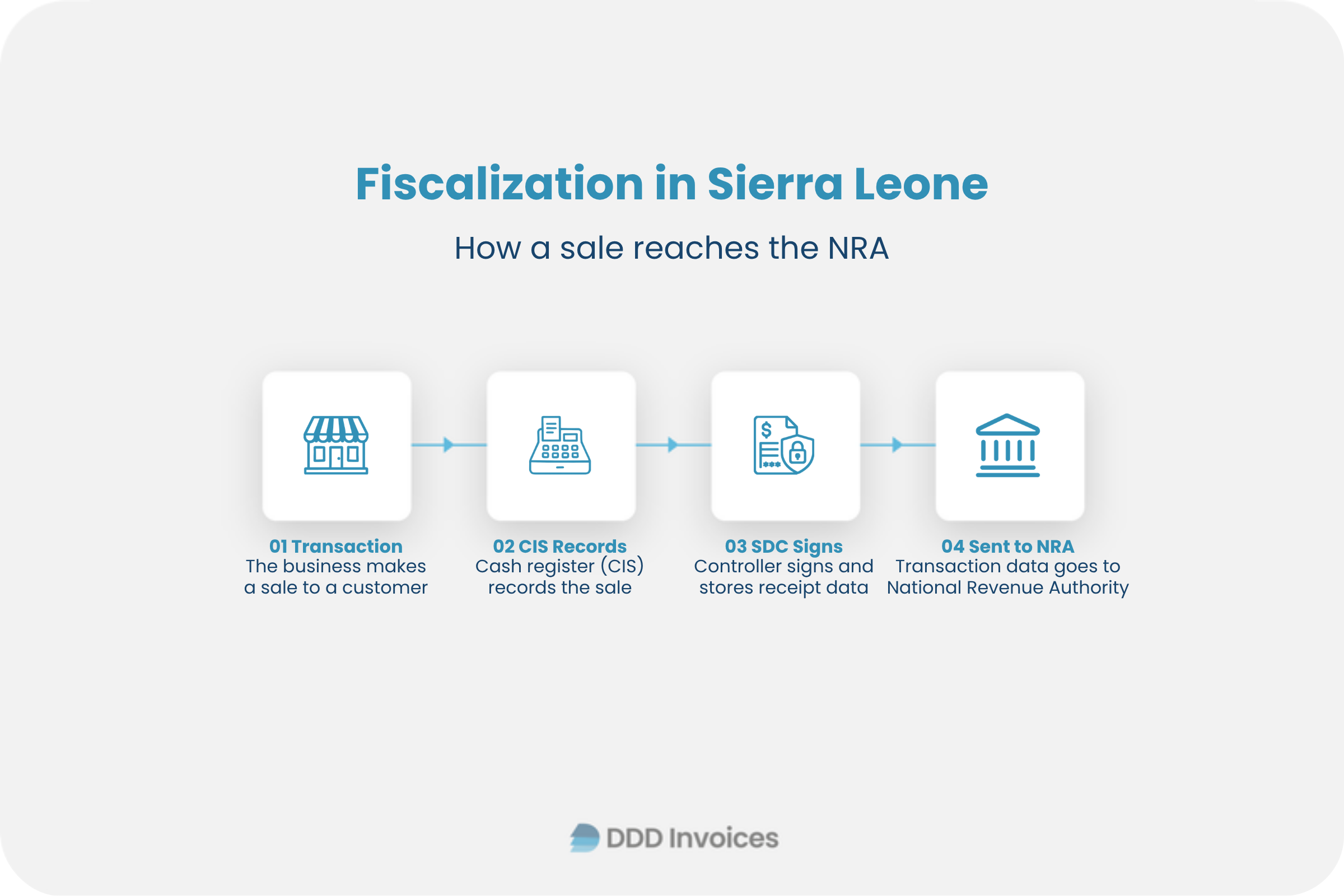
The NRA describes an ECR as two connected components: a Certified Invoicing System (CIS), which manages sales transactions, and a Sales Data Controller (SDC), also called an Electronic Signature Device. The SDC signs receipts, stores their information and sends that information to the NRA’s server.
The core process is:
This is why an ordinary PDF invoice, payment confirmation or digitally printed receipt does not, by itself, demonstrate fiscal compliance. The relevant requirement concerns the approved system and its transaction controls, not just the document’s appearance.
Which fiscal regulations apply
Businesses need to distinguish new 2026 amendments from obligations already in force. These amendments apply under the Finance Act 2026, which is deemed effective from 1 January 2026.
Requirement | What businesses need to know |
Replacement of faulty ECR machines | Section 21 of the Finance Act 2026 requires taxpayers to replace damaged, faulty or defective ECR machines at a cost determined by the Commissioner-General and published in the Gazette. |
GST payment deadline | Section 22 of the Finance Act 2026 makes GST payable no later than the end of the month following the tax period. |
Digital-service suppliers | Sections 18 and 24 extend registration requirements to taxable digital services supplied to consumers in Sierra Leone, regardless of physical presence. Suppliers without a local presence or registered office must appoint a locally present representative in writing. |
GST relief certificates | Section 19 provides for GST relief certificates for eligible persons and organisations under the Third Schedule, subject to the Commissioner-General’s anti-abuse safeguard. |
The GST return deadline is separate from the payment deadline. Section 13 of the Finance Act 2025 requires a return, accompanied by the prescribed input-and-output GST schedule, within 21 days after the tax period. For monthly periods, this means filing by the 21st of the following month.
For implementation planning, confirm the applicable gazetted replacement charge with the NRA rather than assuming replacements remain free. Non-resident digital-service suppliers should also confirm their reporting arrangements.
Who does fiscalization in Sierra Leone Affect?
The core ECR obligation concerns GST-registered businesses. It is not restricted to sales to individual consumers: the receipt requirement covers supplies by registered businesses, including transactions with business customers.
Businesses meeting the gst registration tests
The registration threshold established by the Finance Act 2024 is NLe500,000. It should be read alongside the GST registration tests, rather than treated as a simple calendar-year sales limit.
The NRA’s guidance also identifies retrospective and expected-turnover tests, including a four-month test based on one-third of the threshold. Exempt supplies are excluded from taxable turnover, while zero-rated supplies are included.
Businesses registered regardless of turnover
Turnover is not the only consideration. NRA guidance identifies public-entertainment promoters, operators of entertainment premises, and government entities or councils carrying out taxable activities as categories requiring registration irrespective of turnover. Voluntary registration may also be approved by the Commissioner-General.
A business should therefore confirm its registration status before deciding that low turnover removes its fiscal obligations.
Businesses using several sales channels
The legal duty follows the registered supplier and its supplies, rather than being limited to one customer category or payment channel. A business operating through several locations, applications or sales processes should assess how each transaction reaches the required fiscal issuing process.
What are the implications and penalties?
Sierra Leone enforces strict ECR compliance, covering receipt issuance, equipment maintenance and transaction records.
- Corrections: Refunds and cancellations must use the ECR’s designated functions.
- Breakdowns: Report faults within 24 hours. Alternative receipts require written NRA authorisation and must be recorded once the ECR is restored.
- Record retention: Keep sales and purchase records for at least six years.
- Non-compliance: Failure to issue fiscal receipts, ECR tampering or obstructing installation can result in fines of up to:
NRA taxpayer category | Late filing without good cause | Non-filing |
Small taxpayer | NLe500 | NLe1,000 |
Medium taxpayer | NLe2,500 | NLe5,000 |
Large taxpayer | NLe5,000 | NLe10,000 |
Your trusted partner for fiscalization in Sierra Leone
Fiscalization requires coordination between transaction software, tax data, receipt generation and reporting. The right implementation should fit those controls into everyday business operations without creating unnecessary manual work.
DDD Invoices provides a unified API for fiscalization and tax reporting across supported markets. Our platform standardises integration while handling country-specific formats, validations and transmission requirements, allowing businesses to retain their existing software experience.
Displays a content card with title, subtitle, list/body, and action button
{{__CTA:GenericCtaJson:{"type":"content","contentCta":{"layout":"cardList","title":"Talk to us!","subtitleHtml":"Still have questions?","button":{"href":"https://calendly.com/ddd-invoices/30min-intro","label":"Book a free 30min call","color":"white"},"bodyHtml":"In the <strong>30min free call</strong> we will discuss:","listHtml":"<ul><li><strong>your requirements</strong> in invoicing</li><li>how integration works</li><li><strong>demo</strong> of the product</li><li>next steps</li></ul>"}}__}}FAQs
Is fiscalization mandatory in Sierra Leone?
Yes. GST-registered businesses are required to use the applicable NRA electronic framework and issue the required receipts. Businesses should confirm their installation and implementation arrangements with the NRA rather than interpreting an ongoing rollout as a general exemption.
Can a business use an ordinary PDF invoice instead?
A PDF alone does not establish compliance. The underlying invoice or receipt must be generated through the required ECR or other NRA automated system where the obligation applies.
Does every transaction need approval from the NRA before the receipt is issued?
The NRA describes receipt signing, storage and transmission through the CIS–SDC framework. That description should not be confused with a separate, universal requirement to obtain central NRA approval before every receipt can be issued.
What happens when an ECR breaks down?
Report the fault within 24 hours and obtain written authorisation for the prescribed alternative receipting process. Temporary manual records must subsequently be entered when the ECR is restored, following NRA instructions.
Are the GST filing and payment deadlines the same?
No. Monthly GST returns are due by the 21st of the following month, while GST payment is due by the end of that month.